When We Find Them: The Day After Detection
Scientists have written the protocols. Governments have made quiet preparations. But there's no binding agreement on what happens the day after we detect alien intelligence. The political, scientific, and psychological scramble that follows is worth thinking through before the signal arrives.
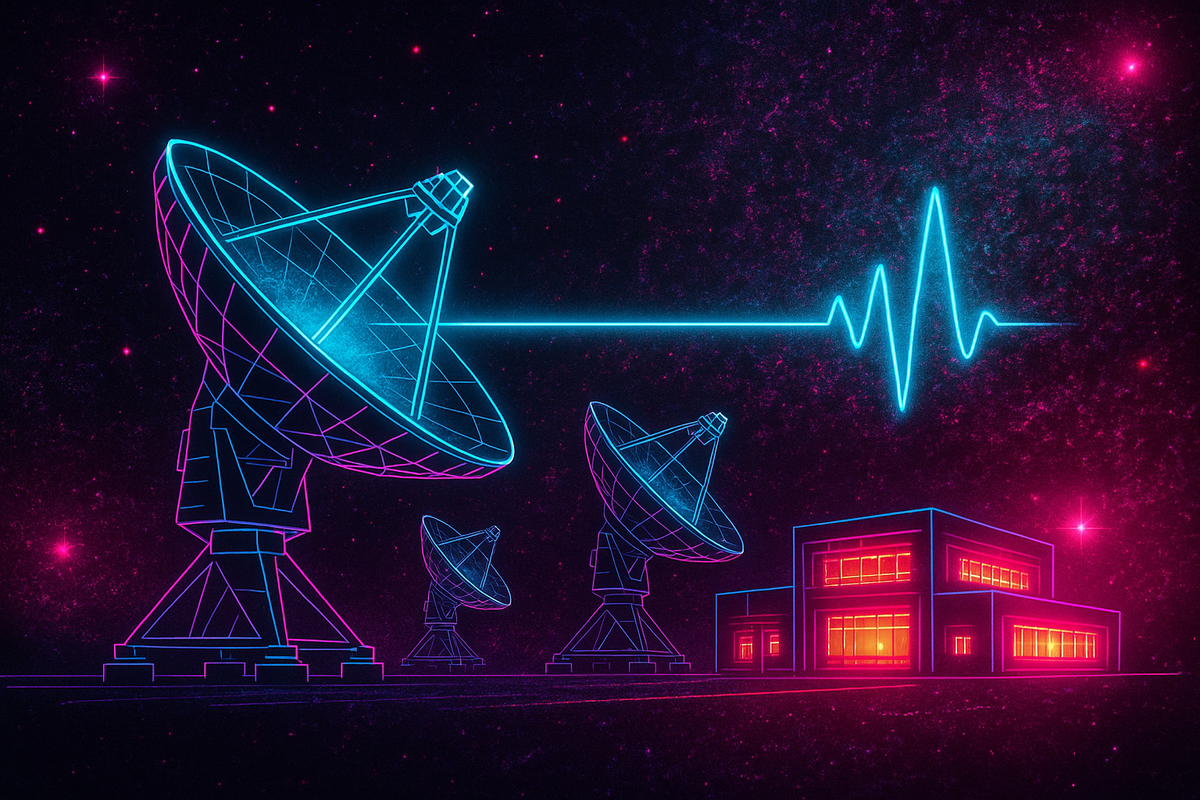
When We Find Them: The Day After Detection
Series: Technosignatures | Part: 8 of 9
In 1967, Jocelyn Bell Burnell noticed something odd in the radio telescope data at Cambridge. A regular pulse—so precise, so rhythmic—that her team half-jokingly labeled it LGM-1: Little Green Men 1. They were prepared to announce first contact. Instead, they discovered pulsars—rapidly rotating neutron stars that sweep radio beams across space like cosmic lighthouses.
The moment passed. But the protocol didn't disappear. It crystallized into something more formal, more carefully considered. Because the real question wasn't whether we'd detect an alien signal. It was what happens in the hours and days after we do.
We have protocols now. Plans for the day after detection. Most people don't know they exist. But astronomers do. SETI researchers do. The International Academy of Astronautics has a document called the "Declaration of Principles Concerning Activities Following the Detection of Extraterrestrial Intelligence." It's dry. Bureaucratic. And absolutely critical.
This is about what happens when the signal stops being hypothetical. When someone, somewhere, picks up an unambiguous technosignature—a narrowband transmission, an engineered megastructure transit, a laser beacon—and the universe changes forever.
The Detection Moment: From Anomaly to Confirmation
First contact won't be dramatic. No mothership hovering over Manhattan. No Independence Day beam cutting through the atmosphere. It will be a graduate student noticing an anomaly in a data stream at 2 AM. A spectral line that doesn't belong. A modulation pattern too precise to be natural. A repeating signal that survived every filter designed to eliminate interference.
The first response is skepticism. Always. Because every SETI researcher has seen false positives. Radio interference from satellites, terrestrial transmitters, cosmic ray strikes, instrumental glitches. The field has learned through painful experience: extraordinary claims require extraordinary evidence.
So the protocol begins with verification. Not announcement. Not excitement. Verification.
The detection gets logged. Time-stamped. The telescope gets repointed to confirm the signal persists. Other instruments get trained on the same coordinates. Is it still there? Does it repeat? Can multiple observatories detect it independently?
This is where the International Astronomical Union's Central Bureau for Astronomical Telegrams becomes crucial. In the event of a credible detection, this bureau acts as the clearinghouse—the place where independent confirmations are collected, cross-checked, and assessed. The goal is to rule out terrestrial sources, instrumental artifacts, and natural phenomena before any public announcement.
The timeline matters. The 1977 "Wow! signal"—a 72-second radio burst detected by Ohio State University's Big Ear telescope—was never independently confirmed. It became a legend precisely because it was anomalous and unrepeated. Modern protocols aim to prevent this ambiguity. A credible detection requires replication across multiple sites, multiple instruments, and ideally, multiple wavelengths.
This is active inference at the civilization scale. We're minimizing surprise by testing predictions. The hypothesis: "This is an alien signal." The prediction: "It will be detectable again, from different locations, with consistent characteristics." The test: observation, replication, falsification attempts.
If the signal survives—if it persists, if it shows signs of artificial modulation, if it can't be explained by known astrophysical processes—then the verification phase transitions to confirmation. And that's when everything changes.
The First 24 Hours: Information Containment and Scientific Protocol
The IAA protocols are explicit: before any public announcement, the discovering team must notify the International Telecommunication Union, the United Nations Office for Outer Space Affairs, and relevant scientific academies. The signal must be described in sufficient technical detail that other observatories can attempt independent confirmation.
But here's the tension: you can't verify in secret. You need other telescopes. Other researchers. Coordination across institutions and nations. Which means information starts leaking. Graduate students talk. Telescope scheduling anomalies get noticed. Rumors begin circulating on astronomer mailing lists.
The protocols acknowledge this. They don't mandate silence—they mandate responsible disclosure. The discovery should be shared with the scientific community for verification before it hits the press. But in the age of social media, that window is narrow. Hours, not days.
So the first 24 hours become a race: can the scientific community confirm or refute the detection before the news cycle spins into speculation?
The optimal scenario looks like this:
- Hour 0-6: Initial detection logged. Repointing confirms persistence. First internal verification.
- Hour 6-12: Key collaborators contacted under embargo. Multiple telescopes begin independent observation.
- Hour 12-18: Cross-site confirmations start arriving. Terrestrial interference ruled out. Natural explanations tested and rejected.
- Hour 18-24: Coordinated announcement prepared. Major observatories, space agencies, and the IAA brief key media contacts. Press conference scheduled.
The goal is to control the narrative long enough to establish scientific credibility. Because once the announcement breaks, the information environment gets chaotic. Fast.
This is coherence under constraint. The scientific community is an epistemic system trying to maintain coherence—shared understanding, coordinated assessment, collective sense-making—while under immense external pressure to go public, to speculate, to claim credit. The protocols are Markov blankets: boundaries that define who knows what, when, and how information crosses thresholds.
The Public Announcement: Coordination and Institutional Response
The press conference will be global. NASA, ESA, the Chinese National Space Administration, major observatories—all coordinated. Because the detection isn't owned by any nation or institution. It's a discovery about the cosmos, and the protocols make this explicit: "The discovery should be confirmed and announced to the world promptly, openly, and widely through scientific channels and public media."
But what gets announced?
Not speculation. Not interpretation. Just the facts: coordinates, frequency, modulation characteristics, observational history, and the statistical case for artificial origin. The announcement will emphasize uncertainty. "Consistent with technosignature" rather than "confirmed alien signal." The bar for claiming contact is high—deliberately so.
The immediate institutional response will be economic and political. Stock markets will react. Defense departments will demand briefings. Religious institutions will issue statements. The UN will convene emergency sessions. All within 48 hours of the announcement.
And here's the critical constraint: the protocols prohibit any attempt to reply without international consultation. You can't just point a transmitter at the signal's origin and start broadcasting. That decision—whether to respond, what to say, who speaks for Earth—requires global coordination.
The Committee on the Peaceful Uses of Outer Space (COPUOS) becomes the default forum. Because we have no global governance structure for this. No precedent. No elected representatives of humanity. Just existing international bodies repurposed for a scenario they were never designed to handle.
The political curvature spikes. Nations that cooperate on nothing else will suddenly need to coordinate on first contact. The coherence demands are immense: translating across languages, cultures, strategic interests, ideological frameworks. And all under time pressure, media scrutiny, and public fear.
Because make no mistake: the public reaction will be fear. Excitement for some. Curiosity. But also fear. What do they want? Are they hostile? How advanced are they? Are we safe?
The protocols can't answer these questions. They can only structure the response to preserve epistemic coherence long enough for deeper analysis.
Scientific Triage: What We Learn First
Assuming the signal is confirmed, the scientific community enters triage mode: what can we learn immediately, and what requires long-term study?
First-order questions (answerable within weeks):
- Distance: How far is the source? Spectral characteristics and signal strength give rough estimates.
- Bandwidth and modulation: Is it narrowband (artificial beacon) or broadband (leakage radiation)? Does it carry information?
- Directionality: Is it aimed at us, or are we intercepting a transmission meant for someone else?
- Repeatability: Does the signal continue, or was it a one-time event?
Second-order questions (months to years):
- Information content: Can we decode meaningful structure? Are there patterns, redundancies, error correction?
- Technological inference: What does the signal tell us about the sender's capabilities? Power output, transmission method, coordination across stellar distances?
- Temporal dynamics: Is it continuous or pulsed? Does the pattern change over time?
The distinction matters because first-order questions determine strategy. If the signal is continuous and directional, it might be a deliberate beacon—an invitation to respond. If it's intermittent leakage radiation (like our own TV broadcasts once were), responding might be pointless—they don't even know we're here.
The scientific triage is also about resource allocation. Every major radio telescope will want time on the target. Observatories will need to coordinate scheduling to maintain continuous coverage. Data archives will need to be combed for missed earlier detections. Computational power will be redirected to signal analysis.
This is collective attention entrainment. The entire field—and adjacent fields—reorients toward the detection. Conferences get scheduled. Funding priorities shift. Graduate students pivot dissertation topics. The system synchronizes around the new information.
And this is where active inference becomes critical. We're not passively receiving data. We're actively probing, testing hypotheses, updating models. The signal is an opportunity for iterative refinement: observe, predict, act, observe again.
The Reply Debate: Who Speaks for Earth?
The elephant in the room: should we reply?
The protocols say no—not unilaterally. Any response requires international consultation. But consultation with whom? The UN General Assembly? COPUOS? A specially convened international committee? And how long does consultation take? Months? Years? Decades?
Meanwhile, the signal is there. Confirmed. Repeating. Possibly waiting for a response.
There are camps:
The "Don't Reply" camp argues that revealing our presence is existentially reckless. We know nothing about the sender's intentions, capabilities, or ethical frameworks. Earth's location is already encoded in the signal we're receiving (if it's directional), but actively replying confirms intelligence, technology, and attention. Why take the risk?
This is the position of researchers like Stephen Hawking (before his death) and organizations advocating for caution in METI (Messaging to Extraterrestrial Intelligence). The argument is simple: we have no idea what we're dealing with, and cosmic silence might be protective.
The "Reply Immediately" camp counters that if they can detect us, we're already exposed. Our radio leakage has been propagating for a century. Our atmospheric chemistry shows industrial biosignatures. If they're hostile and capable, waiting won't save us. And if they're reaching out, not replying is a missed opportunity for knowledge, contact, and potentially collaboration.
The "Deliberate and Coordinate" camp (the IAA position) argues for a middle path: no immediate response, but active preparation for a coordinated reply if consensus emerges. This buys time for analysis, ethical deliberation, and the construction of a message that represents humanity thoughtfully.
But here's the problem: enforcing "no reply" is impossible. Any nation, institution, or individual with access to a powerful transmitter could decide to respond unilaterally. The protocols have no enforcement mechanism. They're norms, not laws.
So the real question becomes: how do we build sufficient global coherence that a coordinated response is possible before someone breaks ranks?
This is a coordination problem at civilization scale. Game theory applies. If everyone agrees to wait, we maximize collective deliberation. But any single actor can defect, send a message, and claim the historical credit. The incentive to defect is enormous.
The only solution is reputational cost. Make unilateral messaging so reputationally damaging—so scientifically and ethically irresponsible—that no credible actor attempts it. This requires consensus-building, public education, and institutional pressure.
The protocols attempt this. But they're fragile. Untested. And they assume rational actors operating under normal incentives. In the chaos following detection, those assumptions might not hold.
Long-Term Implications: Science, Philosophy, and Civilization
If the signal persists, if it's confirmed beyond doubt, the implications unfold over decades.
For science: The detection rewrites astrobiology. The Drake Equation gets real numbers. The Fermi Paradox demands new explanations. Funding priorities shift toward SETI, exoplanet characterization, and technosignature science. New telescopes get built. New detection methods get explored.
For philosophy: The Copernican Principle gets yet another confirmation. We're not special. Not central. Not alone. Existential questions about meaning, purpose, and human significance get reframed. Religious traditions adapt—or fracture. The concept of "humanity" as a coherent category gets tested.
For civilization: The knowledge that we're not alone changes the boundary conditions for human activity. Long-term thinking becomes more plausible—if civilizations can last millions of years, maybe ours can too. International cooperation becomes more urgent—if we're speaking to the cosmos, we need a coherent voice. Existential risk becomes more tangible—if they can build Dyson swarms, what can we build? And what might destroy us first?
This is coherence under new constraints. Humanity as a system must integrate the knowledge that we're not the only instance of intelligence. The curvature of our collective sense-making changes. The geometry of meaning adapts.
In AToM terms, this is M = C/T at the species level. Meaning emerges from coherence over time. Detection introduces a new timescale—cosmic time, the time it takes for light to cross interstellar distances. Suddenly, our civilization's coherence must extend across centuries, millennia, to sustain communication. The tension (T) is immense: coordinating across human cultures is hard enough. Coordinating with alien intelligences adds layers of inferential distance we can barely imagine.
But coherence is possible. We've done it before—across languages, cultures, epochs. Science itself is a coherence-generating system. Peer review, replication, falsification—these are mechanisms for building shared understanding across minds that start with wildly different priors.
The detection protocols are an extension of this. They're an attempt to structure the transition from "we are alone" to "we are not" in a way that preserves epistemic coherence long enough for deeper integration.
Whether they'll work remains unknown. They've never been tested. Not really. The LGM-1 moment passed too quickly. The Wow! signal was never confirmed. Every other candidate has been ruled out.
But someday, the signal will come. And when it does, the protocols are our best attempt to keep civilization coherent through the most profound information update in human history.
Preparing for the Signal: What Individuals Can Do
This might seem abstract. Remote. Something that won't happen in your lifetime, if ever.
But SETI researchers don't think that way. They think in terms of observational time, telescope sensitivity, and the expanding search space. Every year, we scan more of the sky, at more wavelengths, with better instruments. The detection probability increases.
So how do you prepare for something that might happen tomorrow, or in a century, or never?
The answer is epistemic readiness. Understanding the protocols means you're not blindsided when the news breaks. You know what verification looks like. You know why caution matters. You know the difference between "anomalous signal detected" and "confirmed alien transmission."
This is active inference at the personal scale. You're building a model of what detection means so that when it happens, your prediction error is manageable. You're not panicking. Not doomscrolling. Not falling for hoaxes. You're oriented.
And orientation matters. Because the information environment after detection will be chaotic. Misinformation will spread. Conspiracy theories will proliferate. Grifters will claim insider knowledge. Cults will form overnight.
Your best defense is a coherent model. Not certainty—coherence. A framework for making sense of the signal, the science, the implications. And that framework starts with understanding the protocols.
Because when the signal comes, the day after detection won't be about aliens. It will be about us—how we respond, how we coordinate, how we maintain coherence under the most profound update imaginable.
The protocols are our attempt to ensure that response is measured, thoughtful, and collaborative. Not perfect. Not guaranteed. Just structured enough to give us a chance.
And when someone, somewhere, picks up that signal—when the anomaly survives verification, when the confirmations arrive, when the announcement breaks—we'll see if the structure holds.
This is Part 8 of the Technosignatures series, exploring how we search for alien technology and what it means to find it.
Previous: Beyond Little Green Men: The Scientific Search for Alien Technology
Further Reading
- International Academy of Astronautics. (2010). "Declaration of Principles Concerning Activities Following the Detection of Extraterrestrial Intelligence." IAA SETI Permanent Committee.
- Tarter, J. (2001). "The Search for Extraterrestrial Intelligence (SETI)." Annual Review of Astronomy and Astrophysics, 39, 511-548.
- Vakoch, D. A., & Dowd, M. F. (Eds.). (2015). The Drake Equation: Estimating the Prevalence of Extraterrestrial Life through the Ages. Cambridge University Press.
- Gertz, J. (2016). "Reviewing METI: A Critical Analysis of the Arguments." Journal of the British Interplanetary Society, 69, 31-36.
- Shostak, S. (2020). "SETI After 60 Years." Nature Astronomy, 4, 8-9.
Comments ()