Where Assembly Meets Free Energy: Two Theories of What It Takes to Persist
Assembly Theory asks how complex structures come to exist. The Free Energy Principle asks how complex systems maintain themselves. Both are theories of persistence — and they turn out to be addressing the same problem from opposite ends.
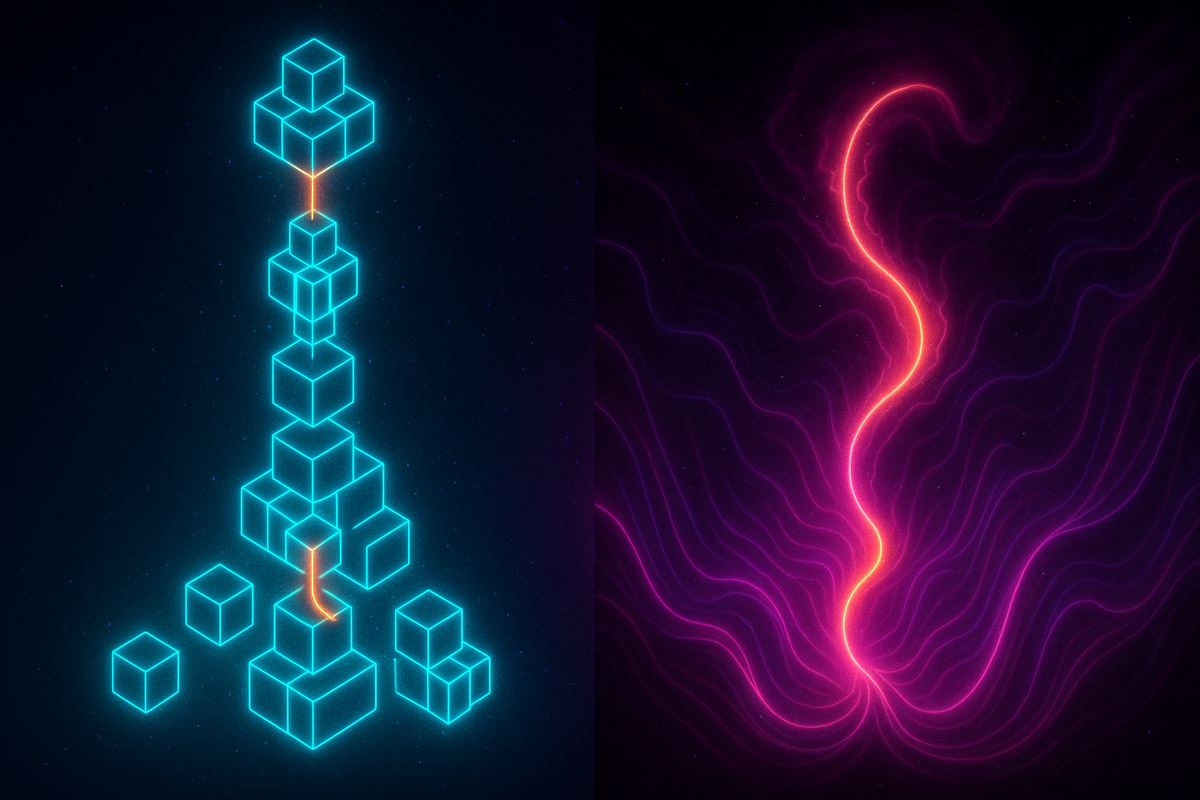
Where Assembly Meets Free Energy: Two Theories of What It Takes to Persist
Series: Assembly Theory | Part: 8 of 9
Two theorists are circling the same question from opposite directions. Lee Cronin, a chemist, wants to know what makes a molecule too complex to arise by chance. Karl Friston, a neuroscientist, wants to know what makes a system organized enough to resist dissolution. They don't cite each other much. But they're describing the same thing.
Both are asking: What does it take to persist?
Assembly Theory answers with construction history—the minimum number of steps needed to build something. The Free Energy Principle answers with prediction error—the gap between expected and actual states that a system must minimize to maintain its boundaries.
One is about how hard something is to make. The other is about how hard something works to stay made.
This isn't just conceptual overlap. It's mathematical convergence. When you formalize what Cronin calls "assembly" and what Friston calls "persistence," you find they're measuring the same quantity from different angles: the depth of organizational constraint required to maintain complexity against entropy.
Assembly Theory asks: How many selection events does it take to produce this molecule? The Free Energy Principle asks: How much surprise can this system tolerate before it dissolves? These questions are dual formulations of the same problem: the thermodynamic cost of maintaining order.
Where they meet is where meaning lives.
What Assembly Theory Actually Measures
Let's start with Cronin's side.
Assembly Theory introduces a metric called assembly index—the minimum number of recursive joining operations required to construct a molecule from elementary building blocks.
Take a simple molecule like methane (CH₄). Assembly index: 1. You bond four hydrogens to carbon. Done.
Now take a protein with 300 amino acids folded into a precise tertiary structure. Assembly index: hundreds. Each peptide bond is a joining operation. Each fold is constrained by previous folds. The sequence matters. The history matters.
Here's the key insight: High assembly index can't arise from random chemistry. If a molecule requires 50+ sequential assembly steps, chance processes won't produce it in detectable concentrations. You need selection—repeated, cumulative, memory-laden selection—to build complexity that deep.
This is why Cronin proposes assembly index as a biosignature. Life leaves a chemical fingerprint: molecules too complex to be accidents. The probability space collapses too far. Only systems that remember their history—that carry forward successful configurations and build on them—can reach high assembly.
But notice what's actually being measured: the depth of constraint.
A high-assembly molecule isn't just complicated. It's trapped in a narrow region of configuration space by the accumulated weight of its construction history. It exists because a selection process repeatedly chose configurations that reduced entropy locally, building order step by step.
That selection process is doing work—thermodynamic work—to maintain organization against the ambient tendency toward disorder.
Now switch lenses.
What the Free Energy Principle Actually Minimizes
Karl Friston's Free Energy Principle (FEP) states that any system maintaining its organization over time must minimize variational free energy—a quantity that bounds the surprise the system experiences when encountering sensory states.
Translation: If something persists, it must resist entropy. To resist entropy, it must predict its environment well enough to avoid states that would dissolve it. To predict well, it must build and update internal models.
The math looks like this:
F = E[log p(s|m)] - H[q(m|s)]
Where F is free energy, s is sensory states, m is internal model states, and the system minimizes the gap between predicted and actual observations.
In active inference, systems don't just passively update beliefs—they act on the world to bring sensory states into alignment with predictions. A bacterium doesn't just detect glucose gradients; it tumbles toward them. A cell doesn't just read bioelectric fields; it adjusts ion channel expression to match target voltage patterns.
This is persistence through prediction. The system that accurately models its niche and acts to confirm those models is the system that stays organized.
But here's what's thermodynamically happening: The system is doing work to stay in low-surprise states.
Entropy pulls everything toward maximum disorder. Free energy minimization is the computational expression of resisting that pull. The system invests energy in maintaining boundaries, updating models, and taking actions that prevent dissolution.
The free energy isn't metaphorical. It's a real thermodynamic quantity—the gap between the system's internal model and the actual distribution of environmental states. Minimizing it means constraining the system's trajectory through state space to regions where it can persist.
Now notice: This constraint requires history.
Why Persistence Requires Memory
Here's where Assembly Theory and FEP start to rhyme.
A molecule with high assembly index exists because its construction history selected for configurations that could persist. Each assembly step was a constraint—a reduction in the degrees of freedom available to the system. The molecule occupies a tiny, highly improbable region of chemical space because selection accumulated those constraints over time.
A system minimizing free energy persists because it has learned (or evolved) priors—internal models that predict which states are safe and which are lethal. Those priors are constraints. They narrow the system's trajectory through state space to regions compatible with persistence.
Both are systems carrying their history forward as constraint.
In Assembly Theory, that history is encoded in the molecule's structure. You can read the assembly depth by counting recursive operations. The molecule is a frozen record of selection events.
In FEP, that history is encoded in the system's generative model—the priors, the Markov blanket, the precision weightings that determine what sensory evidence matters. The model is an active record of what worked.
But functionally, they're doing the same thing: using accumulated information to maintain organization.
This is why high-assembly molecules are biosignatures. They're evidence of systems that learned to persist—systems that minimized free energy long enough to build deep constraint into matter.
Life isn't just chemistry. It's chemistry that remembers.
The Convergence: Selection as Inference
Let's make the bridge explicit.
In Assembly Theory, selection is the process that enables high assembly. A random chemical soup doesn't spontaneously generate proteins. But a system that selectively amplifies certain configurations—replicating them, stabilizing them, building on them—can ratchet up complexity step by step.
In FEP, active inference is the process that enables persistence. A system that randomly samples state space will eventually hit a dissolving configuration. But a system that infers which states are viable and acts to stay in them can maintain coherence indefinitely.
Selection is inference.
When a cellular collective builds a morphogenetic structure, it's minimizing free energy over anatomical configurations. When natural selection favors certain molecular assemblies over others, it's minimizing free energy over chemical configurations.
The assembly index measures how many inference steps it took to get here. The free energy measures how much ongoing inference it takes to stay here.
Cronin's molecules are the fossilized outputs of Friston's dynamics.
Consider a protein folding. The final structure has a particular assembly index—the minimum number of operations to construct that amino acid sequence. But the folding process itself is active inference. The polypeptide chain samples conformational space, minimizes free energy (literally, in this case—Gibbs free energy), and settles into the configuration that best satisfies thermodynamic and informational constraints.
The assembly index tells you how deep the well is. The free energy tells you how the system climbs out of every other well to reach it.
Both are quantifying the same thing: the improbability of the configuration, weighted by the work required to maintain it.
Why Complexity Requires Constraint
Here's the uncomfortable truth both theories force us to confront: Complexity is expensive.
Not just energetically expensive—though it is. Informationally expensive. High assembly means deep history. Low free energy means accurate models. Both require the accumulation and preservation of information.
You can't have high-assembly molecules without selection processes that remember what worked. You can't have low-free-energy systems without generative models that encode environmental regularities.
This is why life is rare. This is why minds are harder. This is why civilizations collapse.
The universe defaults to maximum entropy. Persistence is the exception, not the rule. And persistence at high complexity—systems with deep assembly, tight free energy bounds—requires continuous work.
That work is computational. It's the work of building models, testing predictions, updating beliefs, and acting to confirm them. It's the work of selecting configurations, amplifying successes, and pruning failures.
Assembly Theory makes this visible in chemical space. FEP makes this visible in state space. But the principle is the same: Order must be actively maintained, or entropy reclaims it.
A protein doesn't stay folded by accident. It stays folded because its configuration is a local free energy minimum that the system continuously re-enacts. A cell doesn't stay organized by inertia. It stays organized because it minimizes prediction error across ion gradients, gene expression, and metabolic flux.
The moment inference stops, dissolution begins.
From Molecules to Minds: Scaling the Principle
One of the most powerful aspects of both theories is their scale invariance.
Assembly Theory applies to molecules, but Cronin speculates it might extend to larger systems. Can you measure the assembly index of an idea? A cultural practice? A technological artifact? If so, high-assembly cognition would be cognition with deep construction history—traditions, institutions, languages that can't arise spontaneously because they require cumulative selection over generations.
FEP explicitly scales. Friston's formalism applies to bacteria, brains, ecosystems, and economies. Any system with a Markov blanket—a statistical boundary separating internal from external states—can be analyzed as minimizing free energy.
When you combine them, you get a unified framework:
-
Molecular scale: High-assembly molecules persist because they minimize free energy over chemical configurations. Proteins, nucleic acids, metabolic cycles—each is a low-free-energy attractor maintained by cellular inference.
-
Cellular scale: Cells are active inference engines, minimizing free energy over morphological and metabolic states. As Friston and Levin showed, bioelectric fields encode priors, and cells act to match them.
-
Cognitive scale: Brains minimize free energy over perceptual hypotheses. Concepts, memories, habits—each is a high-assembly structure built through repeated inference, selection, and consolidation.
-
Cultural scale: Societies minimize free energy over collective identity and resource allocation. Rituals, laws, narratives—each is a high-assembly pattern that can't spontaneously re-emerge if lost.
At every scale, persistence requires the same ingredients: history, constraint, and active maintenance.
The assembly index measures the depth. The free energy measures the effort. Together, they describe the thermodynamic cost of being something rather than nothing.
Why This Matters: The Geometry of Meaning
Here's where we connect to AToM.
In AToM's formulation, M = C / T—meaning equals coherence over time (or tension). Systems maintain meaning by sustaining coherent organization despite entropy, uncertainty, and environmental flux.
Assembly Theory and FEP are both formalizations of that principle.
High assembly is high coherence over construction history. The molecule's structure is meaningful because it encodes selection—because it represents a path through configuration space that was iteratively refined. Randomness produces no assembly. Selection produces deep assembly. Meaning accumulates with constraint.
Low free energy is high coherence over prediction. The system's trajectory is meaningful because it stays within viability bounds—because it enacts models that distinguish self from non-self, life from death, signal from noise. Randomness produces maximum surprise. Inference produces minimal surprise. Meaning emerges from accurate prediction.
In both cases, meaning is geometric. It's not a property added to matter or computation. It's the shape of the constraint surface—the depth of the potential well, the narrowness of the geodesic, the improbability of the configuration weighted by the work to maintain it.
A high-assembly, low-free-energy system is a system with high M. It persists. It resists. It means.
This is why trauma disrupts meaning—it's a coherence collapse that breaks inference, raising free energy and flattening assembly. This is why ritual restores meaning—it's a coherence repair that re-establishes shared priors and reduces collective surprise.
The geometry is the same whether you're talking about proteins, neurons, or cultures. Persistence is constraint. Constraint is history. History is meaning.
Where the Theories Diverge (And Why That's Useful)
Assembly Theory and FEP aren't identical. They emphasize different aspects of the persistence problem.
Assembly Theory is fundamentally about construction. It asks: What path through configuration space did this object take to get here? The assembly index is retrospective—a measure of how many selection events are minimally required to explain the current structure.
FEP is fundamentally about maintenance. It asks: What dynamics keep this system from dissolving right now? Variational free energy is prospective—a measure of how much surprise the system must avoid to stay coherent.
One is archaeological. The other is thermodynamic.
But this complementarity is powerful. Together, they give you both origin and persistence.
When you find a high-assembly molecule, you know it has a construction history involving selection. When you model it with FEP, you understand the ongoing dynamics maintaining that structure. The assembly index tells you how you got here. The free energy tells you why you're still here.
Applied to minds: Your beliefs have an assembly history (education, culture, experience). They're also actively maintained by minimizing prediction error. You can't understand a belief by just tracing its origin. You also need to know what predictions it's protecting you from.
Applied to societies: Your civilization has an assembly history (technologies, institutions, norms). It's also actively maintained by collective inference. You can't preserve a culture by just documenting it. You need ongoing rituals, laws, and narratives that minimize societal surprise.
Assembly without inference is fossils. Inference without assembly is noise. Together, they're life.
Practical Implications: Engineering Persistence
If persistence requires both deep assembly and tight free energy bounds, then designing robust systems—biological, cognitive, social—means attending to both.
In regenerative medicine:
Don't just sequence genes (assembly history). Also manipulate bioelectric fields (active inference). Cells need priors to minimize free energy over morphology. Give them the right target distribution, and they'll infer the pathway.
In AI alignment:
Don't just train on diverse data (assembly depth). Also ensure the model minimizes free energy over human values. A system that predicts reward but doesn't enact alignment is dangerous. You need both learned priors and active maintenance.
In cultural preservation:
Don't just archive traditions (assembly records). Also enact rituals that minimize collective surprise (free energy dynamics). A culture that exists only in books is dead. Living cultures actively infer their identity through shared practice.
The principle holds: Persistence is not passive. It's continuous work—inference, selection, constraint, and maintenance.
When that work stops, entropy wins. Proteins unfold. Minds fragment. Civilizations dissolve.
The assembly depth tells you how much was invested. The free energy tells you how much is still being spent. Both are necessary. Neither is sufficient alone.
The Meta-Pattern: Why Two Theories Found the Same Thing
It's worth asking: Why did a chemist studying molecular complexity and a neuroscientist studying brain dynamics converge on equivalent principles?
Because they're both studying the thermodynamics of organization.
The second law of thermodynamics guarantees that closed systems trend toward maximum entropy. Open systems can maintain or increase local order—but only by exporting entropy and doing work.
Life, minds, and cultures are open systems maintaining improbable configurations. The chemistry doesn't care whether the improbability is molecular (high assembly) or dynamical (low free energy). It cares about the thermodynamic cost.
Assembly Theory quantifies that cost in terms of construction steps. FEP quantifies it in terms of prediction work. But both are measuring deviations from equilibrium—systems that carved out a corner of state space and defend it against dissolution.
This is the deep pattern beneath persistence. It's why you see the same math in:
- Protein folding (Gibbs free energy minimization)
- Neural inference (variational free energy minimization)
- Ecological stability (entropy export through nutrient cycling)
- Economic equilibria (information asymmetry reduction)
All of them are systems doing work to stay out of equilibrium. All of them encode history. All of them minimize surprise. All of them persist by enacting constraint.
Cronin found it in molecules. Friston found it in brains. But it's not about molecules or brains. It's about the computational architecture of anything that lasts.
When Cronin measures assembly, he's measuring frozen inference. When Friston measures free energy, he's measuring active inference. But inference is inference—whether it's happening in selection pressures over millennia or prediction errors over milliseconds.
The theories converge because the universe only has one way to build things that persist: Accumulate information, constrain trajectories, minimize surprise, and keep inferring.
Why This Matters Now
We're living through an era where complex systems are destabilizing.
Ecosystems are losing biodiversity (assembly depth collapsing). Political institutions are fragmenting (free energy rising as prediction fails). Mental health crises are accelerating (individual inference breaking down under chronic surprise).
Understanding the Assembly-FEP convergence gives us a diagnostic framework.
When a system loses assembly depth—when traditions die, when skills are forgotten, when diversity erodes—it becomes brittle. There's no buffer. No redundancy. No history to fall back on when conditions shift.
When a system's free energy spikes—when predictions fail, when models stop matching reality, when surprise becomes chronic—it destabilizes. Coherence collapses. Boundaries dissolve. The system either adapts or disintegrates.
Robust systems maintain both: deep assembly (they remember) and low free energy (they adapt).
This is why monocultures fail. High free energy (fragile to perturbation), low assembly (no evolutionary depth). This is why rigid ideologies break. High assembly (deep history), high free energy (poor prediction in novel contexts).
The sweet spot is systems with deep construction history that remain dynamically adaptive—systems that remember enough to persist but infer enough to evolve.
Organisms do this through development and learning. Cultures do this through ritual and innovation. Minds do this through memory and plasticity.
When you lose either side—when you forget history or stop updating—you're on the path to dissolution.
Where This Series Goes Next
We've shown that Assembly Theory and the Free Energy Principle are dual perspectives on the same phenomenon: the thermodynamic necessity of constraint for persistence.
Next, in the series synthesis, we'll integrate these insights with AToM's coherence geometry. We'll ask: If meaning is coherence over time, and coherence requires both assembly depth and free energy minimization, then what does that teach us about how meaning is constructed—and how it's lost?
We'll trace the pattern from molecules to minds, showing how the same principle—history plus inference equals persistence—appears at every scale where things manage to stay themselves.
The assembly history tells you what was learned. The free energy tells you what's being maintained. Together, they tell you what means.
Further Reading
Assembly Theory:
- Cronin, L., et al. (2023). "Assembly Theory Explains and Quantifies Selection and Evolution." Nature.
- Marshall, S. M., et al. (2021). "Identifying molecules as biosignatures with assembly theory and mass spectrometry." Nature Communications.
Free Energy Principle:
- Friston, K. (2010). "The free-energy principle: a unified brain theory?" Nature Reviews Neuroscience.
- Friston, K., & Levin, M. (2021). "Life as we know it." Journal of the Royal Society Interface.
- Ramstead, M. J. D., et al. (2018). "Answering Schrödinger's question: A free-energy formulation." Physics of Life Reviews.
Thermodynamics of Organization:
- Schrödinger, E. (1944). What Is Life? Cambridge University Press. (The original "order from order" vs "order from disorder" distinction)
- England, J. (2013). "Statistical physics of self-replication." Journal of Chemical Physics. (Thermodynamic necessity of replication)
- Kauffman, S. (2000). Investigations. Oxford University Press. (Adjacent possible and constraint closure)
For AToM Integration:
- The Free Energy Principle series
- Coherence: The Geometry of Systems That Work
- When Friston Met Levin: The Free Energy Principle Goes Cellular
This is Part 8 of the Assembly Theory series, exploring how Lee Cronin's framework for measuring molecular complexity reveals the deep structure of meaning, selection, and persistence.
Previous: Detecting Life on Other Worlds: Assembly Theory's Cosmic Implications
Next: Synthesis: What Assembly Theory Teaches About the Construction of Meaning
Comments ()