Why Life Chemistry Is Special: What Assembly Theory Reveals About Biological Molecules
Random chemistry produces simple molecules. Life produces proteins, DNA, and ATP — molecules so complex they couldn't plausibly have assembled without a history of selection. Assembly theory tries to turn that intuition into a measurable, falsifiable number.
Why Life Chemistry Is Special: What Assembly Theory Reveals About Biological Molecules
Series: Assembly Theory | Part: 3 of 9
You can make benzene in a lab with six carbon atoms and six hydrogen atoms. The assembly index is low—maybe 4 or 5 steps to construct the ring structure. You can also find benzene in space, formed spontaneously from simpler molecules under the right conditions. The universe makes benzene without selection, without memory, without anything resembling life.
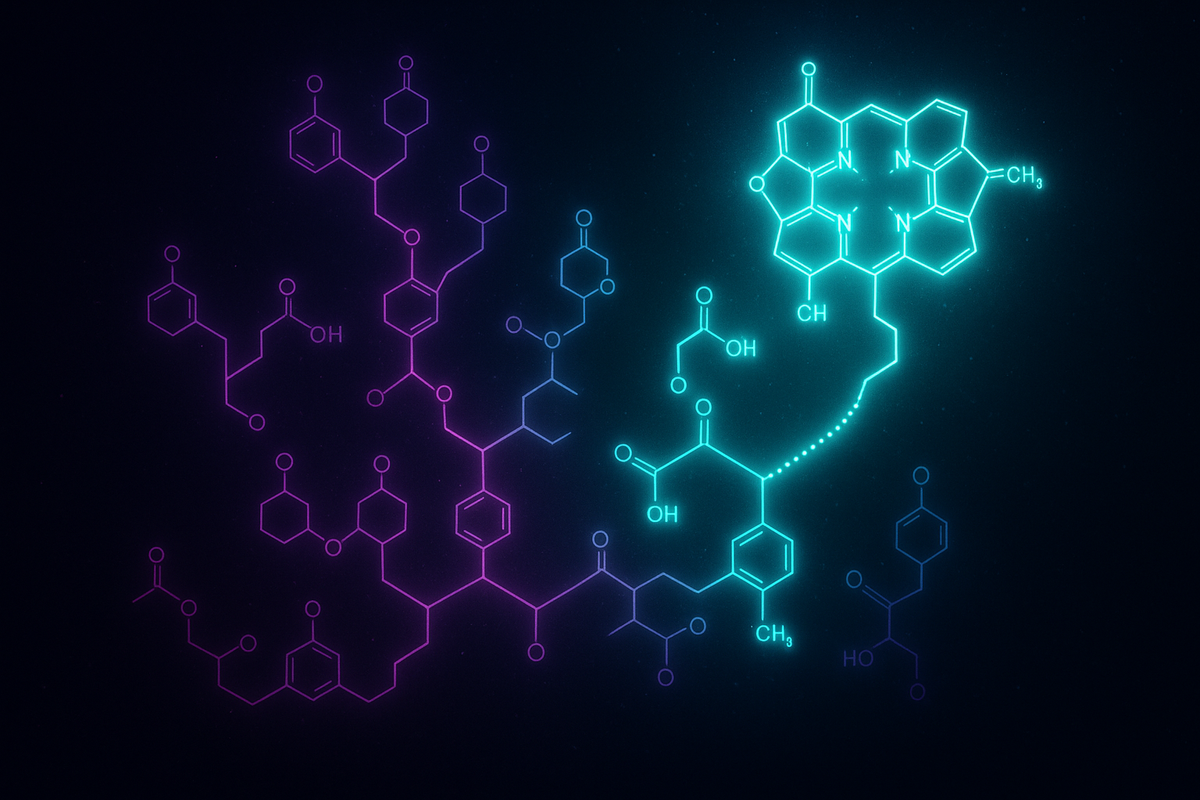
Now consider chlorophyll, the molecule that makes photosynthesis possible. Its assembly index exceeds 50. You cannot find chlorophyll floating in the interstellar medium. You cannot make it by accident. Every chlorophyll molecule on Earth exists because biological systems constructed it through precise, multi-step enzymatic pathways that took billions of years to evolve.
This is what Lee Cronin means when he says assembly theory reveals the signature of selection. High assembly molecules don't just happen. They require something to remember how they were made and repeat the process. They require evolution.
The Chemistry of Random Accidents
Simple molecules dominate the universe. Hydrogen, water, methane, ammonia—these form readily wherever atoms collide under plausible conditions. Their assembly indices rarely exceed 10.
Why? Because each construction step in assembly space is a potential dead end. The more steps required, the less likely random processes will stumble through all of them in sequence. Chemical space is unimaginably vast—roughly 10^60 possible small organic molecules—and only a tiny fraction of that space is accessible through blind combinatorial exploration.
Cronin's assembly theory quantifies this. A molecule with assembly index 3 might form in billions of locations across the galaxy. A molecule with assembly index 30 requires what he calls assembly contingency—the pathway to that molecule must be preserved and repeated, which means something must be selecting for it.
The universe's chemistry, left to its own devices, stays simple. Complexity requires memory. Memory requires selection. Selection requires something doing the selecting.
The Threshold Where Life Begins
In 2021, Cronin's team analyzed millions of molecules and found a threshold around assembly index 15. Below this threshold, molecules appear in both living and non-living contexts. Above it, the distribution shifts dramatically—high assembly molecules are almost exclusively biological.
This isn't arbitrary. Assembly index 15 represents roughly the point where the probability of random formation drops below the threshold where selection becomes necessary. Any molecule more complex than this must have been built by a system that remembers how to build it.
Consider ATP (adenosine triphosphate), the energy currency of cells. Its assembly index sits around 25. Every ATP molecule in your body right now exists because your mitochondria synthesized it through enzymatic pathways encoded in your genome. Those pathways are the memory. Evolution is the selection process that refined them over four billion years.
Or take DNA itself. A single nucleotide has modest assembly complexity. But string together thousands of nucleotides in a specific sequence that encodes functional proteins, and you've created a molecule with assembly index in the hundreds or thousands. That sequence cannot form randomly. It requires selection—natural selection—operating over vast timescales on populations of replicating systems.
Why High Assembly Requires Selection
The mathematics is unforgiving. Suppose you're trying to construct a molecule with assembly index 30 through random combinations. Each step involves choosing one operation from a vast possibility space—which bond to form, which atom to add, which ring to close.
Even with generous assumptions about reaction rates and available precursors, the combinatorial explosion makes blind search implausible. Assembly theory shows that the number of possible assembly pathways grows exponentially with complexity, but only a minuscule fraction of those pathways lead to stable, functional molecules.
Selection solves this problem by preserving successful pathways. Once a ribosome figures out how to make a useful protein, that pathway gets encoded in RNA, which gets replicated, which means the system can make that protein again without rediscovering the construction sequence from scratch.
This is not mere information theory in Shannon's sense—assembly theory tracks the actual physical construction process, the historical dependency of later steps on earlier ones. A high assembly molecule is not just improbable. It is historically contingent. It exists because something built it before and remembered how.
Cronin calls this assembly depth: not just how many steps, but how many times those steps had to be repeated before the pathway stabilized. High assembly depth is the signature of iterative refinement, which is the signature of evolution.
Biological Molecules Are Construction Memories
This reframes what a protein is. It's not just a particular fold of amino acids. It's a frozen history of assembly operations that evolution found worth preserving. The sequence encodes not just structure but the memory of how to construct that structure from simpler parts.
When you look at the molecules in a living cell—not just proteins but lipids, carbohydrates, nucleic acids—you're looking at a library of construction memories. Each molecule is a solution to some problem that natural selection encountered and decided was worth keeping.
Non-biological chemistry doesn't work this way. A crystal grows according to thermodynamic minimization. Its structure emerges from local energy gradients, not from memory of how previous crystals formed. Crystals don't have assembly depth in Cronin's sense because they don't require selection.
But a biological molecule like hemoglobin—which requires precise folding of four protein subunits, each with heme groups positioned exactly right to bind oxygen reversibly—cannot form without the accumulated memory of how to build it. That memory lives in the genome. The genome exists because replication preserved it. Replication exists because evolution selected for it.
Assembly theory reveals life as the universe learning to remember what it built.
The Copy Number Problem
Here's where assembly theory diverges sharply from intuition. High assembly molecules should be rare—they're hard to make. But in biological systems, high assembly molecules often exist in enormous copy numbers.
Your blood contains roughly 25 trillion red blood cells, each packed with 250 million hemoglobin molecules. That's 10^21 copies of a molecule with assembly index around 40. If hemoglobin formed randomly, you'd expect maybe one copy in the observable universe.
This abundance paradox is the signature of life. When you find many copies of a high assembly molecule, you've found selection at work. The only way to flood the environment with complex molecules is to have a system that can reliably construct them over and over—which means memory, which means selection, which means (probably) life.
Cronin's team has demonstrated this empirically. In mass spectrometry analysis of samples from Earth, they found high assembly molecules always correlate with high copy number. Samples from meteorites show low assembly molecules, which sometimes appear in high abundance (because simple molecules can form via many pathways), but never show the high assembly + high copy number combination characteristic of biology.
This has implications for astrobiology. If you want to detect life on Mars or Enceladus or an exoplanet atmosphere, forget about looking for DNA or amino acids specifically. Look for the statistical signature: many copies of molecules with assembly index above 15. That pattern cannot form abiotically.
Why This Differs from Shannon Information
You might wonder: isn't this just information content? Shannon entropy measures how many bits you need to specify a molecule's structure. High complexity molecules have high Shannon entropy. But assembly theory is not measuring the same thing.
Shannon information is static. It asks: how much data is required to describe this molecule? Assembly theory asks: what physical process was required to construct it? A random 100-bit string has high Shannon entropy but low assembly depth—there's no shorter pathway to construct it than writing out all 100 bits.
But a highly structured 100-bit sequence—say, a sequence that encodes for a functional protein domain—might have lower Shannon entropy (because it has regularities) but much higher assembly depth, because the regularities themselves are the outcome of selection acting on functional constraints.
Assembly theory tracks historical dependency. It measures not what a molecule is but what had to happen for it to come into existence. This is why assembly index correlates with selection: only processes with memory can climb the assembly complexity ladder without getting lost in combinatorial explosions.
Cronin and his collaborator Sara Walker argue that assembly theory is fundamental to understanding evolution itself. Life is not just information processing (though it involves that). Life is the universe discovering how to make complex objects repeatedly, which requires learning, which requires memory, which requires selection.
Life Chemistry Is Recursively Self-Referential
Here's the deepest insight: biological molecules are not just products of assembly processes. They are participants in those processes. Proteins catalyze the reactions that build other proteins. RNA molecules help synthesize the ribosomes that make more RNA molecules. Lipids self-organize into membranes that compartmentalize the very reactions that produce more lipids.
This is what autopoiesis theorists call organizational closure—living systems produce the components that produce the system. Assembly theory gives this idea a quantitative foundation. High assembly molecules are both the output of biological construction and the machinery that enables future construction.
This creates a feedback loop that non-biological chemistry cannot achieve. A crystal doesn't use its structure to build more crystals. A star doesn't use its fusion products to catalyze more fusion (well, sort of—but not in a self-perpetuating way that increases assembly depth over time).
But cells do exactly this. They construct molecules that construct the next generation of molecules, and over evolutionary time, this recursive construction process explores higher and higher assembly indices, discovering molecules that no random process could ever stumble upon.
The Coherence Connection
In AToM terms, biological chemistry exhibits high coherence precisely because it operates through memory and selection. Coherence is the property of systems whose parts constrain each other in ways that persist over time. High assembly molecules are coherent because their construction depends on previously constructed components, and those dependencies are preserved across replication cycles.
Random chemistry has low coherence—each reaction is thermodynamically driven, independent of historical context. But biological chemistry locks in patterns. DNA replication ensures that today's proteins are constructed using pathways refined over billions of years. That's coherence at the molecular scale: trajectories through assembly space that remain integrable because selection weeded out the pathways that diverge.
Cronin's threshold of assembly index 15 is effectively a coherence threshold. Below it, chemistry is random, incoherent, forgetful. Above it, chemistry becomes historical, coherent, shaped by the constraints of what worked before.
This connects directly to coherence geometry: life occupies a region of assembly space with low curvature (stable, repeatable pathways) and high dimensionality (many possible molecules, but navigated through learned maps rather than blind exploration). High assembly molecules are the landmarks in this space—points that selection discovered and decided were worth returning to.
What This Means for Understanding Life
Assembly theory offers a universal biosignature that doesn't depend on knowing what life looks like. You don't need to specify carbon versus silicon, water versus ammonia, DNA versus something else. You just need to look for molecules with high assembly index appearing in high copy numbers.
This has practical implications:
Astrobiology: When we analyze atmospheric spectra from exoplanets or drill cores from Martian permafrost, we should look for the statistical distribution of molecular complexity, not specific molecules. Any chemistry producing lots of copies of molecules above the assembly threshold is almost certainly biological.
Origins of life: The transition from prebiotic chemistry to living systems is the transition from low assembly to high assembly. Understanding how this transition happens—how random chemistry starts encoding memory—is the central question. Assembly theory provides a quantitative framework for studying it.
Synthetic biology: If we want to engineer novel life forms or molecular machines, assembly theory tells us we need selection to explore high assembly space efficiently. Random molecular design won't work. Evolutionary algorithms, directed evolution, and iterative refinement are necessary.
Defining life: Forget about debating whether viruses are alive or whether artificial intelligences could be alive. Ask: does the system produce high assembly molecules in high copy numbers through a process that preserves construction memory? If yes, it's doing the thing that distinguishes biology from non-biological complexity.
The Limits of Random Chemistry
The universe is full of complex structures—galaxies, hurricane systems, crystal lattices. But none of these have high assembly depth because none of them require memory. A galaxy's spiral arms emerge from gravitational dynamics. A hurricane forms from thermodynamic gradients. A snowflake grows from minimization of surface energy.
These are beautiful, complex, dynamic. But they're not alive. They don't remember how they formed. They don't pass on their structure to descendants. They don't evolve.
Life is the exception, not because it's complex, but because its complexity is historical. Every protein fold, every enzymatic pathway, every metabolic network exists because something—natural selection acting on populations over time—remembered what worked and discarded what didn't.
Assembly theory quantifies this difference. Below assembly index 15, chemistry is blind. Above it, chemistry has memory. And once chemistry has memory, it starts doing something the rest of the universe doesn't: learning.
Further Reading
- Cronin, L., & Walker, S. I. (2016). "Beyond prebiotic chemistry." Science, 352(6290), 1174-1175.
- Marshall, S. M., et al. (2021). "Identifying molecules as biosignatures with assembly theory and mass spectrometry." Nature Communications, 12, 3033.
- Sharma, A., et al. (2023). "Assembly theory explains and quantifies selection and evolution." Nature, 622, 321–328.
- Walker, S. I. (2017). "Origins of life: A problem for physics, a key issues review." Reports on Progress in Physics, 80(9), 092601.
This is Part 3 of the Assembly Theory series, exploring how complexity emerges from selection and memory in chemistry.
Previous: Assembly Index: A New Way to Measure How Hard Something Is to Make
Next: Beyond Shannon: How Assembly Theory Differs from Information Theory
Comments ()