Why Myths Stick: The Cognitive Science of Minimally Counterintuitive Concepts
A talking rock is hard to remember. A talking statue is unforgettable. Boyer calls this "minimally counterintuitive" — enough strangeness to flag the concept as important, not so much that it overloads working memory. Myths are precision-engineered for recall.
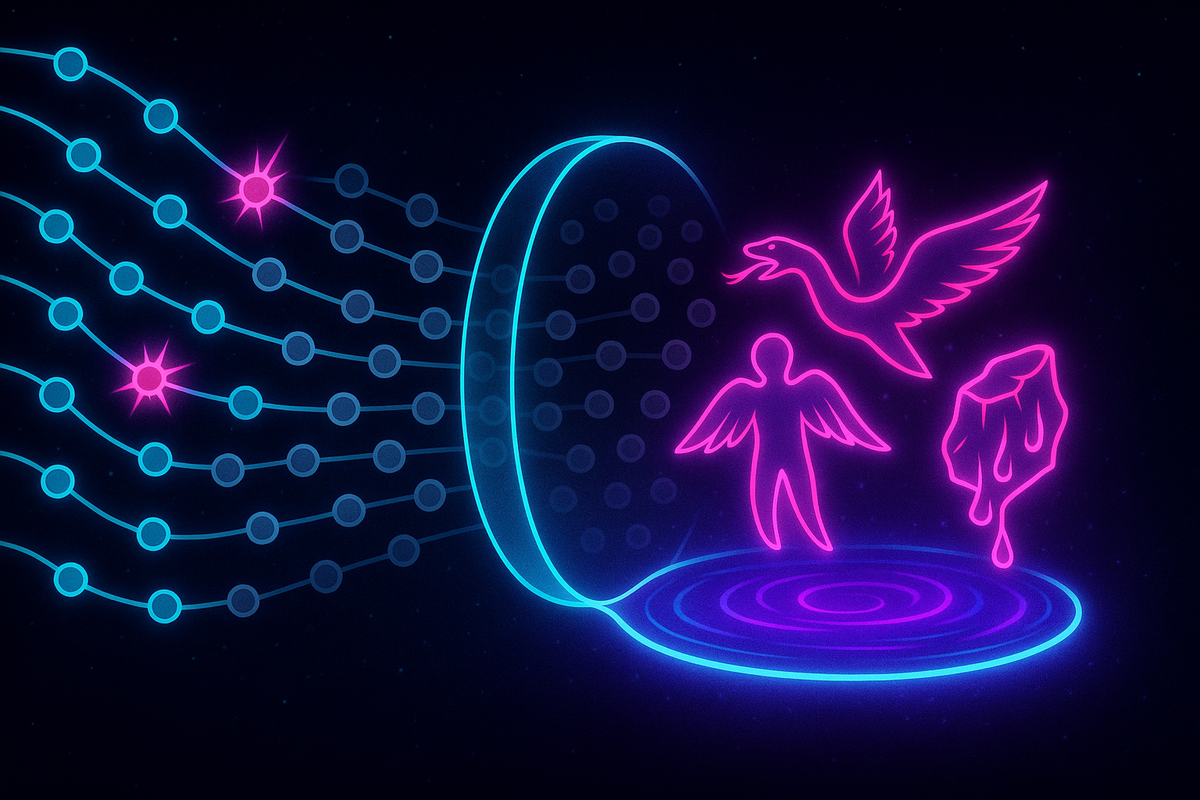
Why Myths Stick: The Cognitive Science of Minimally Counterintuitive Concepts
A talking snake. A virgin birth. A man who lives inside a whale. Zeus turning into a swan to seduce a woman. The Buddha being born from his mother's side. Egyptian gods with human bodies and animal heads.
Every mythology is packed with these reality violations. And for centuries, scholars assumed this was evidence of primitive thinking—people who didn't yet understand natural law making up fantastical explanations.
But cognitive scientist Pascal Boyer asked a different question: If these concepts are so weird, why do they transmit so successfully across generations? Why don't they get filtered out by natural selection like maladaptive beliefs about, say, which mushrooms are poisonous?
The answer reveals something fascinating about how human memory actually works—and why myths are built from precisely calibrated violations of expectations rather than pure fantasy or pure realism.
The Transmission Problem
Imagine you're an anthropologist studying two villages. In Village A, creation stories describe perfectly naturalistic events: "Long ago, people gradually developed tools and language." In Village B, the stories feature gods, talking animals, and miraculous transformations.
If you came back 100 years later, which village would still be telling their creation stories?
Village B. Every time.
This isn't because people prefer fantasy to reality. It's because human memory is optimized for pattern-breaking, not pattern-matching. Your brain allocates attention and encoding resources to things that violate expectations, because deviations from prediction are where new information lives.
When you walk down a familiar street, you barely encode the houses you pass every day—they match predictions perfectly, so your brain compresses them into "same as yesterday." But if one house is painted neon pink overnight, you notice. You remember. You tell people about it.
This is why "man meets woman, they fall in love normally, nothing unusual happens" doesn't become cultural mythology. It matches category expectations perfectly. Your brain tags it as redundant information and deprioritizes encoding.
But "man meets woman, she's actually a swan transformed by Zeus, their children become the founders of a dynasty"—now you're paying attention. The concept violates intuitive ontology just enough to hijack attention while remaining comprehensible enough to transmit.
Boyer calls these concepts minimally counterintuitive (MCI). And they dominate cultural transmission because they exploit a sweet spot in human cognitive architecture.
The Goldilocks Zone of Weirdness
Here's Boyer's key insight: concepts that succeed in cultural transmission are neither fully intuitive nor maximally bizarre. They occupy a narrow band where they violate expectations enough to be memorable but not so much that they're incomprehensible.
Think of it as a spectrum:
Fully intuitive: "There is a rock."
→ Boring. Matches all category expectations. Forgettable.
Minimally counterintuitive: "There is a rock that bleeds when you cut it."
→ Interesting. Violates one expectation (rocks don't bleed) while preserving others (still solid, still subject to cutting, still a rock). Memorable.
Maximally counterintuitive: "There is a rock that bleeds, speaks backwards, exists only on Thursdays, and grants wishes to people whose names contain the letter Q."
→ Too many violations. Cognitively expensive to represent. Fails to transmit.
The most successful religious and mythic concepts cluster in that middle zone. They take ordinary ontological categories (person, animal, object, place) and violate one or two features while preserving the rest.
An angel is a person who doesn't die and can appear/disappear. That's two violations (immortality, non-physical presence) but otherwise follows person-logic: has intentions, communicates, makes choices.
A sacred tree is a tree that hears prayers. One violation (perception without sense organs) but otherwise tree-complete: rooted, wooden, subject to seasons.
A ghost is a person without a body. One violation (existence without physical substrate) preserving everything else about personhood.
Compare this to purely invented fantasy that doesn't respect this constraint, and you see why those concepts don't become lasting mythology. Cthulhu is cool, but geometrically impossible elder gods whose very appearance drives you mad aren't sticky across millennia. They're too many violations stacked too high.
Why This Works: Attention Hijacking and Memory Encoding
The reason MCI concepts dominate transmission isn't arbitrary. It's rooted in how predictive processing allocates cognitive resources.
Your brain is running constant predictions about what's coming next—what objects will do, what people will say, how situations will unfold. Most of the time, predictions are accurate, and your brain compresses experience into "same as expected." But when predictions fail—when you encounter prediction error—your brain pays attention, allocates encoding resources, and updates models.
Fully intuitive concepts generate zero prediction error. A normal rock does rock things. Your brain doesn't bother encoding "saw another rock today" as significant information.
Maximally counterintuitive concepts generate so much prediction error that your brain can't integrate them into coherent world-models. You can't run productive simulations about entities that violate too many ontological assumptions at once. They're cognitive garbage—interesting momentarily but cognitively expensive to maintain.
But MCI concepts hit the sweet spot: they generate just enough prediction error to hijack attention while remaining coherent enough to integrate into world-models.
When you hear "there is a snake that talks," your brain:
- Activates snake schema (slithers, predator, dangerous)
- Detects violation (snakes don't talk)
- Allocates attention to the anomaly
- Encodes the concept with heightened salience
- Integrates it into memory as significant
Now you remember that snake. You're more likely to tell others about it. If the talking snake appears in a story with moral implications (temptation in the Garden), the MCI violation acts as an attention anchor that makes the whole narrative more memorable.
This isn't magic. It's optimal cognitive exploitation of prediction error mechanisms. Myths evolved to be sticky by randomly mutating until they hit the MCI sweet spot, then persisting because brains preferentially transmitted them.
Gods as MCI Person-Category Violations
The most important category for human social cognition is person. We have massive neural machinery dedicated to modeling other minds—predicting intentions, tracking commitments, inferring beliefs, coordinating action.
So it makes sense that the most successful MCI concepts are violations of person-category expectations. And indeed, gods are almost universally persons with one or two supernatural violations:
Greek/Roman gods: Persons who don't die, can shapeshift, control natural forces. Still jealous, vengeful, lustful, strategic—completely person-like in psychology.
Abrahamic God: Person who is omniscient, omnipotent, eternal. Massively violated on power/knowledge dimensions but still fundamentally person-shaped—has preferences, makes covenants, gets angry, shows mercy.
Hindu devas: Persons with multiple arms, animal heads, divine powers. Violations on physical form and capability while preserving person-psychology.
Ancestors/spirits: Persons who persist after death. Single violation (disembodied existence) while maintaining relationship to living descendants.
The pattern is clear: successful god-concepts preserve person-intentionality (the capacity for goal-directed action, moral evaluation, relationship) while violating physical limitations. This makes gods tractable for social cognition—you can predict what a god might want, negotiate with a god, form relationships with a god—while maintaining the memorability-boost of MCI violation.
Compare this to theological traditions that move too far from person-schema (Brahman as formless absolute, the Tao as impersonal process) and you see they struggle with popular transmission. They require intellectual sophistication to grasp. MCI gods with person-psychology spread effortlessly because they plug directly into existing social cognition machinery with minimal modification.
Why Myths Are Full of MCI Concepts
If you analyze the core narrative elements of successful myths, you find they're built almost entirely from MCI building blocks:
Talking animals (violation: language/reason in non-human) → Aesop's fables, trickster coyote, Raven stories
Magical objects (violation: agency or power in inanimate things) → Excalibur, the Holy Grail, Thor's hammer, magic lamps
Miraculous births (violation: conception without sex, or unusual parentage) → Virgin birth, born from ocean foam, hatched from egg
Shapeshifters (violation: fixed form) → Zeus as swan, selkies shedding sealskins, werewolves
Underworlds (violation: places the living can't normally access) → Hades, Hel, Xibalba
Immortals (violation: death inevitability) → Elves, vampires, the Wandering Jew
Each of these violates exactly one or two intuitive expectations while preserving enough structure to remain cognitively tractable. And myths string these MCI elements together into narratives that become super-memorable because every key plot point involves a prediction-error anchor.
The hero meets a talking cat who gives him a magic sword to defeat a giant who guards an enchanted castle where his cursed lover sleeps until true love's kiss wakes her. The whole narrative is studded with MCI concepts that act as attention magnets, making the story impossible to forget and irresistible to retell.
Contrast this with a realistic story: "A man worked hard, saved money, proposed to a woman, she said yes, they got married." Perfectly coherent. Socially valuable as a model. But cognitively forgettable because it's pure category-matching with zero prediction error.
The Cultural Selection Mechanism
Here's where it gets evolutionary. Myths aren't designed by committees to optimize memorability. They emerge through cultural selection over generations.
Imagine a proto-myth in its first telling: "There was a warrior who fought a dragon." Already MCI—dragons violate animal ontology with fire-breathing and speech. But details vary in each retelling.
In one version, the warrior is unusually brave. In another, he has magic armor. In another, he must sacrifice his daughter to appease the dragon. In another, the dragon is actually a cursed prince.
Over dozens of retellings, some versions stick and others fade. Why? Because the versions that include stronger MCI elements get remembered and retold preferentially. The magic armor version survives better than the "just brave" version because magical objects are MCI anchors. The cursed prince version survives better than random monster because transformation adds a second MCI violation.
After centuries, what persists are myths saturated with MCI concepts because those are the ones that survived the cultural selection bottleneck of human memory. This isn't conscious design. It's unconscious optimization through differential transmission.
Boyer and colleagues tested this by having people read stories with varying MCI densities, then asking them to recall and retell the stories weeks later. Stories with 2-3 MCI violations showed the best recall. Stories with zero MCI concepts were forgotten. Stories with 6+ violations got garbled in transmission because they were too weird to accurately remember.
The myths that make it through 500 generations are the ones that hit the MCI sweet spot. Cultural evolution filtered for cognitive exploitability.
Beyond Religion: MCI in Contemporary Culture
Once you see the pattern, you recognize MCI structure everywhere in successful cultural transmission:
Urban legends: "There's a kidney-theft ring operating out of hotel bars." Takes real crime category and adds one counterintuitive element (specific organ harvesting conspiracy) that makes it unforgettable and viral.
Conspiracy theories: Usually built around one or two massive MCI violations ("the earth is flat," "the moon landing was faked") while preserving everything else about how institutions work. The violations are big enough to grab attention while the framework remains coherent enough to elaborate.
Brand myths: "This phone just works." "This car makes you free." Minimal violations of product-category expectations (phones break, cars constrain) that make marketing memorable.
Celebrity narratives: "Rags to riches." "Fall from grace." "Comeback kid." All involve category violations (sudden wealth/poverty, moral inversion, resurrection-like return) that make them stickier than "person had steady career."
Internet memes: The most viral memes often contain MCI elements. A frog that's also a Nazi symbol. A gorilla killed in a zoo becoming a tragic martyr. These violations hijack attention and propagate because brains notice and remember the ontological breaks.
The underlying mechanism is identical to mythic transmission: concepts that violate expectations just enough get remembered and shared. Concepts that match expectations perfectly or violate them incomprehensibly get filtered out.
We haven't transcended the cognitive architecture that made myths sticky. We've just applied it to new domains.
The Dark Side: When MCI Becomes Manipulation
Understanding MCI transmission has a shadow side. If you know how to engineer concepts for maximum memorability, you can weaponize attention-hijacking for purposes that don't serve coherence.
Advertisers do this constantly. "This product will change your life" is an MCI product-claim (products rarely transform existence) that sticks better than "this product works adequately."
Political propaganda exploits it. "They are plotting against us" activates MCI conspiracy logic (coordinated malicious intent at scale) that's more memorable than "there are complex structural issues."
Cults use it. Charismatic leaders with MCI properties (special enlightenment, unique destiny, divine communication) attract followers more effectively than people claiming ordinary expertise.
The fact that MCI concepts stick doesn't mean they're true. It just means they're optimized for transmission. And that creates a problem: in a media environment optimized for engagement, the most memorable ideas aren't necessarily the most accurate. They're the ones that best exploit your prediction-error detection.
This is why myth literacy matters. Understanding that your brain preferentially encodes MCI violations helps you notice when that mechanism is being exploited. You can ask: "Is this concept sticky because it's true, or just because it violates expectations in attention-grabbing ways?"
Bringing It Back to Coherence
So what does MCI theory tell us about myth's relationship to coherence?
Myths aren't just random violations. The successful ones use MCI elements to anchor coherence instructions in memorable form.
The talking snake isn't just weird for weirdness' sake. It's a narrative device that makes the temptation story unforgettable. And the temptation story encodes a coherence lesson: "integration requires accepting constraint; violations of boundary lead to expulsion from stable attractor."
The virgin birth isn't arbitrary miracle-stacking. It's an MCI anchor that makes the savior narrative stick across generations. And the savior narrative encodes: "transformation requires death/rebirth; new coherence emerges from old pattern's dissolution."
The magic sword isn't random fantasy equipment. It's a memorable representation of "external tools that amplify agency" which helps transmission of the larger pattern: "confronting chaos requires resources beyond ordinary capacity."
MCI concepts are the attention hooks that make coherence templates transmissible. They solve the engineering problem of cultural transmission: how do you get crucial navigational wisdom to stick in human memory across generations when you don't have writing, when you can't rely on individual genius, when you need millions of ordinary people to remember and retell?
You encode it in minimally counterintuitive narrative form. You make it weird enough to remember. You make it coherent enough to transmit. You let cultural selection optimize it over centuries.
And what you get are myths: high-compression coherence algorithms built from MCI components that exploit prediction-error mechanisms to achieve near-permanent cultural storage.
Further Reading
- Boyer, Pascal. Religion Explained: The Evolutionary Origins of Religious Thought. Basic Books, 2001.
- Barrett, Justin L. Why Would Anyone Believe in God? AltaMira Press, 2004.
- Norenzayan, Ara, and Atran, Scott. "Cognitive and Emotional Processes in the Cultural Transmission of Natural and Nonnatural Beliefs." In The Psychological Foundations of Culture, edited by M. Schaller and C. Crandall. Lawrence Erlbaum, 2003.
- Sperber, Dan. Explaining Culture: A Naturalistic Approach. Blackwell, 1996.
This is Part 2 of the Cognitive Mythology series, exploring how myths function as compression algorithms for coherence instructions.
Previous: Myths Are Not Primitive Science: What Stories Actually Do for Brains
Next: Hyperactive Agency Detection: Why We See Minds Everywhere
Comments ()