Why Rituals Work: The Neuroscience of Collective Synchronization
Forty thousand years of ritual practice weren't superstition — they were empirical engineering. The neuroscience now confirms what practitioners always knew: synchronized bodies produce synchronized minds, and synchronized minds produce states unavailable to isolated individuals.
Why Rituals Work: The Neuroscience of Collective Synchronization
Series: Ritual Entrainment | Part: 1 of 11
Every Sunday morning at 11 AM, millions of humans file into buildings, sit in rows, stand and sit in coordinated unison, recite memorized phrases together, and sing. At the same moment, thousands gather in stadiums, chant synchronized syllables, perform coordinated movements, and experience waves of emotion that sweep through the crowd like weather. On Friday nights in warehouses across continents, young people move their bodies to repetitive 4/4 beats at 128 BPM for hours, feeling a connection to strangers they'll never speak to.
These aren't separate phenomena. They're all implementations of the same technology—a technology humans have been refining for at least 40,000 years. We call them rituals, but that word carries so much historical and religious baggage that we've forgotten what they actually do.
Rituals are entrainment technologies. They're systems designed to synchronize nervous systems across individuals, creating temporary coherent states that feel transcendent precisely because they are genuinely more-than-individual. The "sacred" feeling isn't supernatural—it's the phenomenology of your nervous system coupled to others, operating at a scale your individual cognition can't normally access.
This isn't mysticism. It's neuroscience. And once you understand the mechanism, you see it everywhere.
The Problem Rituals Solve
Human cognition is fundamentally isolating. You have direct access to your own phenomenology—your sensations, emotions, thoughts—but everyone else's inner life is completely opaque to you. We're each trapped in our own Markov blanket, inferring the world including other minds through indirect evidence.
This creates a profound coordination problem. How do groups maintain coherent collective states when individual minds are statistically bounded from each other? How do you create shared meaning when meaning itself is constructed through individual predictive processing?
The obvious answer is language and explicit communication. But language is slow, serial, and operates at the wrong timescale for many forms of coordination. You can't talk a group into synchronized emotion. You can't verbally negotiate shared physiological states. Words fail precisely where rituals succeed.
Rituals solve the coordination problem by operating beneath conscious symbolic processing. They work at the level of rhythmic coupling—heart rates, breathing patterns, motor synchrony, hormonal cascades. By entraining biological oscillators across individuals, rituals create temporary coherent systems where the boundaries between "my nervous system" and "your nervous system" become functionally porous.
The coherence is real. The transcendence is phenomenologically accurate. You genuinely become part of something larger than yourself because the system that emerges is literally distributed across multiple bodies.
What Entrainment Actually Means
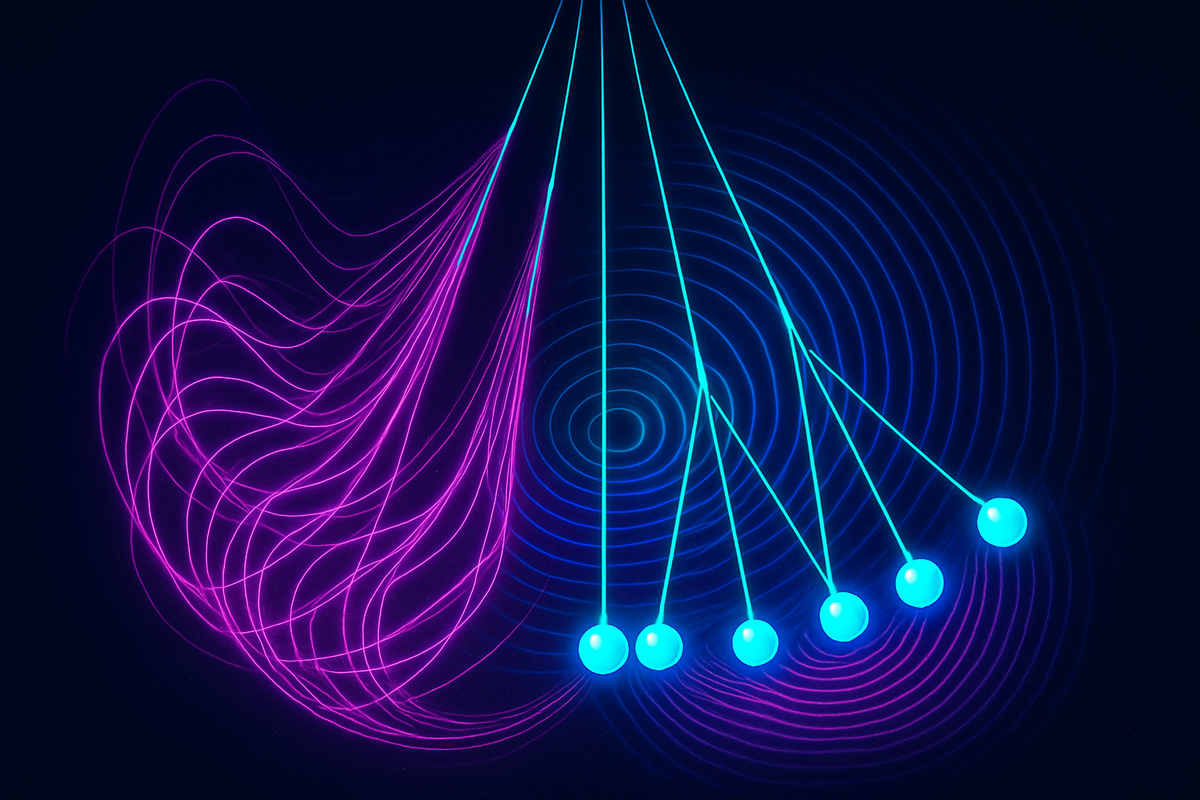
In 1665, Christiaan Huygens observed something strange about the pendulum clocks in his study. When he mounted two clocks on the same wall, they would slowly synchronize, their pendulums swinging in perfect opposition. He called it "sympathy of clocks" and correctly identified that tiny vibrations transmitted through the shared wall were the coupling mechanism.
This is entrainment: when two or more oscillating systems interact, they tend to synchronize their rhythms, phase-locking into stable coordinated patterns. It's not mysterious—it's basic physics. Any system with periodic behavior can entrain with other periodic systems if there's a coupling mechanism, no matter how weak.
Pendulum clocks entrain through wall vibrations. Fireflies entrain through light. Neurons entrain through synaptic connections. And humans entrain through everything—sound, visual motion, touch, pheromones, electromagnetic fields from heartbeats.
We are walking collections of biological oscillators: cardiac rhythms, respiratory cycles, neural oscillations across frequency bands, circadian clocks, hormonal pulses, gait patterns. Every one of these can couple to corresponding oscillators in other bodies. When they do, something remarkable happens.
The coupled system—the group—develops coherent dynamics that don't exist at the individual level. In AToM terms, coherence propagates from individual to collective scale through phase-locking of coupled oscillators. The "group mind" isn't metaphor—it's emergent coherent dynamics in a distributed multi-body system.
The Neuroscience of Collective States
Barbara Ehrenreich's Dancing in the Streets documents the universality of collective ritual across cultures, but recent neuroscience research has started mapping what actually happens in synchronized groups.
When people engage in synchronized movement—drumming, dancing, marching—their neural oscillations in motor cortex and supplementary motor areas phase-lock. Their heart rate variability syncs. Respiratory patterns coordinate. But the effects cascade beyond simple motor synchrony.
Research by Lindenberger and colleagues using dual-EEG setups shows that when people perform coordinated actions, their brain activity synchronizes not just in motor regions but across frontal and parietal networks involved in attention, social cognition, and self-representation. The more synchronized the behavior, the stronger the inter-brain coherence.
Guillaume Dumas's work on social neuroscience demonstrates that this inter-brain synchrony predicts coordination quality, empathy, and the subjective experience of connection. When brains sync, people report feeling "as one," understanding each other without words, losing track of individual boundaries.
This isn't just correlation. Studies using transcranial magnetic stimulation and pharmacological interventions show that enhancing neural synchrony improves coordination, while disrupting it degrades performance. The coupling is functional, not epiphenomenal.
What happens at the hormonal level is equally striking. Synchronized ritual activity triggers coordinated release of oxytocin (bonding), endorphins (natural opioids creating euphoria and pain tolerance), serotonin (mood elevation), and dopamine (reward signaling). When groups synchronize, they're literally getting high together—sharing a neurochemical state that reinforces the behavior and creates positive associations with the group.
The phenomenology—the felt sense of transcendence, of ego dissolution, of connection to something larger—directly reflects these physiological realities. You feel transcendent because your individual nervous system has temporarily become part of a larger coherent system. You feel connected because you literally are connected through coupled oscillators. You lose your sense of separate self because the Markov blanket that normally defines "you" has become porous.
Why It Feels Sacred
Émile Durkheim argued in The Elementary Forms of Religious Life that the sacred is fundamentally social—it's what groups generate through collective ritual. He called the peak experience "collective effervescence," the moment when group energy reaches critical intensity and participants feel seized by something beyond themselves.
Durkheim was onto something profound, but he lacked the mechanistic vocabulary. In coherence terms: sacred experiences are the phenomenology of high-coherence collective states. When a group achieves strong phase-locking across multiple oscillatory systems, the resulting integrated dynamics feel qualitatively different from individual cognition.
Why? Because they are different. Your brain is designed to model yourself as a bounded agent, separate from the environment. But in strong ritual entrainment, that model breaks down. Your nervous system is receiving signals—synchronized heartbeats, shared breathing rhythms, coordinated movement, unified vocalizations—that indicate you're part of a larger coherent system.
Your brain's best explanation for this anomalous data is that you've made contact with something transcendent. Not supernatural, but trans-individual—literally across individuals. The "spirit" that communities describe isn't in heaven; it's in the synchronized collective state the ritual generates.
This is why rituals across cultures feel sacred despite wildly different theological content. A Pentecostal revival, a Sufi dhikr, a rave, and a stadium crowd perform fundamentally similar operations: rhythmic synchronization leading to collective coherence leading to phenomenological experiences of transcendence and connection.
The content—the specific gods, ideologies, or narratives—is the culture-specific interface. The underlying mechanism is universal neuroscience.
The Dark Side: Entrainment Without Wisdom
Understanding rituals as entrainment technology immediately clarifies why they're simultaneously so powerful and so dangerous.
Entrainment is value-neutral. It generates coherence, but coherence can serve any purpose. A lynch mob is a synchronized collective. So is a fascist rally. Cult indoctrination relies heavily on ritualized synchronization—repetitive chanting, coordinated movement, sleep deprivation to enhance susceptibility to entrainment.
When you couple nervous systems strongly enough, you can override individual judgment. The coherent collective state feels right precisely because high coherence feels intrinsically valuable. Your brain interprets synchronized collective experience as evidence of truth, regardless of content.
This is the mechanism behind groupthink, mob violence, religious extremism, and totalitarian spectacles. Nuremberg rallies worked because they were effective entrainment technologies. The content was monstrous, but the mechanism was the same one that makes a congregation feel touched by divine love.
The question isn't whether to use entrainment—humans will always seek collective coherence because it's phenomenologically and evolutionarily valuable. The question is: what constraints and containers prevent entrainment from serving destructive ends?
Healthy ritual traditions have developed wisdom around this. They limit ritual intensity, constrain participation, embed rituals within larger ethical frameworks, and create exit pathways. Modern secular rituals—concerts, sports, fitness communities—often lack this traditional wisdom, which is why they sometimes go sideways into cult dynamics.
Why Modern Life Feels Disconnected
If humans are designed to regularly entrain with collectives, what happens when we don't?
Modern individualistic cultures have systematically dismantled most of the traditional ritual infrastructure. We don't sing together. We don't dance together (except in restricted contexts like weddings or concerts). We don't chant. We don't move in coordinated groups. Even eating—once a synchronized collective activity—has become something we often do alone, scrolling phones.
Religious participation has declined in the West, but nothing has replaced the functional role religion played: regular, repeated collective synchronization. Going to church wasn't primarily about believing propositions; it was about weekly entrainment with your community.
The result is what sociologists call "bowling alone"—radical isolation despite nominal social connection. Online interaction provides information exchange but almost no synchronization. You can't entrain over text. Video helps, but it's fundamentally asymmetric—you're not coupled, just observing.
We're running our nervous systems in a mode they weren't designed for: chronic isolation from collective coherent states. The loneliness epidemic, the meaning crisis, the rise of depression and anxiety—these aren't just psychological problems. They're coherence deficits at the collective level.
Humans need ritual like they need sleep. Not as metaphor—as literal biological requirement. When you're ritual-deprived, your nervous system lacks regular access to collective coherent states, and you feel it as disconnection, meaninglessness, and existential isolation.
The Ritual Renaissance
Recognizing this, people are rediscovering and reinventing ritual. Often unconsciously.
The explosive growth of group fitness classes isn't just about exercise—it's about synchronized movement in collective space. CrossFit, yoga studios, spin classes, boot camps: all of them create entrainment through coordinated physical activity. The "high" people describe isn't just endorphins from exercise; it's the phenomenology of collective synchronization.
Electronic music culture—raves, festivals, club nights—has accidentally reconstructed full ritual systems: pilgrimage to special sites, preparation and purification (getting ready with friends), threshold crossing (entering the venue), sustained synchronized movement to rhythmic music, peak experiences (the drop), and communitas (the feeling of boundless connection with strangers).
Even parasocial ritual is emerging: Twitch streams where thousands watch and chat in synchronized time, creating weak but real entrainment through shared attention and coordinated text. It's not as strong as bodies in the same room, but it's something.
What's striking is that these emerging forms often work despite participants having no explicit theory of entrainment. People don't go to raves because they understand coupled oscillators. They go because it feels necessary, and they don't know why.
This is unconscious ritual literacy—navigating toward collective coherence through embodied intuition rather than explicit understanding.
Toward Conscious Ritual Design
What would it look like to design rituals consciously, understanding the mechanism?
First: recognize that the goal is entrainment, not any particular traditional form. You're free to experiment with novel implementations as long as they achieve synchronized collective states.
Second: understand the toolkit. Rhythm is fundamental—shared beats create the carrier wave for entrainment. Repetition allows nervous systems time to couple. Coordinated movement provides direct sensorimotor feedback. Synchronized vocalization couples breath and creates acoustic vibration. Shared consumption (eating, drinking, substances) aligns biochemical states.
Third: create appropriate containers. Rituals need clear boundaries—beginnings, endings, safe spaces. Without containers, entrainment can become overwhelming or destructive. Traditional rituals understood this; modern experiments often don't.
Fourth: calibrate intensity. Strong entrainment is powerful but dangerous. Most regular ritual should be moderate—enough to create connection without overwhelming individual judgment. Save high-intensity entrainment for rare, carefully structured contexts.
Fifth: embed in ethical frameworks. Coherence feels good regardless of content. Wisdom traditions knew to surround ritual with teachings, precepts, and community accountability. Strip ritual from ethical context and you get cults.
Sixth: design for sustainability. One-off peak experiences don't build long-term coherence. What matters is regular, repeated, accessible practice. Better weekly moderate ritual than annual ecstatic experience.
The Bridge to Meaning
In AToM terms, ritual is the technology that scales coherence from individual to collective. When nervous systems entrain, meaning can propagate across the boundary between self and other. The M = C/T equation doesn't just apply within individual minds—it applies to distributed cognition across synchronized collectives.
This is why rituals generate meaning. Not because they convey information (though they can), but because they create the coherent substrate within which shared meaning can exist. You can't have genuine collective meaning without collective coherence, and you can't have collective coherence without entrainment.
Traditional cultures understood this implicitly. They built elaborate ritual calendars—daily, weekly, monthly, seasonal, lifecycle rituals—creating rhythmic entrainment at multiple timescales. This ritual infrastructure was the mechanism maintaining cultural coherence and transmitting meaning across generations.
Modern secular individualism tried to replace ritual with reason, assuming explicit belief was what mattered. But belief is downstream of belonging, and belonging is physiological before it's ideological. You believe what your entrained group believes because synchronized nervous systems converge on shared interpretations.
The way forward isn't to reject modernity and return to traditional religion (though some will). It's to understand the mechanism and consciously rebuild ritual infrastructure appropriate to contemporary life. Not religion per se, but regular collective practices that achieve the functional goal: synchronized nervous systems creating shared coherent states.
What Comes Next
This is Part 1 of the Ritual Entrainment series. We've established what rituals are and why they work. The next articles will go deeper into specific mechanisms, examine diverse implementations across cultures and contexts, and explore how to build effective ritual in modern conditions.
Part 2 examines the physics and biology of entrainment itself—how oscillating systems couple, what determines synchronization strength, and why phase-locking is fundamental to all collective coherence.
Part 3 returns to Durkheim's theory of collective effervescence and shows why this 19th-century sociologist had better intuitions about ritual than most contemporary researchers.
Part 4 catalogs the universal ritual toolkit—the specific practices (chanting, drumming, movement, shared consumption) that appear in every culture because they exploit universal features of nervous system architecture.
And subsequent parts will examine specific implementations: sports fandom as secular religion, electronic music as entrainment technology, fitness communities as ritual containers, and the possibilities and limits of digital ritual.
By the end, you'll see ritual everywhere. In team meetings that start with check-ins. In coffee shop regular routines. In the way families gather for meals. In concerts, protests, celebrations, and mourning.
Wherever humans synchronize—in body, in breath, in rhythm, in shared attention—they're implementing the same ancient technology. The question is whether we'll do it consciously or unconsciously, wisely or naively, toward flourishing or destruction.
Understanding the mechanism is the first step.
This is Part 1 of the Ritual Entrainment series, exploring how rhythmic practices synchronize nervous systems and generate collective meaning.
Next: Entrainment: How Oscillating Systems Learn to Move Together
Further Reading
- Durkheim, É. (1912). The Elementary Forms of Religious Life. (Trans. Karen Fields, 1995).
- Ehrenreich, B. (2006). Dancing in the Streets: A History of Collective Joy. Metropolitan Books.
- Lindenberger, U., et al. (2009). "Brains swinging in concert: cortical phase synchronization while playing guitar." BMC Neuroscience, 10(1), 22.
- Dumas, G., Nadel, J., Soussignan, R., Martinerie, J., & Garnero, L. (2010). "Inter-brain synchronization during social interaction." PLoS ONE, 5(8), e12166.
- Tarr, B., Launay, J., & Dunbar, R. I. (2014). "Music and social bonding: 'self-other' merging and neurohormonal mechanisms." Frontiers in Psychology, 5, 1096.
- McNeill, W. H. (1995). Keeping Together in Time: Dance and Drill in Human History. Harvard University Press.
Comments ()