Wormholes: Tunnels Through Spacetime
Einstein's equations allow wormholes. They don't forbid them — they just require something we've never found: exotic matter with negative energy. Traversable wormholes live at the edge of what general relativity permits and what the universe seems willing to provide.
Wormholes: Tunnels Through Spacetime
Series: Spacetime Physics | Part: 4 of 9 Primary Tag: FRONTIER SCIENCE Keywords: wormholes, Einstein-Rosen bridge, traversable wormholes, exotic matter, spacetime topology
In 1935, Einstein and Nathan Rosen published a paper exploring a peculiar feature of Schwarzschild's black hole solution.
The math seemed to show that a black hole could connect to another region of spacetime through a "bridge"—what we now call an Einstein-Rosen bridge, or more colloquially, a wormhole.
The idea captured imagination: a shortcut through space, a portal to distant galaxies or perhaps other universes. Science fiction embraced it. But what does physics actually say about wormholes?
The answer is complicated: they're permitted by general relativity's equations, but making one that's actually useful faces severe obstacles.
The Einstein-Rosen Bridge
Schwarzschild's solution describes spacetime around a spherical mass. But there's a subtlety: the solution actually describes two regions connected by a "throat."
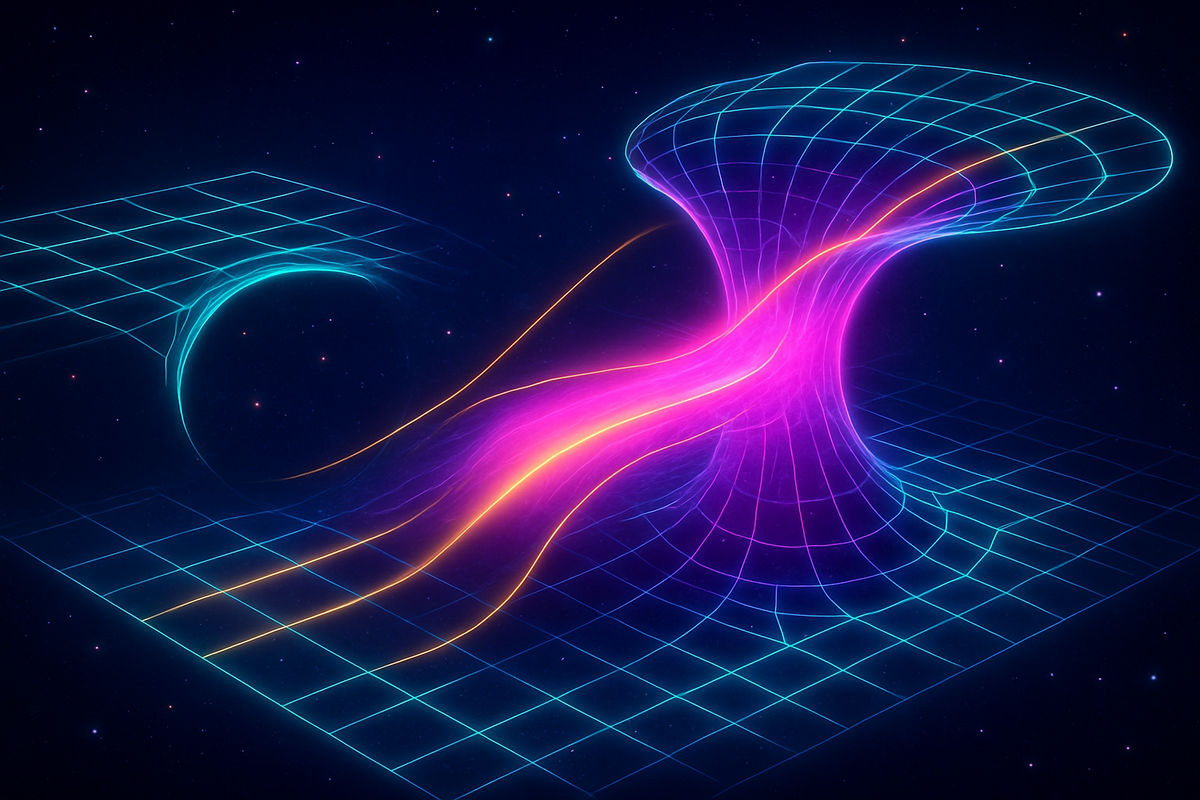
Visualize it like this: take a 2D surface, punch a hole in it, stretch the hole into a tube, and connect the tube to another hole in a different surface (or a distant part of the same surface). The two surfaces are connected by a throat, a topological handle.
This is the Einstein-Rosen bridge. The two "mouths" of the wormhole can be very far apart in ordinary space while being directly connected through the throat.
Sounds exciting. But there's a problem: the Einstein-Rosen bridge pinches off too quickly to traverse. It opens and collapses faster than light could travel through it. Nothing, not even information, can make it through a classical Schwarzschild wormhole.
The Einstein-Rosen bridge is mathematically real but physically useless for travel or communication.
Traversable Wormholes
In 1988, Kip Thorne and Michael Morris asked: could there be wormholes you could actually pass through?
The answer: yes, if you accept exotic matter.
General relativity allows many spacetime geometries. Thorne and Morris worked backward: they specified the geometry of a traversable wormhole (one that stays open long enough to cross, with manageable tidal forces) and asked what kind of matter would be needed to create it.
The answer was troubling. The required matter must have negative energy density in the region of the throat. Not negative pressure or negative mass exactly—negative energy density as measured by someone moving through the wormhole.
This "exotic matter" violates the energy conditions that ordinary matter satisfies. It's not known to exist. But it's not strictly forbidden by physics either—quantum effects can produce negative energy densities in some circumstances (the Casimir effect, for instance).
So the physics says: traversable wormholes are permitted by general relativity, but they require matter with properties we don't know how to produce in the required quantities.
The Stability Problem
Even if you could gather exotic matter, keeping a wormhole stable is a challenge.
Small perturbations tend to collapse the throat. A wormhole might be like a pencil balanced on its point—mathematically possible to keep upright, but the slightest disturbance brings it down.
Calculations suggest that sending even a single photon through some wormhole designs would cause collapse. The wormhole is self-destructive.
Some researchers have proposed more sophisticated designs that might be more stable. Others argue that quantum effects would inevitably destabilize any macroscopic wormhole. The question is open.
Wormholes and Time Travel
Here's where it gets weird.
If you could create a traversable wormhole, you might be able to turn it into a time machine.
The method (proposed by Thorne): take one mouth of the wormhole and accelerate it to high speed, then bring it back. Due to special relativistic time dilation, less time passes for the accelerated mouth. Now the two mouths are at different times—one in the future relative to the other.
Go through the wormhole, and you travel backward in time. Come back through regular space, and you've completed a closed timelike curve—a path through spacetime that returns to its own past.
Does this mean wormholes would allow time travel? Physics doesn't cleanly rule it out. But several arguments suggest the universe might protect itself:
Chronology protection conjecture: Stephen Hawking proposed that the laws of physics conspire to prevent closed timelike curves. When you try to create a time machine, quantum effects might destabilize the wormhole before the loop closes.
Cauchy horizon instability: The boundary where a time machine would form (the Cauchy horizon) tends to be unstable. Small perturbations blow up there.
Grandfather paradox: Time travel creates logical contradictions (kill your grandfather before your parent is born, etc.). Some physicists take this as evidence that time machines are impossible; others propose self-consistency constraints (the Novikov self-consistency principle) or branching timelines.
We'll explore time travel more fully in the next article. The point here is that wormholes, if traversable, have implications beyond just shortcuts through space.
ER = EPR?
In 2013, Juan Maldacena and Leonard Susskind proposed a speculative connection: ER = EPR.
ER refers to Einstein-Rosen bridges (wormholes). EPR refers to Einstein-Podolsky-Rosen entanglement (quantum entanglement).
The proposal: every pair of entangled particles is connected by a microscopic wormhole. Quantum entanglement IS wormhole connection at the Planck scale.
This is not established physics. It's a conjecture, a research direction, an attempt to connect quantum mechanics and gravity through a deep identification.
If true, it would mean wormholes are everywhere—but too small to send anything through, and not traversable in the useful sense. The mysterious "spooky action at a distance" of entanglement would have a geometric explanation.
This remains speculative but shows how wormholes connect to fundamental questions about the nature of spacetime.
What We Know and Don't Know
We know: - Einstein's equations permit wormhole solutions - The simplest wormholes (Einstein-Rosen bridges) are not traversable - Traversable wormholes require exotic matter with negative energy density - Negative energy densities exist in quantum effects, but not in the quantities needed - Stability is a serious problem
We don't know: - Whether exotic matter in sufficient quantities is possible - Whether any wormhole design is truly stable - Whether time machines formed from wormholes would work or self-destruct - Whether microscopic wormholes connect entangled particles
We're pretty sure: - Natural wormholes aren't forming and connecting different regions of our universe (we'd see evidence) - Building a macroscopic traversable wormhole is far beyond any foreseeable technology - If wormholes are possible, we don't know how to make one
Why Think About This?
If wormholes are so speculative, why study them?
First, the mathematics is consistent. Wormholes aren't forbidden by known physics; they're permitted by the equations that also predict black holes and gravitational waves. The obstacles are practical, not theoretical.
Second, studying wormholes teaches us about general relativity's flexibility. The theory allows wild geometries—exploring them reveals what the theory permits and what additional principles might constrain it.
Third, wormholes connect to deep questions. The ER=EPR conjecture, if true, would revolutionize our understanding of entanglement and spacetime. Even if that specific idea is wrong, exploring such connections is how physics advances.
Fourth, we've been surprised before. Black holes were once considered too exotic to exist. Now we photograph them. Physics doesn't always stay in the "practical" lane.
The Honest Assessment
Could you ever step through a wormhole to Alpha Centauri?
Physics doesn't absolutely forbid it. General relativity permits the geometry. The obstacles—exotic matter, stability, the energy required—are severe but not known to be insurmountable.
But there's no evidence wormholes exist naturally. There's no plausible path to creating one with foreseeable technology. The theoretical obstacles might be hiding fundamental impossibilities.
The honest answer: we don't know. Wormholes are a possibility that physics hasn't ruled out, existing in the space between "forbidden" and "feasible." They might be forever impossible. They might be engineerable by a civilization far more advanced than ours. They might teach us something profound about spacetime even if they turn out to be impossible.
That ambiguity is uncomfortable but accurate.
Further Reading
- Morris, M. & Thorne, K. (1988). "Wormholes in spacetime and their use for interstellar travel." American Journal of Physics. - Visser, M. (1995). Lorentzian Wormholes: From Einstein to Hawking. AIP Press. - Maldacena, J. & Susskind, L. (2013). "Cool horizons for entangled black holes." Fortschritte der Physik.
This is Part 4 of the Spacetime Physics series. Next: "Time Travel: What Physics Actually Allows."
Comments ()