Xenobots and the Plasticity of Biological Coherence
Frog skin cells removed from their normal context, given a new shape, placed in a dish — they don't die. They start behaving like organisms. Moving, cooperating, self-replicating. Biological coherence isn't a fixed program; it's a dynamic property that emerges from goals, not origin.
Xenobots and the Plasticity of Biological Coherence
Series: Basal Cognition | Part: 6 of 11
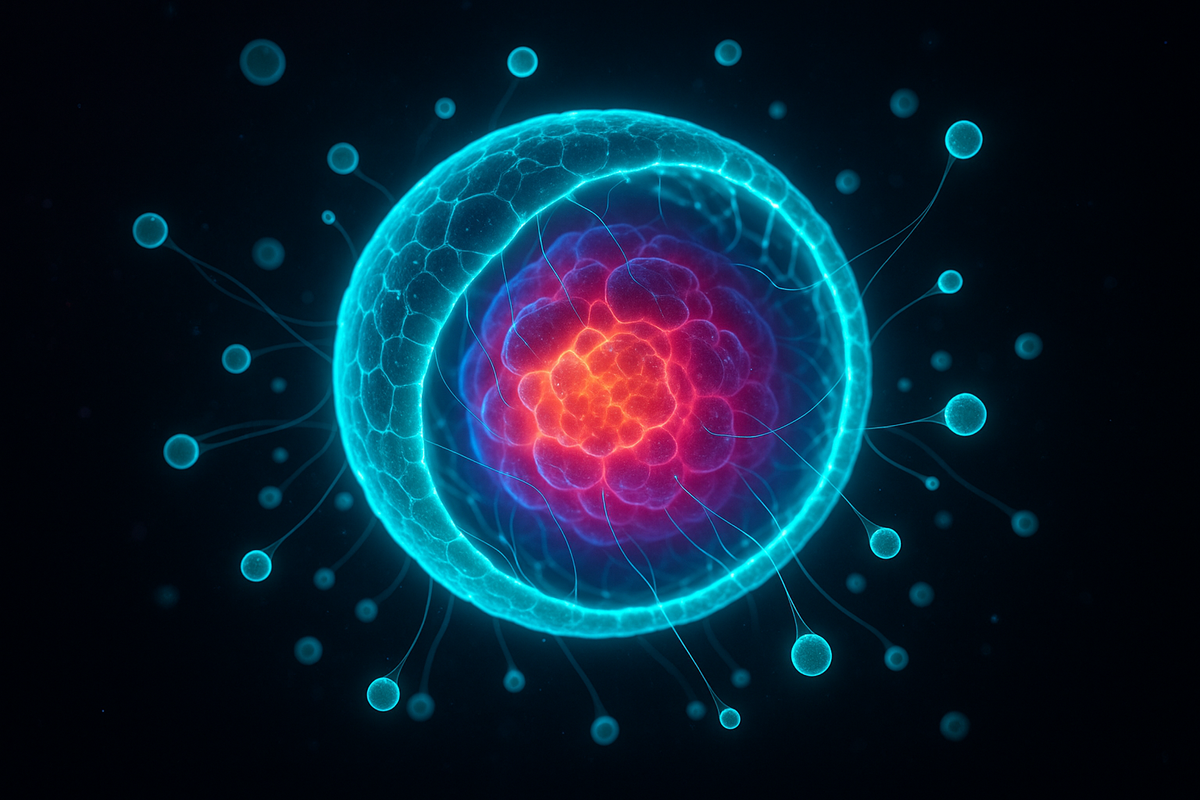
In 2020, Michael Levin's lab at Tufts University scraped cells from frog embryos, dissociated them into a cellular slurry, and watched as these liberated cells—removed from their developmental context, stripped of any guiding scaffold—spontaneously reorganized into something nobody had seen before. Not a frog. Not a tumor. Not a random clump. Xenobots—millimeter-scale biological robots that could navigate their environment, push pellets around, cooperate with other xenobots, self-repair when damaged, and even reproduce by a mechanism unknown to biology.
The xenobots didn't need genetic engineering. They weren't programmed with synthetic DNA or guided by external controllers. They were simply frog cells doing what frog cells do—constructing coherence—but in a novel configuration that had never existed in evolutionary history.
This is the plasticity of biological coherence made visible. Not cells executing hardwired instructions, but cells as competent problem-solvers, navigating a fitness landscape in morphological space, finding solutions to the problem "how do we remain coherent here?" when here is radically different from anything their genome "planned" for.
The implications reach far beyond synthetic biology. Xenobots demonstrate that biological coherence is not genome-determined but context-negotiated, maintained through active inference at the cellular scale. This fundamentally challenges the genetic program metaphor that has dominated biology since Watson and Crick. Genomes don't encode outcomes. They encode competencies for coherence construction.
The Experiment That Broke the Blueprint Metaphor
Take a frog embryo at the right developmental stage—after cells have committed to becoming skin cells (epithelial) and heart muscle cells (cardiac)—and dissociate the tissue. You now have individual cells floating in medium, disconnected from their embryonic architecture. According to the genetic program model, these cells should either die (having lost their positional information) or form a disorganized mass (lacking developmental instructions).
They don't.
Instead, they aggregate. The epithelial cells migrate to the outside and form a coherent boundary. The cardiac cells cluster inside and begin beating, their contractions creating coordinated locomotion. The resulting structure is roughly spherical, roughly millimeter-scale, and roughly capable of navigating a dish. It lives for days to weeks. It can heal injuries by reorganizing its cellular constituents. Some configurations discover how to replicate by gathering loose cells and compressing them into new xenobots—a form of kinematic reproduction requiring no genetic change.
What's most striking is the spontaneity. No one told the cells how to build a xenobot. The experimenters didn't provide a scaffold or inject guiding signals. They just created the conditions and observed what coherence looks like when cells are freed from their normal constraints but still possess their evolved competencies for staying organized.
This isn't a developmental program executing predictably. It's improvisation constrained by competence. The cells are solving a novel problem: how to be a stable, bounded, motile entity in this configuration-space we've never occupied before.
Coherence Construction vs Genetic Determinism
The dominant metaphor in biology treats genomes as blueprints or programs—specifications that, when executed correctly, produce a predetermined form. Under this model, development is about following instructions: gene X activates protein Y which triggers cascade Z which positions cell type A relative to landmark B. The organism is what the genome codes for.
Xenobots shatter this story. Frog genomes don't contain instructions for building xenobots. Frogs have been frogs for hundreds of millions of years. The xenobot configuration has no evolutionary history. It's not an attractor basin carved by selection. Yet here it is—coherent, robust, adaptive.
Levin's interpretation: genomes encode problem-solving competencies, not outcomes. What's conserved across evolutionary time isn't a specific body plan but a capacity to construct and maintain coherence in morphological space. Cells are equipped with tools for:
- Detecting stress (bioelectric gradients indicating boundary violations)
- Communicating state (gap junctions, ion flows, signaling molecules)
- Cooperating toward stability (collective migration, differentiation negotiation)
- Repairing damage (regenerative responses to coherence perturbations)
These competencies evolved to build frogs, but they're general enough to build other things when cells find themselves in novel arrangements. The genome doesn't say "build a frog." It says "here's how to detect if you're part of something coherent, and here's what to do when you're not."
This is active inference at the cellular scale. Each cell has a generative model—not of "frog" but of "coherence"—and acts to minimize surprise relative to that model. When dissociated cells aggregate, they're not executing a developmental program. They're minimizing free energy in morphological space, finding configurations that satisfy the constraints their bioelectric and biochemical sensors detect.
Morphogenetic Fitness Landscapes: Where Xenobots Live
To understand how xenobots emerge without design, we need to think about morphological fitness landscapes—multi-dimensional spaces where axes represent possible configurations of cells, and height represents stability (or coherence, or free energy minimization, depending on your framework).
A normal frog is a deep attractor basin carved by hundreds of millions of years of selection. The developmental pathway from zygote to adult frog descends reliably into that basin because the genome has been tuned to make it easy. Perturbations (injuries, environmental stress) get corrected by regenerative mechanisms that push the system back toward the frog-shaped minimum.
But the landscape has other minima—other stable configurations that cells can settle into if you place them on a different part of the landscape. Xenobots occupy one of these alternative basins. They're not as deep as the frog basin (they don't reproduce sexually, they don't develop complex organ systems, they live for weeks instead of years), but they're stable enough to persist, move, repair, and in some cases replicate kinematically.
The remarkable thing is that cells don't need to be told where this basin is. They explore the landscape through local interactions, and the physics of their coupling—mediated by bioelectric fields, mechanical forces, chemical gradients—naturally drives them toward configurations that minimize collective prediction error.
This is why xenobots exhibit such diversity. Depending on initial conditions, cell density, and random fluctuations, different dissociated cell populations settle into different stable configurations. Some are spherical with cardiac cells distributed evenly. Others have cardiac cells concentrated on one side, creating asymmetric motion. Some develop hair-like cilia that allow different forms of locomotion. The system isn't following instructions; it's navigating a landscape and finding local optima.
This resonates with what we discussed in Morphogenetic Fields as Markov Blankets: cells collectively define a boundary (a Markov blanket) between "us" and "not-us," and they maintain that boundary through coordinated inference and action. The specific shape that boundary takes depends on where in configuration-space the cells happen to be, but the competence to construct some boundary is baked into their cellular machinery.
Bioelectric Signaling: The Coordination Layer
How do cells without brains coordinate to build xenobots? The answer involves bioelectric networks—patterns of ion flows and voltage gradients that cells use to communicate state and modulate collective behavior.
In normal frog development, bioelectric signals play a crucial role in specifying body plan, organ placement, and regenerative responses. Cells maintain voltage gradients across their membranes (typically around -50mV), and these voltages regulate which genes get expressed. Depolarizing a cell (making it less negative) can shift it from proliferative to differentiative mode. Hyperpolarizing cells in specific regions can trigger eye formation even in non-standard locations (Levin has demonstrated this experimentally—inducing ectopic eyes on tadpole tails by manipulating bioelectric states).
When cells are dissociated and allowed to aggregate, they re-establish bioelectric coordination networks. Epithelial cells at the boundary maintain different voltage profiles than cardiac cells in the interior. Gap junctions (protein channels that allow ions and small molecules to pass between cells) enable cells to couple their bioelectric states, creating coordinated gradients across the structure.
These gradients function as distributed coherence signals. A cell's bioelectric state tells it: are you in the right place? Are your neighbors in the right state? Is the overall structure stable? If the answers are "no," the cell adjusts—migrating, differentiating, secreting signals that recruit other cells to help stabilize the configuration.
This is not centralized control. There's no master cell issuing commands. It's stigmergic coordination—cells leave traces in the bioelectric field, and other cells respond to those traces, and the collective pattern that emerges is a stable, bounded, coherent entity. Xenobots demonstrate that this coordination mechanism is robust enough to work in novel configurations, not just in the frog embryo context where it evolved.
Kinematic Replication: Reproduction Without Genes
Perhaps the most startling discovery about xenobots is that some configurations spontaneously discover kinematic replication—a form of reproduction requiring no genetic change, no germ cells, no meiosis.
Here's how it works: A xenobot, moving through its environment, encounters loose cells or clusters of cells. If the xenobot has the right shape (specifically, a C-shape or Pac-Man-like opening), it can scoop up the loose cells and compress them into a new aggregate. If the compression is tight enough, the aggregated cells undergo the same process the original xenobot did—epithelial cells migrate to the outside, cardiac cells organize inside, and the cluster becomes a new xenobot.
This is reproduction, but it's reproduction by construction rather than reproduction by genetic template copying. The parent xenobot isn't passing on DNA to offspring (the offspring already have frog DNA; they're just using it differently). The parent is creating the conditions for coherence assembly in a new location.
Levin's group used evolutionary algorithms to optimize xenobot shapes for replication efficiency. They simulated millions of possible configurations and selected for shapes that maximized kinematic replication rate. The result: xenobots with specific morphologies that reliably produce offspring, not because they evolved this capacity biologically, but because the researchers co-discovered with the cells which configurations enable collective self-construction.
This challenges the gene-centric view of inheritance. Xenobots pass on morphological information—the competence to construct coherence—without passing on unique genetic sequences. The information is in the configuration, not the code. The cells already have all the genetic tools they need. What they're inheriting is the organizational pattern that makes those tools cohere into something stable.
In AToM terms, kinematic replication is coherence bootstrapping. A stable configuration (low free energy, high coherence) creates conditions that allow other cells to find that same basin. The morphology itself functions as a scaffold for inference—new cells use the bioelectric and mechanical signals from the parent xenobot as evidence to constrain their own configuration space, settling into the same attractor.
Plasticity Constraints: What Xenobots Can't Do
Xenobots are impressive, but they're not infinitely plastic. Dissociated frog cells don't form arbitrary structures. They don't become tiny cars or miniature flowers. The space of possible xenobots is constrained by the competencies cells evolved for frog-building.
For example:
- Epithelial cells still behave like epithelial cells. They migrate to boundaries and form barriers. They don't suddenly become neural cells or liver cells. Differentiation commitments, once made, are sticky.
- Cardiac cells still contract rhythmically. This is useful for locomotion in xenobot contexts, but it also means xenobots are stuck with contraction-based movement. They can't sprout flagella or develop jet propulsion.
- Size is limited. Xenobots are millimeter-scale because larger structures would need vascular systems to supply oxygen and nutrients to interior cells. Frog cells have competencies for vascular morphogenesis, but those competencies don't activate in xenobot contexts (lacking the appropriate bioelectric triggers).
These constraints aren't failures. They're evidence that coherence construction operates within evolved affordances. Cells can improvise, but they improvise using the toolkit they have. The plasticity is real, but it's not magic.
This parallels what we saw in Cancer as Coherence Collapse—cancer cells exhibit a different failure mode of the same underlying machinery. Cancer represents cells losing their collective coherence constraints and pursuing local optima (proliferation, survival) at the expense of global structure. Xenobots represent cells maintaining coherence constraints but reconfiguring what those constraints apply to.
Both phenomena reveal that cells are not passive executors of genetic programs but active agents navigating fitness landscapes, and the same mechanisms that enable adaptive plasticity (xenobots) can also enable pathological breakdown (cancer) when coordination signals are disrupted.
Synthetic Morphology: Engineering Biological Coherence
Xenobots point toward a new kind of biotechnology: synthetic morphology. Instead of editing genomes to specify outcomes, we engineer conditions that allow cells to construct novel coherences.
Levin's lab is pursuing this through:
- Bioelectric editing: Manipulating voltage gradients to guide cells toward desired configurations without changing their DNA.
- Morphological search algorithms: Using AI to explore configuration space and identify stable, functional forms that cells are capable of building.
- Scaffold engineering: Providing temporary structures that guide initial cell aggregation, then dissolving the scaffold once cells establish their own coordination networks.
The goal isn't to design organisms like we design machines (top-down, blueprint-driven). It's to collaborate with cellular intelligence, creating opportunity spaces and letting cells discover solutions. This is engineering as landscape shaping rather than instruction-following.
The philosophical shift is profound. If biological coherence is context-negotiated rather than genome-determined, then the proper unit of analysis isn't the gene or even the genome—it's the cell collective and its coordination dynamics. Developmental biology becomes a study of how competent agents solve coherence problems under varying constraints.
This also has implications for regenerative medicine. Instead of trying to deliver the "right" genes to repair damaged tissues, we might focus on restoring bioelectric coordination networks that allow cells to collectively infer what needs rebuilding. Levin's group has demonstrated this with planarian flatworms, which can regenerate complete heads or tails from small body fragments. By manipulating bioelectric patterns, they've induced planarians to regenerate heads with anatomies characteristic of different species—two-headed planarians, planarians with heads shaped like those of evolutionarily distant flatworm species—all without changing the genome.
The cells already know how to build complex structures. We just need to understand the signals that frame the coherence problem they're solving.
Xenobots and the Deep Roots of Agency
What are xenobots, really?
They're not organisms in the traditional sense. They don't reproduce sexually. They don't develop from germ cells. They don't have evolutionary lineages.
But they're not machines either. They're not built from non-living parts. They're not programmed or controlled externally. They self-organize, self-repair, and in some configurations, self-replicate.
The best answer: xenobots are temporary coalitions of cells maintaining coherence in a novel configuration. They demonstrate that agency, goal-directedness, and adaptive problem-solving don't require brains or even multicellular bodies in the traditional sense. These capacities emerge from the basic machinery of cellular life—the same machinery that builds frogs, humans, and every other organism.
This is the deep lesson of basal cognition: cognition is what coherent systems do. Cells are cognitive because they model their environment, update beliefs based on evidence, and act to minimize surprise. When you aggregate cognitive agents (cells) and allow them to couple their inferences (via bioelectric networks, gap junctions, mechanical forces), you get collective cognition—distributed intelligence that operates at the scale of tissues, organisms, and in the case of xenobots, entirely novel morphologies.
Xenobots aren't smarter than cells. They are cells, being smart collectively. The intelligence was there all along, latent in the cellular competencies evolution baked in over billions of years. What Levin's lab did was create the conditions for that intelligence to express itself in a new way.
This reframes the central question of developmental biology. It's not "how do genes build bodies?" It's "how do competent agents construct coherence, and what configurations can they discover when we change the constraints they operate under?"
From Frogs to Futures: Scaling Biological Plasticity
If frog cells can build xenobots, what else can cells build?
Levin speculates about anthrobots—xenobot-like entities constructed from human cells. Early experiments with human tracheal cells suggest they too can self-organize into motile, coherent structures when dissociated and reaggregated. These anthrobots might have applications in wound healing (delivering cells to injury sites), drug delivery (navigating the body to targeted locations), or even personalized medicine (patient-derived cells building therapeutic agents on demand).
But the implications go beyond biotech applications. Xenobots force us to rethink the nature of biological possibility. The morphospace accessible to cells is vastly larger than the portion carved out by evolutionary history. Evolution found solutions that work (frogs, humans, trees, bacteria), but those solutions don't exhaust what cellular competencies can construct.
This connects to a broader theme in 4E cognition and embodied intelligence: form and function co-evolve, but form is underdetermined by function. Many possible body plans could support the same functional capacities, and many possible functions could emerge from the same underlying components. What we think of as "biological limits" may be better understood as evolutionary habits—paths that worked and got reinforced, not fundamental constraints on what cells can do.
Xenobots reveal that biological coherence is more plastic, more context-sensitive, and more improvisational than genetic determinism suggests. Cells aren't passengers on a genetic program's ride to a predetermined destination. They're navigators in morphological space, and given new starting points, they'll find new destinations.
Coherence All the Way Down
Xenobots make visible what's always been true: biological coherence is actively maintained, not passively inherited. At every scale—from ion channels regulating membrane voltage, to cells coordinating migration, to tissues maintaining boundaries, to organisms preserving homeostasis—living systems are engaged in ongoing inference and action to minimize surprise and stay organized.
In AToM terms, xenobots demonstrate that M = C/T applies at the cellular collective scale. The "meaning" of being a xenobot (as opposed to a tumor or a random clump) is the coherence maintained over time. That coherence isn't guaranteed by the genome; it's constructed by cells negotiating their collective configuration through bioelectric signaling, mechanical coupling, and chemical communication.
When we dissociate frog cells and allow them to reaggregate, we're not creating something fundamentally new. We're removing the usual constraints (embryonic architecture, positional information, developmental timing) and revealing the underlying process that was always there: cells solving coherence problems.
This is why xenobots matter beyond synthetic biology. They're a proof of concept that biological intelligence is substrate-general. The same computational principles that build frogs can build other things. The same inference machinery that maintains frog-shaped coherence can maintain xenobot-shaped coherence. What changes isn't the mechanism but the context that shapes what coherence looks like.
This plasticity extends all the way up. If cells can improvise xenobots, then tissues can improvise healing strategies, organisms can improvise behavioral adaptations, and nervous systems—including ours—can improvise ways of being in the world that weren't coded in our genes.
Coherence isn't a destination. It's a process. Xenobots are what happens when competent agents start that process from a new location and discover where it leads.
This is Part 6 of the Basal Cognition series, exploring the cognitive capacities of cells and the implications for understanding life, intelligence, and coherence.
Previous: Cancer as Coherence Collapse
Next: The Collective Intelligence of Cells
Further Reading
- Kriegman, S., Blackiston, D., Levin, M., & Bongard, J. (2020). "A scalable pipeline for designing reconfigurable organisms." Proceedings of the National Academy of Sciences, 117(4), 1853-1859.
- Blackiston, D., Lederer, E., Kriegman, S., Garnier, S., Bongard, J., & Levin, M. (2021). "A cellular platform for the development of synthetic living machines." Science Robotics, 6(52).
- Kriegman, S., Blackiston, D., Levin, M., & Bongard, J. (2021). "Kinematic self-replication in reconfigurable organisms." Proceedings of the National Academy of Sciences, 118(49).
- Levin, M. (2022). "Technological Approach to Mind Everywhere: An Experimentally-Grounded Framework for Understanding Diverse Bodies and Minds." Frontiers in Systems Neuroscience, 16.
- Bongard, J., & Levin, M. (2021). "Living Things Are Not (20th Century) Machines: Updating Mechanism Metaphors in Light of the Modern Science of Machine Behavior." Frontiers in Ecology and Evolution, 9.
Comments ()