Xenobots and Anthrobots: Biological Robots
Xenobots proved the concept: take cells, let evolution design a body plan, get a living machine with no evolutionary precedent. Anthrobots extended this with human cells that self-assemble and have repaired scratched neurons in lab cultures. Biologically-based robotics is a genuinely new field.
Xenobots and Anthrobots: Biological Robots
In 2020, researchers announced they had created the first living robots. Not robots made of metal and silicon. Robots made of frog cells. They called them xenobots, after Xenopus laevis, the African clawed frog whose skin cells they used. The cells were scraped from frog embryos, arranged into novel configurations by an evolutionary algorithm, and then—here's the part that should make you sit up—the cells organized themselves into functional machines. No genes were edited. No programming was inserted. The cells were simply placed in a new context, and they figured out what to do. This isn't robotics. It's something weirder. It's biology revealing that cells are smarter than we thought—and that the line between organism and machine is blurrier than we imagined.
Self-Replicating Xenobots
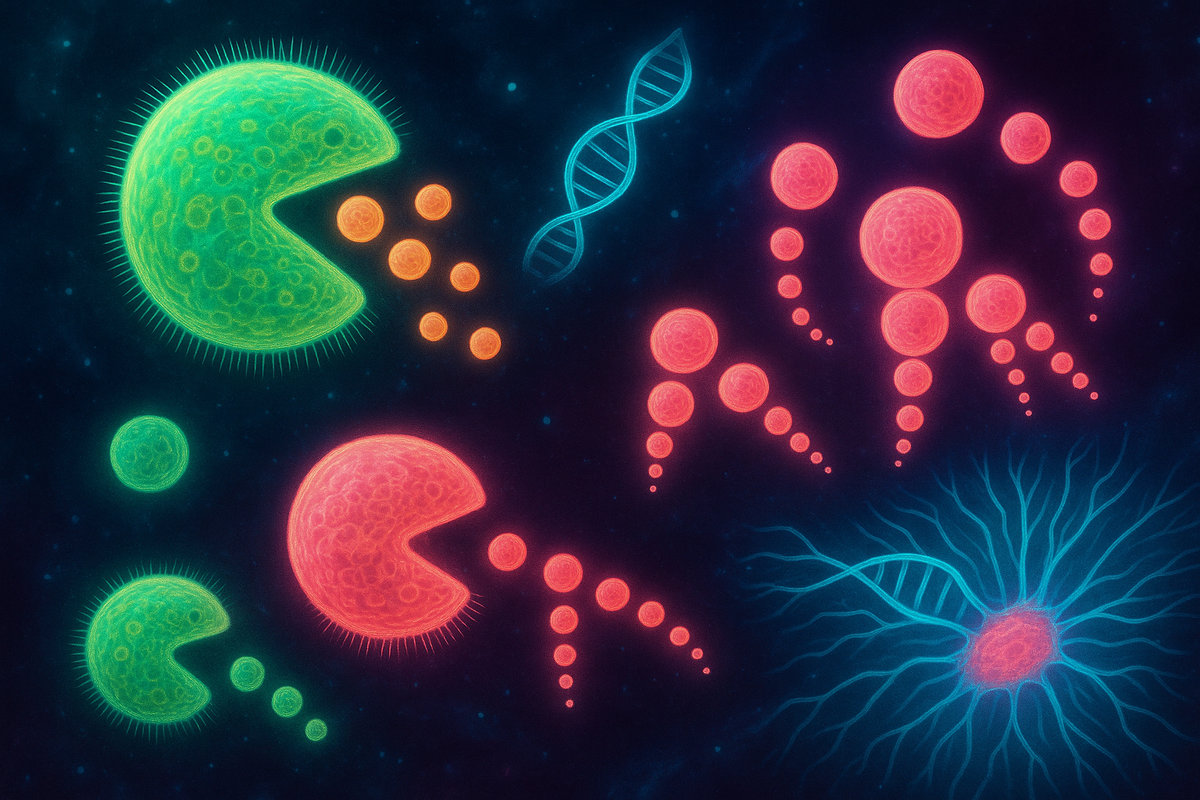
Then, in 2021, the story got stranger. The research team discovered that xenobots could reproduce. Not through division or sex—through kinematic self-replication. Here's what happened: when xenobots were placed in a dish with loose frog stem cells, they started pushing the cells into piles. The piles became new xenobots. Those new xenobots could then make more xenobots. This was the first time self-replicating biological machines had been created in the lab. And the replication method was unlike anything seen in nature. The original xenobots had Pac-Man-like shapes (designed by the algorithm for efficient gathering). They would swim around, collect stem cells with their "mouths," compress them into balls, and the balls would mature into offspring. Five generations of replication were demonstrated. Let that sink in. Frog cells, removed from a frog, arranged into a novel shape, spontaneously discovered a replication strategy that doesn't exist anywhere in the living world. No one programmed this behavior. No genes were edited to enable it. The cells themselves figured out how to make copies. The algorithm designed the shape; the biology handled the rest.
Enter the Anthrobots
In 2023, Levin's lab went further. They created anthrobots—biological robots made from human cells. Human tracheal cells (the ciliated cells that line your airways) were assembled into tiny spheroids. Like xenobots, no genetic modification was involved. The cells were simply taken from adult tissue and placed in conditions where they could self-organize. The anthrobots moved using their cilia—the hair-like projections that normally sweep mucus out of your lungs. In their new context, the cilia became propulsion systems. The anthrobots could navigate through their environment, and—crucially—they could heal wounds. When anthrobots were placed on damaged neural tissue in a dish, they migrated to the wound site and promoted healing. Neurons grew back in areas where anthrobots had been present. The mechanism isn't fully understood, but the cells appeared to be doing what cells do—sensing damage and coordinating repair—just in a completely novel body plan. Anthrobots aren't programmed healers. They're human cells that, when freed from their normal anatomical context, apply their built-in capabilities in new ways. The therapeutic implications are obvious. Imagine anthrobots derived from your own cells, deployed to repair damaged tissue without immune rejection. Imagine biological machines that can navigate your body, find problems, and fix them. That's not science fiction anymore. It's early-stage science.
What This Reveals About Biology
The xenobot and anthrobot experiments aren't just cool demonstrations. They reveal something fundamental about how biology works. Cells are not passive executors of genetic programs. The genome doesn't contain a blueprint for a frog or a human. It contains a set of tools and capabilities that cells use to solve problems in their environment. What a cell becomes depends on context—the signals it receives, the neighbors it has, the challenges it faces. When you remove frog skin cells from a frog embryo, they don't "know" they're supposed to become frog skin. They're not locked into a fate. They're problem-solvers that, in the context of a frog embryo, solve the problem of making skin. In the context of a xenobot, they solve different problems—locomotion, cohesion, survival. The body plan isn't written in the genes. It's computed by cells responding to their environment. Genes provide the hardware and some initial software. But the architecture of an organism is an emergent computation—cells talking to each other, negotiating, cooperating, competing, and eventually settling into a stable configuration. Levin calls this the "competency" of cells. Every cell has competencies—abilities to sense, respond, communicate, cooperate. In normal development, those competencies are channeled toward building a standard body plan. But the competencies themselves are more general. Free the cells from their normal context, and they'll apply those competencies to whatever problem they face. Xenobots are what happens when you give cells a new problem to solve.
The Bioelectric Connection
This is where xenobots connect to the broader bioelectric story. Remember: cells communicate electrically. They maintain membrane voltages. They share electrical signals through gap junctions. The pattern of voltages across a tissue encodes information about what that tissue should become. Levin's hypothesis is that bioelectric patterns are a kind of goal state for cell collectives. The pattern specifies a target configuration. Cells work to achieve that configuration, using whatever tools they have. In normal development, bioelectric patterns guide cells toward standard anatomical outcomes—five fingers, two eyes, one heart. But the patterns can be altered. Change the bioelectric state, and you change the target. Cells will work toward the new goal. Xenobots may be extreme examples of this plasticity. When frog cells are removed from their normal bioelectric environment and placed in a new context, they seek a new equilibrium. They don't have the signals telling them to be frog skin. So they become something else—whatever stable configuration their competencies can achieve. The implication is profound: anatomy is not destiny. It's a local minimum in a vast space of possible configurations. Cells can find other minima if given the chance.
Ethical and Philosophical Tangles
Xenobots and anthrobots raise questions we don't have clear answers to. Are they alive? They metabolize, move, respond to stimuli, and can reproduce (xenobots) or promote healing (anthrobots). By most definitions, yes, they're alive. But they have no evolutionary history, no species, no natural habitat. Are they organisms? They're made of living cells organized into functional wholes. But they weren't built by developmental processes. They were designed by algorithms and assembled by humans. They're organisms in some sense, artifacts in another. What's their moral status? They have no nervous system, no capacity for pain or suffering (as far as we can tell). But they're made from cells that, in other contexts, would be part of sentient creatures. If we scale up to brain cells, the questions get harder. Who owns them? If anthrobots derived from your cells can be mass-produced and used therapeutically, who controls that? You? The researchers? The company that commercializes them? What happens if they escape? Current xenobots and anthrobots are fragile and short-lived. But future versions might be more robust. Self-replicating biological machines released into the environment raise biosafety concerns that don't fit neatly into existing regulatory frameworks. These aren't hypothetical problems for the distant future. They're questions we need to start answering now, as the technology advances.
The Frontier
Xenobots and anthrobots are proofs of concept. They demonstrate that biological matter can be organized into functional machines outside the normal channels of evolution and development. The next steps are predictable:
- Scaling up — Larger, more complex biological robots with more sophisticated capabilities
- Specialization — Robots designed for specific tasks: drug delivery, wound healing, environmental sensing
- Cognitive components — Integration of neural tissue for information processing (already being explored in "organoid intelligence" research)
- Synthetic biology integration — Combining engineered genetic circuits with bioelectric programming
The longer-term possibilities are harder to predict. If cells are general-purpose problem-solvers that can be redeployed to novel challenges, what challenges might we set for them? Self-healing infrastructure? Environmental remediation? Biological computing substrates? We're at the very beginning of understanding what's possible when you take biology's building blocks and reassemble them with intention.
The Coherence Frame
Xenobots embody a key principle: coherence is not a fixed property but an achieved state. Cells seek coherence—stable configurations where signals align and functions integrate. In normal development, coherence means becoming an organism. In xenobots, coherence means becoming something new. The capacity for coherence is built into living matter. Evolution has spent billions of years making cells that can cooperate, communicate, and coordinate. That capacity doesn't disappear when you rearrange the cells. It just finds new expression. Understanding this capacity—and learning to work with it—is the frontier. Not programming biology like we program computers. Collaborating with biology's inherent intelligence to create new forms of living technology. The bioelectric code is one key to that collaboration. The competency of cells is another. Xenobots show us that the combinatorial space of biology is vastly larger than evolution has explored. We're just starting to explore it ourselves.
Further Reading
- Kriegman, S., Blackiston, D., Levin, M., & Bongard, J. (2020). "A scalable pipeline for designing reconfigurable organisms." Proceedings of the National Academy of Sciences.
- Blackiston, D., Lederer, E., Bhattacharyya, T., et al. (2021). "Kinematic self-replication in reconfigurable organisms." Proceedings of the National Academy of Sciences.
- Gumuskaya, G., Srivastava, P., Cooper, B., et al. (2023). "Motile living biobots self-construct from adult human somatic progenitor seed cells." Advanced Science.
This is Part 5 of the Bioelectric Code series. Next: "Ion Channels and Gap Junctions."


Comments ()