Yamanaka Factors: Reversing Cellular Age
Shinya Yamanaka won the Nobel Prize for reprogramming adult cells into stem cells. Now researchers want something more precise: dial the clock back on aging without wiping out what makes a cell a liver cell or a neuron.
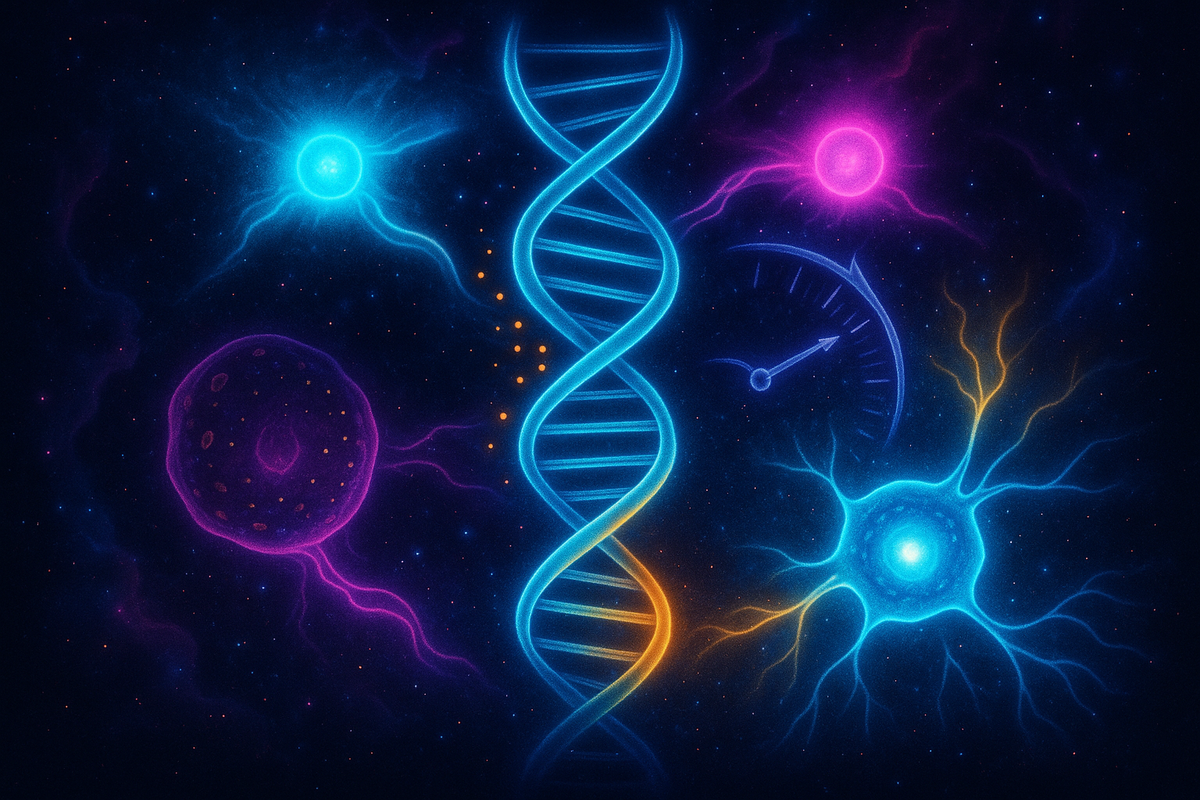
Yamanaka Factors: Reversing Cellular Age
In 2006, Shinya Yamanaka did something that shouldn't have been possible. He took adult mouse skin cells—fully differentiated, committed to their fate—and turned them back into embryonic-like stem cells. Four genes. That's all it took. Four transcription factors, now called the Yamanaka factors, could rewind a cell's developmental clock. A skin cell that could only make more skin cells became a cell that could become anything—heart, brain, bone, anything. Yamanaka won the Nobel Prize in 2012. And within a decade, longevity researchers realized the implications: if you can reset a cell's developmental clock, can you reset its aging clock too? The answer appears to be yes. And that changes everything we thought we knew about aging.
The Epigenetic Clock
Aging leaves marks on your cells—not in the DNA sequence itself, but in the epigenome: the chemical modifications that control which genes are active. DNA methylation is the most studied epigenetic mark. Methyl groups attach to cytosine bases in DNA, typically silencing the genes in that region. The pattern of methylation changes predictably with age. So predictably that Steve Horvath developed an "epigenetic clock" that can estimate biological age from methylation patterns with remarkable accuracy. Here's the key finding: when cells are reprogrammed to iPSCs, their epigenetic clock resets to zero. The methylation pattern reverts to an embryonic state. The cells don't just lose their identity—they lose their age. This raised an obvious question: can you partially reprogram cells—reset their epigenetic age without fully dedifferentiating them? If you could, you might be able to rejuvenate tissues without erasing their identity. A neuron could become a younger neuron rather than becoming a stem cell that has to be re-differentiated.
Partial Reprogramming
The challenge with full reprogramming is that iPSCs can form tumors. They're pluripotent, meaning they can become any cell type—including cancerous ones. You can't safely inject iPSCs into a living organism. But partial reprogramming—briefly activating the Yamanaka factors, then turning them off before dedifferentiation completes—might rejuvenate without the risks. In 2016, Juan Carlos Izpisua Belmonte's lab at the Salk Institute tested this in mice engineered to age rapidly (progeria mice). They cyclically expressed OSKM—turning the genes on for short periods, then off. The results were striking. The mice showed improved tissue function, better organ health, and extended lifespan. Their epigenetic clocks were partially reset. They aged more slowly. Subsequent experiments in normal (non-progeria) mice confirmed the findings. Brief, cyclic expression of reprogramming factors could rejuvenate tissues without causing cancer or loss of cell identity.
What Gets Rejuvenated
Partial reprogramming appears to affect multiple hallmarks of aging: Epigenetic drift: The pattern of gene expression becomes more youthful. Genes that were silenced with age get reactivated; genes that were aberrantly expressed get silenced. Mitochondrial function: Mitochondria in aged cells show improved performance after reprogramming. Telomeres: Some studies show telomere lengthening, though this is less consistent. Inflammatory markers: Aged cells often display a "senescence-associated secretory phenotype" (SASP)—they spew inflammatory signals. Reprogramming reduces this. Tissue function: In animal studies, reprogrammed tissues show improved function—better wound healing, improved muscle regeneration, enhanced cognitive performance. The picture is one of broad rejuvenation—not fixing one specific pathway but resetting the cell's overall state to something more youthful.
The Altos Labs Play
In 2022, Altos Labs launched with $3 billion in funding—one of the largest investments ever in longevity research. Its scientific advisory board reads like a who's who of the field, including Yamanaka himself. Altos is betting big on cellular reprogramming. Their thesis: the Yamanaka factors and related approaches can be developed into therapies that rejuvenate human tissues. Other companies are in the space too: Calico (backed by Alphabet), Retro Biosciences (backed by Sam Altman), Turn Biotechnologies, Shift Bioscience. The investment signals that serious money believes reprogramming could work. The optimistic scenario: Within 10-20 years, we have therapies that can reset cellular age. You go to a clinic, receive a treatment that partially reprograms your tissues, and emerge biologically younger. Repeat as needed. The realistic caveats: We're still mostly working in mice. Human trials are just beginning. Controlling reprogramming precisely enough to rejuvenate without causing cancer or tissue dysfunction is hard. The timeline could be much longer—or the approach could fail to translate.
The Safety Concerns
c-Myc, one of the four Yamanaka factors, is a known oncogene. It's commonly activated in cancers. Turning it on—even briefly—in adult tissues carries risk. Researchers have explored "OSK" cocktails that omit c-Myc, with some success. Other modifications to the protocol aim to reduce cancer risk while maintaining rejuvenation effects. But the fundamental tension remains: reprogramming works by pushing cells toward a less differentiated state, and less differentiation is associated with cancer. The line between rejuvenation and transformation is thin. Long-term studies are needed. We need to know whether partially reprogrammed animals get more cancer years later. We need to understand which tissues can be safely reprogrammed and which can't. We need to develop delivery methods that target specific tissues without affecting others. The field is proceeding carefully—but also quickly, driven by the massive potential payoff.
Epigenetic Information Theory
Here's where it gets philosophically interesting. Yamanaka factors work because the information for youth still exists in old cells. The DNA sequence hasn't changed. What's changed is which genes are accessible—the epigenetic state. Sinclair has called this the "information theory of aging." Aging, in this view, is primarily epigenetic—a gradual loss of the cell's ability to read its own genome correctly. The information is still there; the cell just can't access it. Reprogramming works because it restores access. The factors reset the epigenome, making the instructions for youth readable again. The cell already knows how to be young. It just forgot. If this is right, aging is not damage accumulation (though that contributes). It's not inevitable entropy. It's information loss that can, in principle, be reversed. This framing is optimistic—perhaps too optimistic. Critics note that aging involves more than epigenetics: protein aggregates, DNA mutations, senescent cells, immune dysfunction. Resetting the epigenome doesn't fix accumulated mutations in the DNA sequence. The information theory may be part of the story, not the whole story. But partial reprogramming does work, at least in mice. Something important is being reset. Whether it's enough to meaningfully extend human lifespan remains to be seen.
Where We Stand
What we know:
- Yamanaka factors can reset cellular identity and epigenetic age
- Partial reprogramming can rejuvenate tissues in mice without full dedifferentiation
- Multiple companies are investing billions in developing this into therapies
What we don't know:
- Whether reprogramming translates to humans
- The long-term safety profile
- Which tissues can be safely reprogrammed
- How to deliver reprogramming factors precisely
- Whether the benefits persist or require repeated treatment
The timeline: Human trials are beginning. Results will take years. If successful, therapies could be 10-20 years away. If problems emerge, longer. This is one of the most exciting frontiers in biology. The ability to reset cellular age—if it works, if it's safe, if it can be scaled—would transform medicine and human life. But we're early. The hype is high. The evidence is promising but preliminary. Watch this space.
Further Reading
- Takahashi, K. & Yamanaka, S. (2006). "Induction of Pluripotent Stem Cells from Mouse Embryonic and Adult Fibroblast Cultures by Defined Factors." Cell.
- Ocampo, A. et al. (2016). "In Vivo Amelioration of Age-Associated Hallmarks by Partial Reprogramming." Cell.
- Browder, K. C. et al. (2022). "In vivo partial reprogramming alters age-associated molecular changes during physiological aging in mice." Nature Aging.
This is Part 5 of the Longevity series. Next: "Parabiosis: Young Blood and Old Bodies."


Comments ()