The Bernoulli Equation: A Clever Substitution
Nonlinear ODEs are usually brutal. The Bernoulli equation is the exception: a single substitution transforms it into a linear equation, turning an apparent dead end into a clean solution.
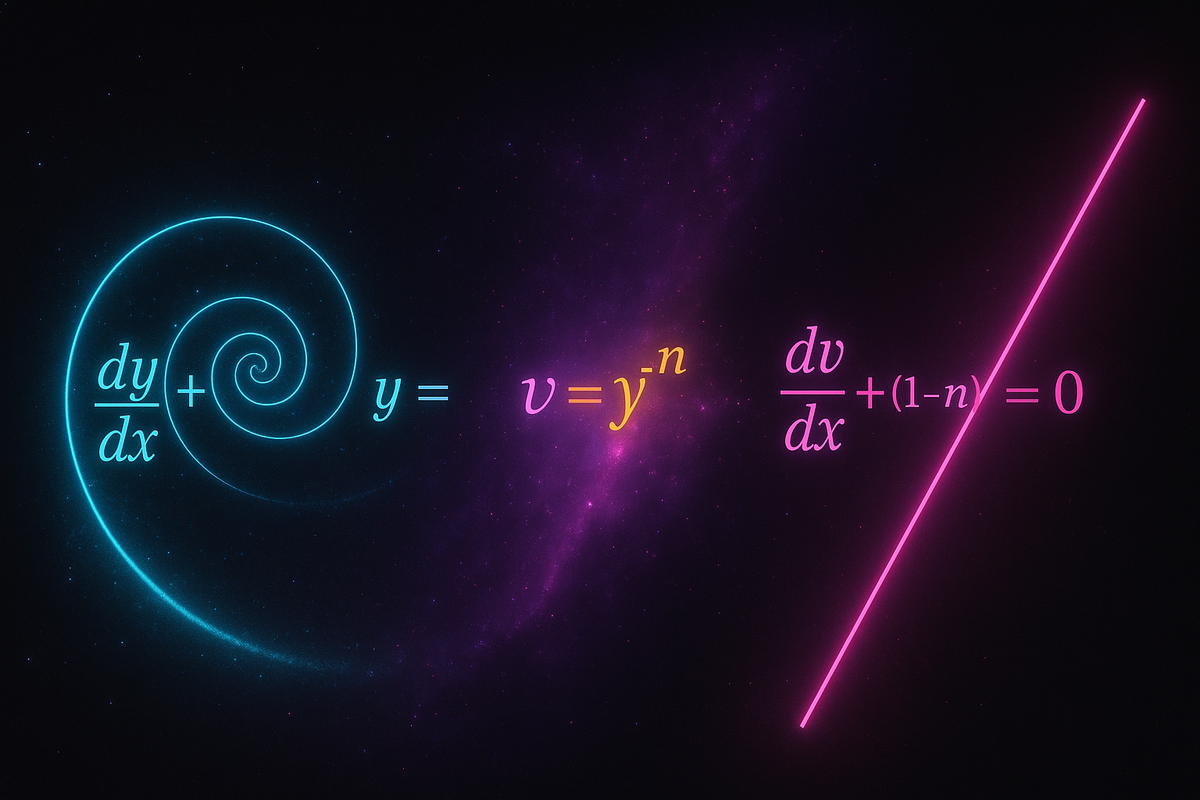
Bernoulli equations are nonlinear but solvable. They look like linear first-order ODEs except for one term—y raised to a power.
Standard form: dy/dx + P(x)y = Q(x)y^n
If n = 0 or n = 1, it's already linear (covered earlier). But for n ≠ 0, 1, the y^n term makes it nonlinear.
The trick: a clever substitution transforms it into a linear equation, which you already know how to solve.
It's a beautiful example of mathematical judo—convert a hard problem into an easy one by changing variables.
What Makes It a Bernoulli Equation
Standard form: dy/dx + P(x)y = Q(x)y^n
Key features:
- First-order
- y and dy/dx appear linearly on the left
- y^n (nonlinear term) appears on the right
Examples:
dy/dx + y = y² (n = 2)
dy/dx - (2/x)y = x²y³ (n = 3)
dy/dx + y/x = xy^(-1) (n = -1)
All Bernoulli equations. The exponent n distinguishes them from linear.
Why It's Nonlinear
The term y^n (for n ≠ 0, 1) makes the equation nonlinear.
If n = 2: dy/dx + P(x)y = Q(x)y²
This is quadratic in y. Superposition fails—if y₁ and y₂ are solutions, y₁ + y₂ generally isn't.
Nonlinearity means no systematic general method exists. But for this specific structure (Bernoulli form), substitution works.
The Substitution
The key: Let v = y^(1-n).
Then: dv/dx = (1-n)y^(-n)(dy/dx)
Rearrange: dy/dx = (1/(1-n))y^n(dv/dx)
Substitute into the Bernoulli equation.
Original: dy/dx + P(x)y = Q(x)y^n
Replace dy/dx:
(1/(1-n))y^n(dv/dx) + P(x)y = Q(x)y^n
Divide through by y^n:
(1/(1-n))(dv/dx) + P(x)y^(1-n) = Q(x)
But v = y^(1-n), so:
(1/(1-n))(dv/dx) + P(x)v = Q(x)
Multiply by (1-n):
dv/dx + (1-n)P(x)v = (1-n)Q(x)
This is linear in v. Solve using the integrating factor method, then back-substitute v = y^(1-n) to get y.
Example 1: Bernoulli with n = 2
Solve: dy/dx + y = y²
Here P(x) = 1, Q(x) = 1, n = 2.
Step 1: Substitute v = y^(1-2) = y^(-1).
Then: dv/dx = -y^(-2)(dy/dx), so dy/dx = -y²(dv/dx).
Step 2: Substitute into equation:
-y²(dv/dx) + y = y²
Divide by y²:
-(dv/dx) + y^(-1) = 1
But v = y^(-1):
-(dv/dx) + v = 1
Multiply by -1:
dv/dx - v = -1
Step 3: This is linear in v. Standard form: dv/dx - v = -1.
Integrating factor: μ = e^(-∫1 dx) = e^(-x).
Multiply: e^(-x)(dv/dx) - e^(-x)v = -e^(-x)
Left side is d/dx[e^(-x)v]:
d/dx[e^(-x)v] = -e^(-x)
Integrate: e^(-x)v = ∫-e^(-x)dx = e^(-x) + C
v = 1 + Ce^x
Step 4: Back-substitute v = 1/y:
1/y = 1 + Ce^x
y = 1/(1 + Ce^x)
General solution: y = 1/(1 + Ce^x)
Check: Differentiate and verify it satisfies the original equation. (It does.)
Example 2: Bernoulli with n = 3
Solve: dy/dx - (2/x)y = x²y³
Here P(x) = -2/x, Q(x) = x², n = 3.
Step 1: Substitute v = y^(1-3) = y^(-2).
Then: dv/dx = -2y^(-3)(dy/dx), so dy/dx = -(1/2)y³(dv/dx).
Step 2: Substitute into equation:
-(1/2)y³(dv/dx) - (2/x)y = x²y³
Divide by y³:
-(1/2)(dv/dx) - (2/x)y^(-2) = x²
But v = y^(-2):
-(1/2)(dv/dx) - (2/x)v = x²
Multiply by -2:
dv/dx + (4/x)v = -2x²
Step 3: This is linear in v.
Integrating factor: μ = e^(∫(4/x)dx) = e^(4ln|x|) = x⁴.
Multiply: x⁴(dv/dx) + 4x³v = -2x⁶
Left side is d/dx[x⁴v]:
d/dx[x⁴v] = -2x⁶
Integrate: x⁴v = ∫-2x⁶dx = -(2/7)x⁷ + C
v = -(2/7)x³ + Cx^(-4)
Step 4: Back-substitute v = 1/y²:
1/y² = -(2/7)x³ + Cx^(-4)
y² = 1/(-(2/7)x³ + Cx^(-4)) = x⁴/(Cx⁴ - (2/7)x⁷) = x⁴/(C - (2/7)x³)
y = ±√(x⁴/(C - (2/7)x³))
Messy, but valid. The point: substitution converted nonlinear to linear.
Example 3: Negative Exponent
Solve: dy/dx + y/x = xy^(-1)
Here n = -1, P(x) = 1/x, Q(x) = x.
Step 1: Substitute v = y^(1-(-1)) = y².
Then: dv/dx = 2y(dy/dx), so dy/dx = (1/(2y))(dv/dx).
Step 2: Substitute:
(1/(2y))(dv/dx) + y/x = xy^(-1)
Multiply by 2y:
dv/dx + (2y²)/x = 2x
But v = y²:
dv/dx + (2v)/x = 2x
Step 3: Linear in v.
Integrating factor: μ = e^(∫(2/x)dx) = e^(2ln|x|) = x².
Multiply: x²(dv/dx) + 2xv = 2x³
Left side is d/dx[x²v]:
d/dx[x²v] = 2x³
Integrate: x²v = ∫2x³dx = (1/2)x⁴ + C
v = (1/2)x² + Cx^(-2)
Step 4: Back-substitute v = y²:
y² = (1/2)x² + Cx^(-2)
y = ±√((1/2)x² + C/x²)
General solution (implicit form acceptable).
When to Use Bernoulli Substitution
Use when:
- Equation has form
dy/dx + P(x)y = Q(x)y^n - n ≠ 0 and n ≠ 1 (otherwise it's already linear or separable)
The substitution v = y^(1-n) always linearizes.
Why This Works
The Bernoulli equation mixes linear and nonlinear terms in a specific way. The nonlinearity is isolated in the y^n term.
The substitution v = y^(1-n) "undoes" that nonlinearity. When you differentiate v, you pull down a factor of y^(-n) from the chain rule, which cancels the y^n in the original equation.
It's engineered to work. The form of the substitution is tailored to the structure of the equation.
Connection to Logistic Equation
The logistic equation dy/dx = ry(1 - y/K) can be written as:
dy/dx = ry - (r/K)y²
Rearrange: dy/dx - ry = -(r/K)y²
This is Bernoulli with P(x) = -r, Q(x) = -r/K, n = 2.
Apply substitution v = y^(-1):
dv/dx + rv = r/K
Linear. Solve:
Integrating factor: μ = e^(rt)
d/dx[e^(rt)v] = (r/K)e^(rt)
e^(rt)v = (1/K)e^(rt) + C
v = 1/K + Ce^(-rt)
Back-substitute v = 1/y:
1/y = 1/K + Ce^(-rt)
y = K/(1 + CKe^(-rt))
This is the standard logistic solution. Bernoulli substitution provides an alternative derivation to separation of variables.
Riccati Equations (Generalization)
A further generalization: Riccati equation.
dy/dx = P(x) + Q(x)y + R(x)y²
This is quadratic in y (like Bernoulli with n = 2) but with an additional P(x) term.
Riccati equations generally can't be solved in closed form unless you know one particular solution. If you have y₁ (a particular solution), you can reduce it to Bernoulli via substitution y = y₁ + 1/v.
Bernoulli is a special case of Riccati where P(x) = 0.
Practical Tips
Tip 1: Always check if n = 0 or n = 1 first. If so, use simpler methods (linear or separable).
Tip 2: The substitution v = y^(1-n) is standard. Memorize it.
Tip 3: After substitution, you get a linear equation in v. Use integrating factor.
Tip 4: Don't forget to back-substitute at the end to recover y.
Tip 5: Solutions can be implicit or messy. That's okay—differential equations don't always yield neat formulas.
When Bernoulli Appears
Bernoulli equations model systems where growth/decay rate depends on a power of the current state.
Population with limited resources: dP/dt = rP - aP² (Bernoulli with n = 2)
Chemical reactions: dC/dt = k₁C - k₂C² (autocatalytic reactions)
Spread of information: dI/dt = αI - βI² (logistic-like models)
Anytime you have linear term ± nonlinear power term, consider Bernoulli.
Summary of Method
To solve dy/dx + P(x)y = Q(x)y^n:
- Check if n = 0 or 1 (if so, use simpler methods)
- Substitute v = y^(1-n)
- Differentiate:
dv/dx = (1-n)y^(-n)(dy/dx) - Replace dy/dx and simplify to get linear equation in v
- Solve linear equation using integrating factor
- Back-substitute v = y^(1-n) to find y
It's algorithmic once you recognize the form.
Next: systems of differential equations, where multiple variables evolve together.
Part 9 of the Differential Equations series.
Previous: Euler's Method: Numerical Approximation Step by Step Next: Systems of ODEs: When Multiple Quantities Change Together
Comments ()