Beyond Vector Search: Why Graph RAG Is the Future of AI Retrieval
Vector search is powerful but structurally blind—it finds similarity without understanding relationships. Graph RAG adds the relational layer that makes AI retrieval capable of multi-hop reasoning and structured knowledge.
Beyond Vector Search: Why Graph RAG Is the Future of AI Retrieval
Series: Graph RAG | Part: 1 of 10
The most expensive part of building an AI system isn't the model. It's what you feed it.
Retrieval-Augmented Generation (RAG) systems power everything from customer service chatbots to enterprise knowledge bases to coding assistants. The architecture is deceptively simple: when a user asks a question, retrieve relevant context from a knowledge base, inject it into the prompt, let the language model synthesize an answer. But that middle step—retrieve relevant context—is where most systems fail catastrophically.
The dominant approach, vector search, treats documents like isolated points in semantic space. It's fast. It's scalable. And it fundamentally misunderstands how knowledge works.
Knowledge isn't a collection of independent facts. It's a web of relationships—causation, contradiction, dependence, hierarchy, temporal sequence. Vector embeddings collapse all of this into a single similarity score. When you search "What causes inflation?", naive vector retrieval might return documents mentioning "inflation" and "cause" but miss the crucial macroeconomic relationships between interest rates, money supply, and fiscal policy. The connections—the structure that makes knowledge meaningful—evaporate.
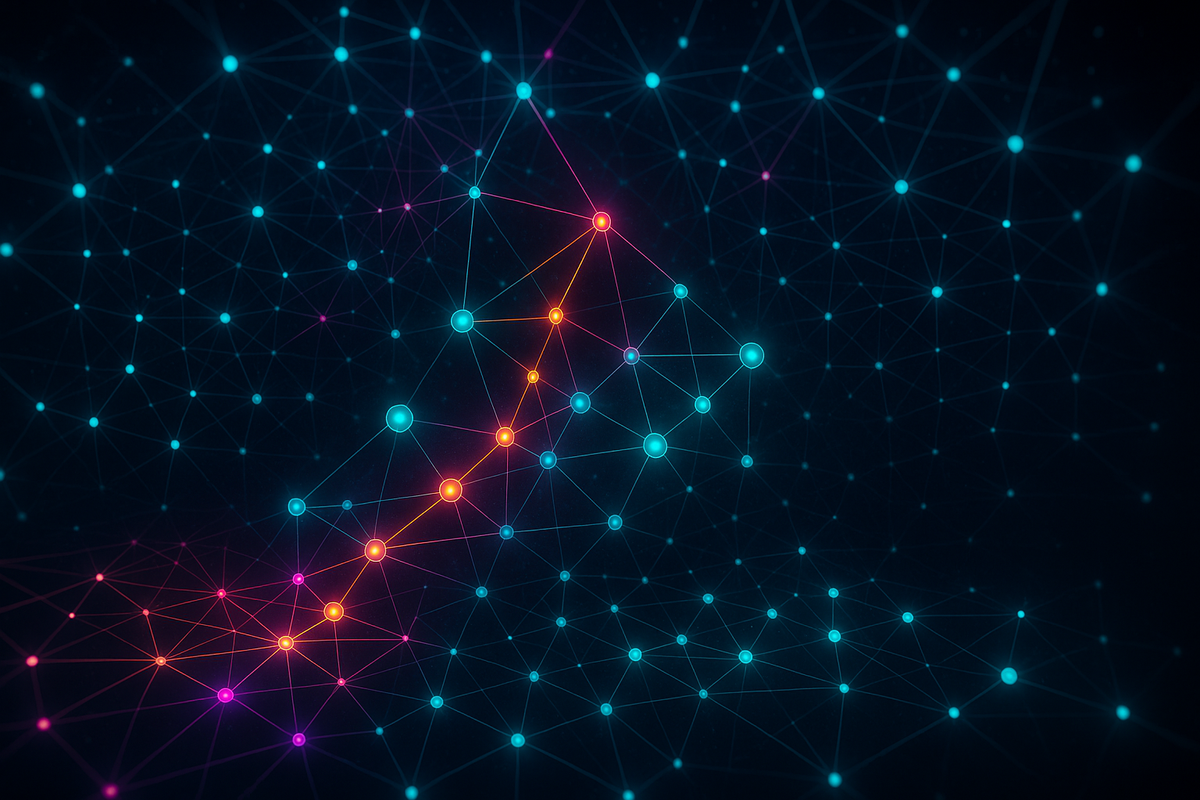
Graph RAG solves this. Instead of treating documents as isolated vectors, it treats knowledge as what it actually is: a graph of interconnected entities and relationships. The retrieval task becomes graph traversal. Context isn't just "similar documents"—it's multi-hop reasoning paths that preserve relational structure.
This isn't a minor optimization. It's a paradigm shift. And if you're building any system that needs to reason over complex, interconnected knowledge, you need to understand why.
The Limits of Naive Vector Retrieval
Vector search works by embedding documents into high-dimensional space where semantic similarity corresponds to geometric proximity. When a user query comes in, embed it, find the nearest neighbors in vector space, return those documents as context.
This works beautifully for retrieval tasks where similarity is actually what you want. "Find me documents about photosynthesis" works great—documents using the word "photosynthesis," "chlorophyll," "light-dependent reactions" cluster together in embedding space.
But most real-world questions aren't similarity searches. They're relational queries.
Consider: "How does climate change affect coffee production in Colombia?"
A naive vector search will return:
- Documents mentioning climate change
- Documents mentioning coffee production
- Documents mentioning Colombia
What it won't capture: the causal chain linking rising temperatures → altered precipitation patterns → elevation shifts for viable coffee cultivation → economic disruption in rural communities → migration patterns → civil conflict dynamics.
Each of those steps exists in different documents. Vector similarity might retrieve one or two of them. But the multi-hop reasoning path—the traversal through a causal graph—gets lost. The model receives isolated fragments and is expected to hallucinate the connective tissue.
Even worse: vector search has no notion of contradiction. If your knowledge base contains both "Coffee production declined 30% in 2022" and "Coffee production increased 15% in 2022" (from different sources or contexts), vector similarity will happily return both. The system doesn't know they're incompatible claims requiring reconciliation.
This is the fundamental problem: vectors encode similarity, not structure.
What Is Graph RAG, Actually?
Graph RAG treats your knowledge base as a graph—nodes are entities (people, places, concepts, events), edges are relationships (causes, contradicts, depends-on, occurs-before, is-part-of).
When a query comes in, instead of embedding-and-matching, the system:
- Identifies query entities — "climate change," "coffee production," "Colombia"
- Finds nodes in the knowledge graph — Link query terms to specific entities
- Traverses multi-hop paths — Walk the graph to discover relevant relational chains
- Extracts subgraph context — Return not just individual documents but interconnected context preserving structure
- Injects structured context into LLM — The model now sees relationships, not just keyword matches
The difference is profound. Instead of "Here are five documents vaguely related to your query," the system provides "Here's the causal chain linking A → B → C, with supporting evidence, contradictory claims flagged, and temporal sequence preserved."
Retrieval becomes reasoning-aware. The graph structure encodes the logical dependencies required to actually answer the question.
Why Knowledge Is a Graph, Not a Vector Space
From a coherence geometry perspective, knowledge isn't a static embedding—it's a state-space topology where meaning emerges from relational structure.
In AToM terms, M = C/T: Meaning equals Coherence over Time (or Tension). Knowledge achieves coherence when its relational structure remains integrable under constraint—when traversing paths through the graph doesn't produce contradictions or logical dead ends.
A vector space collapses this topology into distance metrics. Relationships become implicit, encoded only as proximity. This works for shallow similarity but fails catastrophically for path-dependent reasoning—where the order and structure of inference steps matter.
Compare:
- Vector logic: "These two documents are close in embedding space."
- Graph logic: "Entity A causes Entity B under Condition C, which contradicts Claim D from Source E, but aligns with Historical Pattern F."
The second preserves the geometry of inference. It's not just what's related—it's how they're related, and whether those relationships compose into coherent reasoning chains.
This is why large language models hallucinate less with graph-structured context. You're not asking them to infer structure from similarity—you're providing the structure explicitly. The model's job becomes synthesis, not structure recovery.
The Architecture: How Graph RAG Works
Let's decompose the system.
1. Knowledge Graph Construction
First, you need a graph. This can be built via:
Entity extraction — Named entity recognition (NER) to identify people, places, organizations, concepts in your corpus. These become nodes.
Relationship extraction — Dependency parsing, semantic role labeling, or fine-tuned models to extract relationships. "X causes Y," "A contradicts B," "Q happens before R." These become edges.
Ontology mapping — If you have domain-specific taxonomies (medical ontologies, scientific knowledge bases, legal precedent hierarchies), map entities to standard ontologies. This enables cross-document reasoning: "Drug X" in Document A is the same entity as "Compound X" in Document B.
Temporal grounding — Add temporal metadata to nodes and edges. "Claim C was made in 2019" vs. "Claim D supersedes C as of 2023." This prevents outdated information from contaminating retrieval.
The resulting graph is a structured representation of your knowledge base where documents are decomposed into atomic knowledge units (entities + relationships) rather than treated as monolithic text blobs.
2. Query Processing
When a user query arrives:
Entity linking — Identify which query terms map to entities in your graph. "What regulatory changes affected tech companies in 2023?" → Link "regulatory changes," "tech companies," "2023" to graph nodes.
Relationship inference — Determine what kind of relationships the query implies. "affected" suggests a causal edge. "in 2023" adds temporal constraints.
Subgraph identification — This is the core retrieval step. Instead of semantic search in vector space, perform graph traversal to identify the most relevant subgraph.
This might involve:
- Shortest path algorithms — Find minimum-hop paths between query entities
- Personalized PageRank — Random walk from query nodes to rank connected entities by relevance
- Constraint satisfaction — Filter paths by relationship types and temporal bounds
- Community detection — Identify densely connected subgraphs around query topics
The output is a subgraph—a subset of nodes and edges that form a coherent reasoning context.
3. Context Injection
The extracted subgraph gets serialized into structured text for the LLM:
Entity: Tech Regulation 2023
- Caused by: Antitrust Concerns (2021-2023)
- Implemented via: Digital Markets Act (EU, March 2023)
- Affects: Apple (App Store policies), Google (Search monopoly), Meta (Ad targeting)
- Contradicts: Previous "self-regulation" stance (Source: FTC 2018)
- Leads to: Compliance costs (Estimated $2B, Source: WSJ Oct 2023)
Instead of raw document text, the model receives explicit relational structure. It knows what causes what, what contradicts what, what happened when.
4. Model Generation
With structured context, the LLM generates a response that:
- Follows causal chains correctly
- Flags contradictory information
- Respects temporal ordering
- Cites sources with graph provenance
Hallucination drops because the model isn't inventing structure—it's reading it from the graph.
Concrete Wins: Where Graph RAG Dominates
Scientific Literature
Academic knowledge is inherently graph-structured: papers cite papers, experiments build on experiments, theories contradict or subsume earlier theories.
A vector search for "CRISPR applications in cancer therapy" returns papers mentioning those keywords. Graph RAG traverses:
- CRISPR technique → derived from → bacterial immunity (Barrangou et al., 2007)
- Applied to → gene knockout experiments (Jinek et al., 2012)
- Extended to → human cell lines (Cong et al., 2013)
- Therapeutic applications → cancer immunotherapy (CAR-T modifications, 2017-)
- Current trials → melanoma, leukemia (2020-present)
- Contradictory results → off-target effects (Kosicki et al., 2018 vs. later rebuttals)
The graph preserves the provenance and evolution of scientific knowledge. The model doesn't just list facts—it understands how the field developed.
Legal Reasoning
Legal precedent is a graph: Case A cites Case B, which overturned Case C, which interpreted Statute D, which was amended in Year E.
Vector search: "Find cases about employment discrimination."
Graph RAG: "Find cases about employment discrimination → that cite Title VII → decided after Bostock v. Clayton County (2020, extended protections to LGBTQ+) → but distinguish religious employer exemptions → as clarified in Our Lady of Guadalupe School v. Morrissey-Berru (2020)."
The graph captures the logical dependencies and temporal sequence required for correct legal reasoning.
Enterprise Knowledge
Internal company knowledge is deeply relational: Product X depends on Component Y, which is maintained by Team Z, which reports to VP A, which is affected by Strategic Initiative B launched in Quarter Q.
Vector search: "Who owns the authentication service?"
Graph RAG: "Authentication service (owned by: Identity Team) → depends on: AWS Cognito (vendor), internal Token Manager (owned by: Platform Team) → breaking change introduced: Q3 2023 (affects: Mobile App, Web Portal, API Gateway) → documentation: Confluence page link, GitHub PR #4521 → contacts: @alice (lead), @bob (deputy)."
The graph transforms isolated facts into actionable operational intelligence.
The Trade-Offs: Why Not Everyone Uses Graph RAG Yet
Graph RAG isn't free. It introduces complexity and cost that naive vector retrieval avoids.
Construction Cost
Building a knowledge graph requires entity extraction, relationship extraction, and entity resolution pipelines. For large corpora, this is computationally expensive. Vector embeddings are one pass over the corpus. Graph construction requires multiple passes with NLP models that are often slower than embedding models.
Mitigation: Incremental graph updates (add new documents without reprocessing everything), lightweight entity extraction (rule-based + few-shot LLMs), and hybrid systems (graphs for critical domains, vectors for everything else).
Query Latency
Graph traversal is slower than vector similarity search. A semantic search query is a single nearest-neighbor lookup (milliseconds with HNSW or IVF indexes). A graph query might require multi-hop traversal, constraint checking, and subgraph extraction (potentially seconds for complex queries).
Mitigation: Precomputed graph embeddings (embed subgraphs for fast retrieval), query caching (store frequent query results), and hybrid architectures (vector search narrows candidates, graph traversal refines).
Maintenance Complexity
Graphs require ontology maintenance. Entities need disambiguation (is "Apple" the company or the fruit?), relationships need validation (did we correctly extract causality or just correlation?), and temporal metadata needs updating (is this information still current?).
Mitigation: Automated entity linking to canonical knowledge bases (Wikidata, domain-specific ontologies), active learning pipelines where users flag incorrect relationships, and periodic graph auditing.
But here's the key insight: these costs are upfront investments in structure. Vector search pushes the complexity downstream—the model must infer structure from ambiguous context, leading to hallucination and inconsistency. Graph RAG pays the cost once at indexing time, making every subsequent query more reliable.
From a coherence perspective: vector retrieval has low upfront cost, high ongoing error (low C, high T → low M). Graph RAG has high upfront cost, low ongoing error (high C, low T → high M). Meaning scales with structural investment.
Hybrid Approaches: Best of Both Worlds
The future isn't "graph vs. vector"—it's graph + vector as complementary modalities.
Stage 1: Vector pre-filtering — Use semantic search to narrow the corpus to ~100 candidate documents. Fast, broad recall.
Stage 2: Graph traversal — Within those candidates, perform graph-based reasoning to identify the most relevant relational context. Precision over recall.
Stage 3: Contextual reranking — Use a cross-encoder or LLM-as-judge to rerank results considering both semantic relevance and graph structure.
This hybrid gives you the speed of vector search with the precision of graph reasoning.
Another powerful hybrid: Graph-augmented embeddings. Instead of embedding document text alone, embed (document + entity metadata + local graph structure). This encodes relational hints into the vector itself, improving semantic search without requiring full graph traversal at query time.
Research from Microsoft (GraphRAG, 2024) shows this hybrid approach achieves 40-60% better factual accuracy on multi-hop reasoning tasks compared to naive vector RAG, with only 2-3x latency increase (sub-second for most queries).
The Path Forward: Building Your Own Graph RAG
If you're building a RAG system for a domain where relationships matter—legal, scientific, medical, technical documentation, anything with causal chains or temporal evolution—here's where to start.
Step 1: Audit your failure modes. Look at queries where your current vector RAG hallucinates or misses key information. If the failures involve missing relationships, contradictory sources, or temporal confusion, you need graph structure.
Step 2: Start small. Don't graph your entire corpus. Identify the 10-20% of high-value entities where relational reasoning matters most. Build a focused graph there.
Step 3: Use existing tools. Don't build from scratch. Neo4j, AWS Neptune, and TigerGraph provide graph databases. LangChain and LlamaIndex now have graph RAG modules. OpenAI's structured outputs and function calling make entity extraction easier than ever.
Step 4: Measure what matters. Track not just retrieval recall but reasoning accuracy—does the model correctly follow causal chains? Does it flag contradictions? Does it respect temporal sequence? These are the wins graph RAG delivers.
Step 5: Iterate on ontology. Your first graph schema will be wrong. That's fine. As users interact with the system, you'll discover which relationships matter and which are noise. Evolve the schema accordingly.
Why This Matters Beyond RAG
Graph RAG is a microcosm of a larger shift in AI systems: from pattern matching to structural reasoning.
The transformer revolution gave us models that excel at statistical correlation—"this word follows that word with high probability." But correlation isn't causation, and proximity isn't relationship. As we push AI into domains requiring causal reasoning, temporal logic, and multi-step inference, we hit the limits of pure neural pattern matching.
Graph-structured representations externalize the reasoning substrate. Instead of expecting the model to learn relational structure implicitly from massive datasets, we encode it explicitly and let the model operate over it.
This aligns with broader trends:
- Neuro-symbolic AI — Combining neural networks with symbolic reasoning engines
- Knowledge graphs as memory — Models augmented with external, editable knowledge stores
- Compositional architectures — Systems where specialized modules (retrieval, reasoning, generation) compose rather than monolithic end-to-end training
In AToM terms, this is the move from compressed representations (vectors as lossy encodings of meaning) to geometric representations (graphs as structured state spaces that preserve coherence under traversal).
The question isn't whether AI will move toward graph-structured reasoning. It's how quickly.
Conclusion: Structure Is the Answer
The core problem with naive vector RAG is that it treats knowledge as a bag of documents. But knowledge isn't a bag. It's a web—causally connected, temporally ordered, hierarchically organized, riddled with dependencies and contradictions.
Graph RAG makes this structure explicit. It doesn't ask the model to hallucinate relationships from keyword similarity. It provides the relationships as data.
The result: fewer hallucinations, better multi-hop reasoning, temporal awareness, contradiction detection, and provenance tracking. The system doesn't just retrieve—it understands.
If you're building AI that needs to reason about complex, interconnected knowledge, vector search alone will fail you. The future is graph-aware.
And the future, as it turns out, is already here. You just need to traverse the right path to find it.
This is Part 1 of the Graph RAG series, exploring how knowledge graphs transform AI retrieval from similarity matching to structural reasoning.
Next: "How to Build a Knowledge Graph: From Documents to Entities to Relationships"
Further Reading
- Peng, B., et al. (2023). "Graph-Toolformer: To Empower LLMs with Graph Reasoning Ability via Prompt Augmented by ChatGPT." arXiv:2304.11116.
- Edge, D., et al. (2024). "From Local to Global: A Graph RAG Approach to Query-Focused Summarization." Microsoft Research.
- Yasunaga, M., et al. (2022). "Deep Bidirectional Language-Knowledge Graph Pretraining." NeurIPS 2022.
- Sun, Y., et al. (2023). "Think-on-Graph: Deep and Responsible Reasoning of Large Language Model on Knowledge Graph." arXiv:2307.07697.
Comments ()