Brain Networks Through a Topological Lens
Graph theory misses structure that topology catches. Applying topological data analysis to brain networks reveals connectivity patterns — holes, loops, and clusters — invisible to conventional metrics.
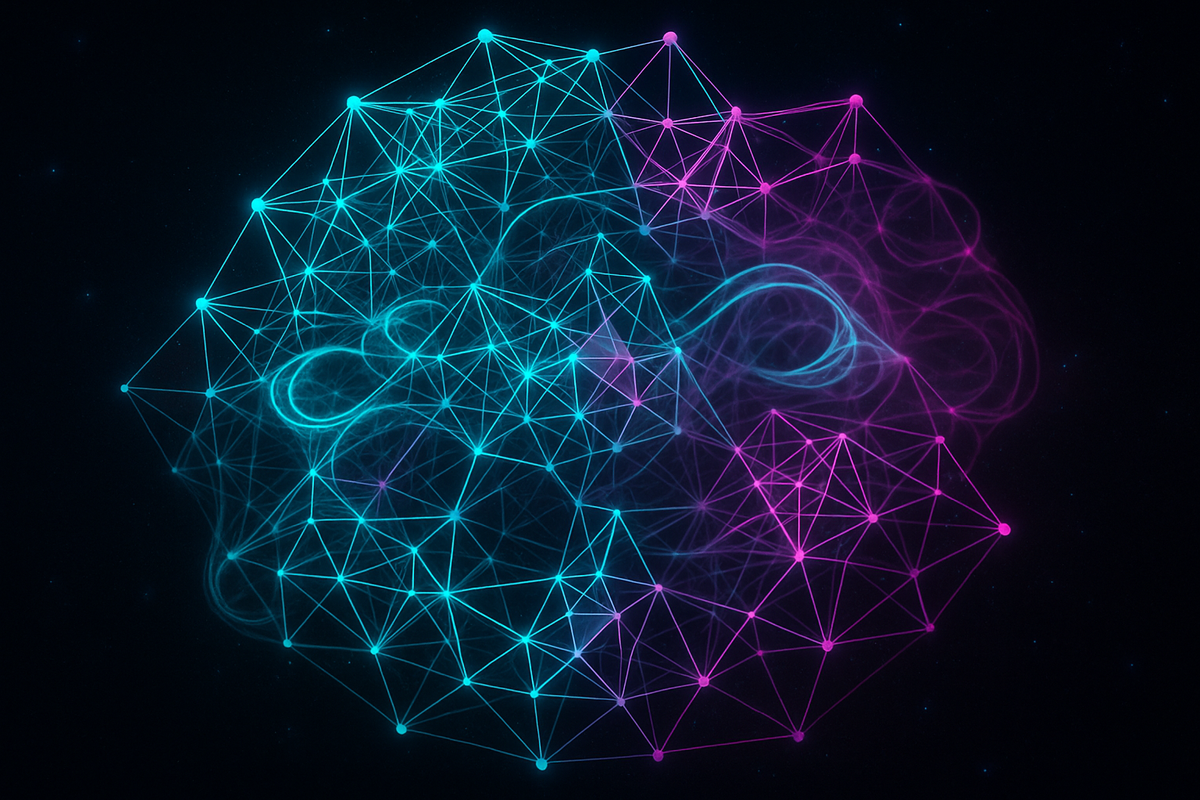
Brain Networks Through a Topological Lens
Series: Topological Data Analysis in Neuroscience | Part: 5 of 9
Your brain is not one thing. It's a network of networks—distinct regions, specialized systems, distributed coalitions that form, dissolve, and reform depending on what you're doing, thinking, or feeling.
Neuroscience has known this for decades. But how do you measure it? How do you quantify the structure of brain networks in ways that capture not just who connects to whom, but the geometry of how those connections organize into functional wholes?
Graph theory tried. It gave us measures like clustering coefficient, path length, modularity, small-world architecture. Useful metrics. But incomplete. Because graphs only see edges—pairwise connections. They miss higher-order structure: triangles, tetrahedra, the cavities and voids where information integrates across many nodes simultaneously.
Topological data analysis sees what graphs miss.
When you apply TDA to brain networks—anatomical connectomes, functional connectivity, dynamic reconfiguration—a richer picture emerges. Not just a wiring diagram. Not just correlation matrices. But geometric scaffolds: persistent structures that organize brain function across scales, across states, across individuals.
The topology reveals how networks actually work.
From Graphs to Geometry
Standard approach to brain networks: represent each brain region as a node, each connection (anatomical fiber tract or functional correlation) as an edge. Analyze with graph theory.
This tells you useful things:
Degree: how many connections a region has.
Clustering: how interconnected a region's neighbors are.
Path length: how many hops to get from one region to another.
Modules: groups of regions more connected to each other than to outsiders.
Hubs: regions with unusually high connectivity critical for integration.
But here's what graph theory can't see: three nodes that all connect to each other form a triangle—not just three separate edges, but a higher-order structure with different computational properties. The triangle enables three-way integration that pairwise connections alone can't achieve.
Four mutually connected nodes form a tetrahedron. Five nodes form a 4-simplex. And so on. These simplicial complexes have topology: they can contain holes, voids, cavities. And those topological features are invisible to graph theory because graph theory only counts edges.
TDA, as we've seen, builds simplicial complexes from your network data and extracts the topology. It sees the triangles. It sees the higher-order structures. It measures the holes.
When you do this for brain networks, extraordinary patterns emerge.
The Homological Scaffolds of Functional Connectivity
Giovanni Petri and colleagues at ISI Foundation applied persistent homology to human fMRI data. They recorded resting-state brain activity—people lying still in the scanner, not performing any task—and computed functional connectivity: which brain regions' activity correlated across time.
Standard analysis would give you a correlation matrix. Threshold it (keep only strong correlations), and you have a graph. Analyze the graph's properties, done.
Petri's team built clique complexes instead. When three regions all correlated with each other strongly, they didn't just add three edges—they filled in a triangle. Four mutually correlated regions got a tetrahedron. And so on up to whatever dimension the data supported.
Then they extracted the persistent homology: which topological features appeared at which threshold values and how long they persisted.
Result: the brain's functional connectivity has a robust homological scaffold.
Certain Betti numbers—counts of holes in each dimension—remained non-zero across a wide range of thresholds. These weren't noise. They were persistent geometric structures organizing brain function.
Different brain regions participated in different topological features:
Default mode network (DMN): high β₁—lots of 1-dimensional loops. The DMN forms geometric circuits where activity can circulate, supporting its role in self-referential thought and memory integration.
Sensory regions: simpler topology, fewer high-dimensional features. Their function is more modular, less globally integrated.
Frontoparietal control network: high-dimensional features (β₂, β₃), indicating complex integration across many regions—consistent with its role in cognitive control and task execution.
The topology matched the function. Regions that need global integration have rich high-dimensional structure. Regions that process locally have simpler geometry.
And critically: individual differences in topology predicted cognitive performance. People with more complex topological scaffolds performed better on tasks requiring integration—working memory, cognitive flexibility, fluid intelligence.
The geometry is not decorative. It's functional.
Dynamic Topology: Networks That Reshape Themselves
Brains aren't static. Functional connectivity changes—second by second, task by task, state by state. The same anatomical substrate reconfigures into different functional networks depending on what you're doing.
This is where topology really shines, because it can track dynamic reconfiguration in ways graph theory struggles with.
Ann Sizemore and colleagues at University of Pennsylvania measured how topological features evolve over time during different cognitive states. They found:
Task states have distinct topological signatures. Working memory tasks produce different Betti numbers than resting state. Attention tasks create different persistent features than imagination tasks. The brain literally changes shape—geometrically, topologically—as it switches between cognitive modes.
Transitions between states follow topological pathways. The brain doesn't jump randomly from one configuration to another. It follows smooth paths through topology-space, evolving through intermediate geometric structures. These paths are predictable—certain sequences of topological transformations recur reliably when switching between specific mental states.
Flexibility correlates with topological richness. People who can rapidly switch between tasks—high cognitive flexibility—show more diverse topological repertoires. Their brains can access a wider range of geometric configurations and transition between them more fluidly.
Pathology disrupts dynamical topology. Depression isn't just reduced Betti numbers at rest—it's reduced ability to reconfigure. The brain gets stuck in certain topological configurations and can't escape. Anxiety shows the opposite: too much instability, topological features that won't persist, geometry that can't stabilize.
This reframes mental health geometrically: healthy brain function is the capacity to navigate topology-space appropriately. Access the right geometric configuration for the task at hand. Maintain it while needed. Transition smoothly when conditions change. Pathology is either too much rigidity (can't access needed configurations) or too much chaos (can't maintain any configuration long enough to function).
Anatomical Topology: The Connectome's Hidden Structure
Functional connectivity shows correlations—which regions activate together. But what about anatomy? What's the topology of the actual physical wiring—the white matter fiber tracts that connect neurons across brain regions?
This is the structural connectome: the network of long-range anatomical connections. Measuring it requires diffusion tensor imaging (DTI) or more advanced tractography to trace fiber pathways through white matter.
Graph theory analysis of connectomes revealed small-world architecture, rich-club organization, modular structure. Important findings.
But topological analysis revealed something deeper: the structural connectome has high-dimensional cavities that predict functional topology.
Soibhan Becker and colleagues at University of Cambridge extracted persistent homology from human connectome data. They found:
High Betti numbers in anatomical structure. The wiring diagram itself—independent of activity—has loops, voids, higher-dimensional features. These aren't random. They're systematically organized.
Anatomical topology constrains functional topology. You can't have functional integration across regions unless anatomy supports it. High-dimensional functional features require underlying anatomical scaffolds with matching topology. Function flows through the geometric channels that anatomy provides.
Development builds topology progressively. Infant brains have simpler connectome topology than adult brains. As white matter matures, as myelination proceeds, as learning reshapes connectivity, the geometric structure becomes more complex. Growing up is partially a matter of building more sophisticated topology.
Individual differences in anatomical topology predict cognitive traits. Intelligence, creativity, certain personality dimensions—they correlate with specific topological features in the structural connectome. The geometry of your wiring partially determines the range of mental states you can access.
This makes sense from AToM's perspective: anatomy is the manifold that neural activity flows across. The topology of that manifold determines which activity patterns are possible, which states are stable, which transformations are accessible. You can't implement computations that require geometric structure your anatomy doesn't support.
Coherence is constrained by topology.
Cross-Frequency Coupling and Topological Hierarchy
Brain rhythms—oscillations at different frequencies (delta, theta, alpha, beta, gamma)—don't operate independently. They couple hierarchically: slow rhythms modulate faster rhythms, creating nested timescales of activity.
This cross-frequency coupling (CFC) is central to brain function. Theta rhythms organize gamma bursts. Slow-wave sleep oscillations coordinate spindles and sharp waves. Attention modulates alpha-gamma coupling.
Can topology capture this hierarchical structure?
Yes. Because different frequency bands form different functional networks, you can extract topology at each frequency and compare.
Recent work shows: cross-frequency coupling creates topological nesting. The topological structure at slower frequencies provides a scaffold for faster frequencies. High-dimensional features in delta-band connectivity organize where and when higher-frequency features appear in gamma.
This is multi-scale topological coherence. The geometry at one timescale constrains the geometry at another. Hierarchical integration through nested topology.
And when coupling fails—when the timescales don't coordinate properly—pathology emerges. Schizophrenia shows disrupted cross-frequency coupling and correspondingly disrupted topological hierarchy. The geometric scaffolds at different frequencies don't align. Information can't integrate across scales.
Again: coherence across scales requires geometric alignment across scales. TDA makes this visible.
Sex Differences and Topological Reorganization Across Life
Are male and female brains topologically different?
Controversial question, often poorly studied. But topology provides objective measures.
Answer: yes, subtle but measurable differences exist.
On average (with huge individual variation), female brains show:
- Higher local topological features (more small loops, local integration)
- Slightly different distribution of high-dimensional features across networks
- Different developmental trajectories—topology matures along slightly different paths
Male brains show:
- Higher long-range connectivity in certain networks
- Different patterns of hemispheric topology
- Different aging trajectories—topology degrades differently with age
But critically: the overlap is enormous. These are statistical tendencies, not categorical differences. Any individual might fall anywhere in the distribution. The geometry of cognition is not strictly sexed—it's individually variable along dimensions that show some population-level trends.
More interesting: topology changes dramatically across lifespan.
Childhood: Rapid topological elaboration. New features form as networks mature.
Adolescence: Pruning and reorganization. Some features collapse, others strengthen.
Adulthood: Relative stability with task-driven flexibility.
Aging: Progressive simplification. High-dimensional features decline. Persistent structures shorten their persistence.
But plasticity remains. Cognitive training can rebuild some topology. Novel experiences create new features. The geometry isn't fixed—it responds to use.
Clinical Application: Topological Biomarkers
If different disorders produce different topological disruptions, topology becomes diagnostic.
Alzheimer's disease: Progressive loss of high-dimensional features. Betti numbers decline as neurodegeneration proceeds. TDA might detect these changes before clinical symptoms—early intervention window.
Autism: Different, not deficient, topology. Local over-connectivity, different global integration patterns. Not collapsed geometry, but reorganized geometry that requires different support strategies.
ADHD: Unstable topology. Difficulty maintaining geometric configurations needed for sustained attention. Features form but don't persist. Medication might work by stabilizing topology.
Schizophrenia: Excess local features, insufficient global integration. Too much topological complexity that doesn't organize coherently. Antipsychotics might work by reducing incoherent complexity.
Depression: Flattened topology at rest, reduced dynamic range. Can't access geometric states associated with positive affect or motivation. Treatment restores topological flexibility.
These aren't just descriptions. They're measurable targets. Track Betti numbers, persistence, geometric features. Interventions that restore healthy topology should restore healthy function—regardless of symptom checklists or diagnostic categories.
This is Part 5 of the Topological Data Analysis in Neuroscience series, exploring how geometric methods reveal the hidden structure of mind.
Previous: Topological Signatures of Consciousness: What Shape Is Awareness?
Next: Learning in Topological Space: How Neural Manifolds Transform
Further Reading
- Petri, G., et al. (2014). "Homological scaffolds of brain functional networks." Journal of The Royal Society Interface, 11(101), 20140873.
- Sizemore, A. E., et al. (2018). "Cliques and cavities in the human connectome." Journal of Computational Neuroscience, 44(1), 115-145.
- Lord, L. D., et al. (2016). "Insights into brain architectures from the homological scaffolds of functional connectivity networks." Frontiers in Systems Neuroscience, 10, 85.
- Giusti, C., et al. (2016). "Two's company, three (or more) is a simplex." Journal of Computational Neuroscience, 41(1), 1-14.
- Becker, C. O., et al. (2018). "Spectral mapping of brain functional connectivity from diffusion imaging." Scientific Reports, 8(1), 1-15.
Comments ()