Changeling Folklore: The Fairy Child Who Was Never Swapped
For centuries, parents said the fairies took their child and left a changeling. A folklorist's lens on who those stories described, the harm they excused, and the eggshell trick.
Wed Oct 28 · Myth
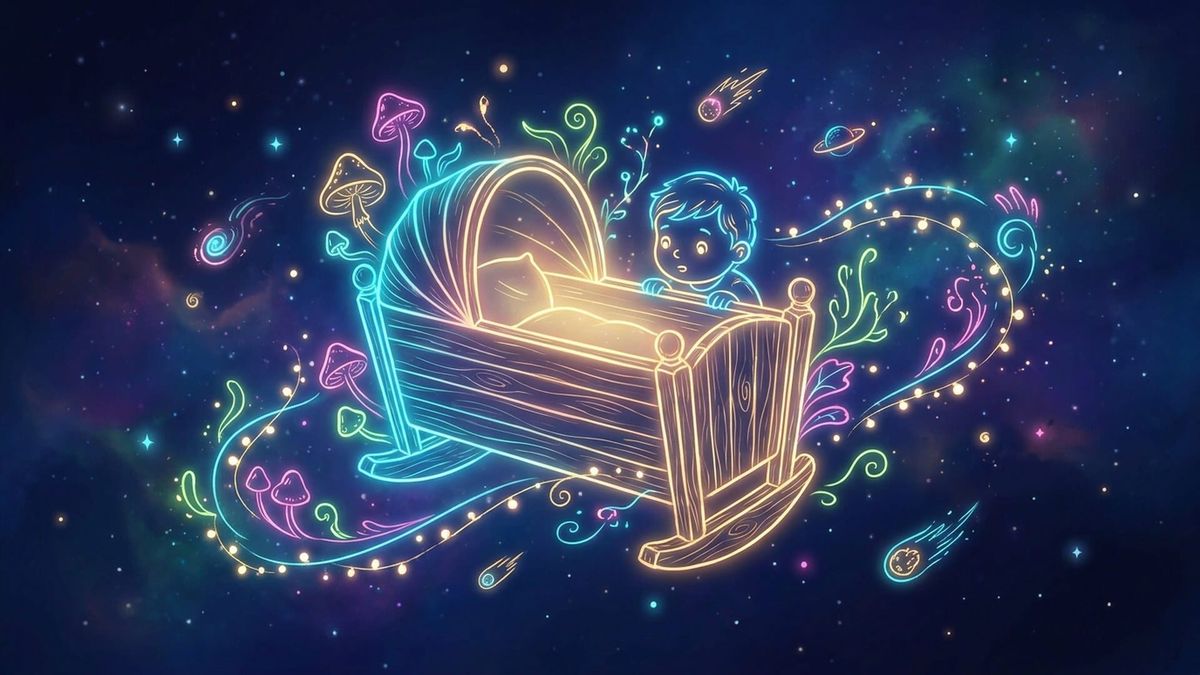
For hundreds of years, across Ireland, Scotland, Scandinavia and Germany, people told a story about children. [5] A baby goes to sleep in the cradle one night. In the morning it looks the same, but something is off. It doesn't feed right. It cries in a strange way. It won't meet your eye. The neighbors nod. The fairies took your child, they say, and left one of theirs.
The one they left was called a changeling.
What a changeling was supposed to be
The details shift from place to place, but the shape stays the same. It might be a fairy child, an old fairy disguised as a baby, or a carved piece of wood made to look alive. [6] It was often described as hungry, fussy, sickly, oddly wise, or uninterested in people. [5]
Some stories include a test for spotting one. The best known, which the Brothers Grimm collected in their household tales, is the eggshell trick [4]: brew something in an eggshell in front of the child. A real baby wouldn't care. The impostor, centuries old under the disguise, can't help itself. It sits up and says it has seen many ages of the world but never brewing in an eggshell. Then it's gone, and the real child is back.
It's a lovely, eerie image: a creature hiding in a baby, given away by its own curiosity.
Who the stories were really about
In 1988 the folklorist Susan Schoon Eberly published a paper in the journal Folklore called "Fairies and the Folklore of Disability." [1] Her argument was that many changeling descriptions match real children with real conditions: babies who failed to thrive, children with congenital differences, and children whose development took a path their parents didn't expect. [1]
Read the old descriptions with that in mind and a lot of them click. The child who seems far away. The one who won't be held the "right" way. The one who seems to know things. Folklore gave parents a way to say this is not the child I expected in the only language they had.
That doesn't mean every changeling story was about one diagnosis. It means the stories were holding a question people didn't have words for yet.
The dark side, briefly
We can't tell this story honestly and skip the cost. Belief in changelings sometimes justified real harm. Martin Luther's Table Talk, conversations written down by his students, has him advising that a twelve-year-old "changeling" in Dessau be suffocated, though historians point out the account is secondhand and was expanded in later retellings into advice to drown him. [2] In Ireland in 1895, Bridget Cleary was killed by her husband, who claimed she had been replaced by a fairy. [3] Her case is still one of the most studied in Irish folklore. [3]
Folk belief is powerful. It can comfort people, and it can be used to hurt them.
Why the changeling still feels familiar
Here's the strange part. Plenty of neurodivergent people describe feeling like a changeling without ever having read the folklore. The sense of being dropped into the wrong family's cradle. Of being a visitor who learned the local customs by watching. Of wearing a disguise so well that everyone forgets it's a disguise.
Read the old stories from the changeling's side and they turn into something else. A visitor from another world, sharper and older than they look, waiting for the moment someone does something interesting enough to make them drop the act.
The eggshell story is the best example. The changeling isn't caught by cruelty. It's caught by wonder. Someone does something so odd and delightful that the creature forgets to pretend and just says what it sees.
If you've ever lost your cover because someone mentioned the one thing you love, you know exactly how that feels.
The fairy child who was never swapped
There's a reason the title of this piece says never swapped. The child in the cradle was always the child. There was no fairy exchange, no stolen baby somewhere under a hill. There was a kid who was different from what the village expected, and a story built to explain it.
The fairies didn't take anyone. But they left us a pretty good metaphor: a mind that looks ordinary from the outside, is ancient and curious on the inside, and gives itself away the moment the world gets interesting.
Sources
- Eberly, S. S. (1988). "Fairies and the Folklore of Disability: Changelings, Hybrids and the Solitary Fairy." Folklore 99(1), 58–77. https://doi.org/10.1080/0015587x.1988.9716425
- Miles, M. (2005). "Martin Luther and Childhood Disability in 16th Century Germany: What did he write? What did he say?" Independent Living Institute. https://www.independentliving.org/docs7/miles2005b.html
- Bourke, A. (1999). The Burning of Bridget Cleary: A True Story. Pimlico. https://www.penguin.co.uk/books/367543/the-burning-of-bridget-cleary-by-bourke-angela/9781844139347
- Grimm, J. & W. Kinder- und Hausmärchen, no. 39, "The Elves," third tale. English text: https://www.pitt.edu/~dash/grimm039.html
- Ashliman, D. L. (1997). "Changelings: An Essay." University of Pittsburgh Folklore and Mythology Electronic Texts. https://sites.pitt.edu/~dash/changeling.html
- Hartland, E. S. (1891). The Science of Fairy Tales, chapter V, "Changelings." https://sacred-texts.com/book/the-science-of-fairy-tales/chapter-v-changelings
Comments ()