Graph RAG Meets Active Inference: Knowledge as Generative Model
When you treat a knowledge graph as a generative model rather than a lookup table, something interesting happens: Graph RAG starts to look a lot like active inference. This piece unpacks the convergence.
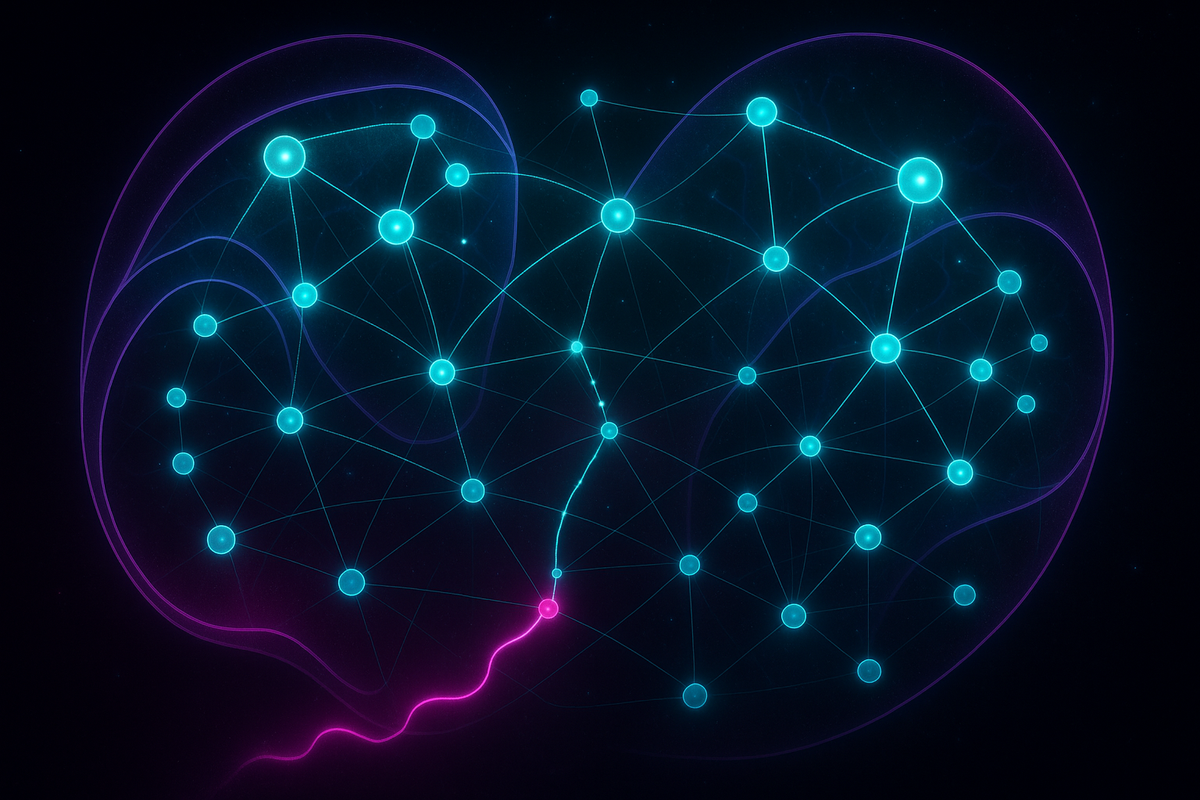
Graph RAG Meets Active Inference: Knowledge as Generative Model
Series: Graph RAG | Part: 9 of 10
Knowledge graphs aren't just databases. They're generative models.
Not in the LLM sense—they don't generate text from learned patterns. In the active inference sense: they provide a structured prior over the state-space of possible answers. They constrain what's possible and guide search through what's plausible.
This connection between Graph RAG and the Free Energy Principle isn't metaphor. It's mechanism.
Active inference agents maintain generative models of their environment: probabilistic beliefs about how the world is structured and how it evolves. They minimize free energy by updating those beliefs when they encounter prediction error and acting to confirm their predictions.
Knowledge graphs serve the same function for AI retrieval agents. The graph is the agent's model of the semantic world. Queries generate prediction errors ("What do I need to know?"). Retrieval updates beliefs. Answer generation confirms predictions.
Understanding this equivalence illuminates why Graph RAG works—and points toward how to make it better.
Generative Models and State-Space Constraints
In active inference, a generative model is a probabilistic description of how observations are generated from hidden states.
For a biological agent, the model might specify:
- Hidden state: "There's food nearby"
- Observations: Visual features, olfactory cues
- Likelihood: P(observations | hidden state)
The agent inverts this model—inferring hidden states from observations—by minimizing the difference between predicted and actual sensory input.
For a Graph RAG agent, the model specifies:
- Hidden state: "The answer to the query exists in this subgraph"
- Observations: Retrieved entities, relationships, text chunks
- Likelihood: P(observations | query intent)
The graph structure is the prior distribution over hidden states. It says: "Entities connected by these relationship types are more likely to be relevant than unconnected entities."
This is why graphs improve retrieval. They provide structured priors that reduce the search space. Instead of considering all possible text chunks as equally plausible, the graph constrains search to semantically structured neighborhoods.
Queries as Prediction Errors
A user query is a prediction error signal.
The agent's current belief state is: "I know what knowledge exists in my corpus." The query challenges that belief: "I need to know X, and I don't have it readily accessible."
In active inference terms:
Free energy = Surprise + Complexity

Surprise: How unexpected is this query given my current model?
Complexity: How much must I update my beliefs to answer it?
A query like "What is the capital of France?" has low surprise (common query, simple answer) and low complexity (single-hop lookup).
A query like "Which services would fail if we removed authentication, and what cascading effects would those failures cause?" has high surprise (complex, multi-hop) and high complexity (requires extensive model traversal).
Graph RAG minimizes free energy by:
- Reducing surprise: The graph makes complex queries tractable by providing structured paths
- Reducing complexity: Community detection and indexing precompute likely query patterns
The better your generative model (graph structure, community partitions, indexed paths), the lower the free energy cost of answering queries.
Graph Structure as Prior Distribution
The topology of the knowledge graph encodes prior beliefs about semantic structure.
Edge types specify relationship priors:
- DEPENDS_ON edges encode belief: "If A depends on B, then changes to B affect A"
- CAUSED_BY edges encode belief: "If X caused Y, then explaining Y requires referencing X"
- IS_A edges encode belief: "Instances inherit properties of their categories"
Graph connectivity encodes relevance priors:
- High-degree nodes (many edges) are central to the domain
- Tightly connected clusters form coherent topics
- Long paths between entities suggest weak semantic relationship
Community structure encodes hierarchical priors:
- Entities in the same community share context
- Queries are local—most information needs are within-community
- Cross-community queries require bridging concepts
These priors are learned from data (via extraction) and structure (via community detection). They're not hand-coded—they emerge from the corpus.
This is analogous to how the brain's generative model is learned through experience. The graph "expects" certain relationships because it's extracted them repeatedly from data.
Multi-Hop Reasoning as Belief Propagation
Active inference agents perform belief propagation: updating beliefs about hidden states by integrating evidence along paths through a factor graph.
Graph RAG does the same during multi-hop queries.
Example: "Who collaborated with Nobel Prize winners?"
Factor graph representation:
Query node → [COLLABORATES] → Person_X → [WON] → Nobel_Prize
Belief propagation:
- Start with prior: "I don't know who Person_X is"
- Observe: "Person_X is connected to Nobel Prize by WON edge"
- Update: "Person_X is a Nobel Prize winner"
- Propagate: "Anyone connected to Person_X by COLLABORATES is a collaborator of a winner"
- Return: All entities satisfying the propagated belief
Each hop is a belief update. Each relationship type constrains the update rule. The final answer is the marginal probability distribution over entities that satisfy the query constraints.
Modern graph databases implement this as traversal optimization, but the underlying computation is belief propagation.
Hybrid Retrieval as Precision Weighting
In active inference, precision weighting determines how much each sensory channel influences belief updates.
High precision: Trust this sense (update beliefs strongly based on its input)
Low precision: Distrust this sense (discount its input, rely on priors)
Hybrid retrieval uses the same principle.
Vector similarity provides one source of evidence:
- "These entities are semantically similar to the query"
- Precision: Moderate (embeddings capture semantics but lack structure)
Graph traversal provides another source:
- "These entities are structurally connected to the query entities"
- Precision: High (relationships are explicit and verified)
The fusion score weights these sources:
score = α × vector_similarity + (1-α) × graph_relevance

where α controls precision weighting
When α is high, you trust semantic similarity more (useful for exploratory queries).
When α is low, you trust graph structure more (useful for dependency queries).
Precision weighting should adapt based on query type. Active inference agents adjust precision dynamically based on context. Graph RAG systems should do the same—learning which evidence sources are most reliable for different query patterns.
Community Detection as Markov Blanket Partitioning
In the Free Energy Principle, systems are defined by their Markov blankets—statistical boundaries that separate internal states from external states.
A Markov blanket defines what's "inside" vs "outside" a system. For an organism, the blanket is the sensory and motor interface. For a cell, it's the membrane.
For a knowledge graph, community boundaries are Markov blankets.
A community is a dense subgraph where:
- Internal states: Entities within the community
- Blanket states: Bridge entities connecting to other communities
- External states: Entities outside the community
Most queries can be answered within a community without crossing the blanket. This is the locality assumption that makes Graph RAG efficient.
Community detection algorithms (Leiden, Louvain) are effectively finding Markov blanket partitions—natural boundaries where internal coherence is high and external coupling is low.
This is why hierarchical community structure works. It mirrors the nested Markov blankets of complex systems. Your codebase has blankets at:
- Function level (local dependencies)
- Module level (subsystem boundaries)
- Service level (architectural partitions)
Graph RAG exploits this structure by querying at the appropriate level—local for detailed questions, global for architectural questions.
Answer Generation as Active Inference
The final step in Graph RAG—LLM-based answer synthesis—is active inference in action.
The LLM receives:
- Query (prediction error signal)
- Retrieved subgraph (structured beliefs)
- Text chunks (unstructured observations)
It generates an answer by:
- Inferring hidden intent behind the query
- Integrating structured (graph) and unstructured (text) evidence
- Producing a response that minimizes prediction error (satisfies the query)
This is Bayesian inference: updating beliefs about what the user wants to know, given the evidence.
The graph constrains the hypothesis space. Without structure, the LLM considers all possible answers (high free energy). With graph structure, it only considers answers consistent with the retrieved subgraph (low free energy).
This is why Graph RAG reduces hallucination. Hallucination is high free energy—generating answers unconstrained by evidence. The graph acts as a strong prior, preventing the model from drifting into implausible state-space regions.
Implications for System Design
Viewing Graph RAG through active inference suggests improvements:
1. Adaptive Precision Weighting
Instead of fixed α for vector/graph fusion, learn per-query-type weights:
For dependency queries: α = 0.2 (trust graph structure)
For exploratory queries: α = 0.7 (trust semantic similarity)
For entity-centric queries: α = 0.5 (balanced)
Train a classifier on query logs to predict optimal α.
2. Uncertainty Quantification
Active inference tracks uncertainty about beliefs. Graph RAG should too:
Answer: "Service X depends on Auth"
Confidence: 0.92
Uncertainty sources:
  - Entity linking confidence: 0.85
  - Relationship extraction confidence: 0.95
  - Graph traversal confidence: 1.0
Surface uncertainty to users. "I'm 85% confident this is the right Service X."
3. Hierarchical Query Planning
Use hierarchical communities to plan queries:
1. Identify query scope (local/regional/global)
2. Route to appropriate community level
3. Traverse at that level only
4. Minimize cross-blanket queries
This mirrors how biological agents plan action hierarchies—deciding the appropriate level of abstraction before acting.
4. Predictive Caching
Active inference agents predict future states. Graph RAG can predict future queries:
Given: User queried "What is Service X?"
Predict: Next query likely about X's dependencies or configuration
Prefetch: Subgraph around X, common follow-up paths
This reduces latency for predictable query sequences.
The Deeper Connection
Graph RAG isn't just retrieval infrastructure. It's a concrete implementation of active inference principles for knowledge systems.
The graph is a generative model. Queries are prediction errors. Retrieval is belief updating. Answer generation is active inference.
This isn't metaphor—it's the same mathematical framework. Graph traversal is belief propagation. Community detection finds Markov blankets. Hybrid retrieval is precision weighting.
Understanding this equivalence does more than provide conceptual clarity. It suggests concrete improvements: adaptive weighting, uncertainty quantification, hierarchical planning, predictive caching.
The lesson: When you build Graph RAG systems, you're not just engineering better search. You're building agents that minimize free energy over knowledge space. And the principles that govern biological and artificial intelligence—coherence, structure, inference—apply equally here.
Further Reading
- Friston, K. et al. (2017). "Active Inference: A Process Theory." Neural Computation.
- Parr, T. & Friston, K. (2019). "Generalised Free Energy and Active Inference." Biological Cybernetics.
- Ramstead, M. et al. (2022). "On Bayesian Mechanics: A Physics of and by Beliefs." Interface Focus.
This is Part 9 of the Graph RAG series, exploring how knowledge graphs solve the limitations of naive vector retrieval.
Previous: Graph RAG at Scale: Production Engineering Challenges
Next: Synthesis: What Graph RAG Teaches About Structured Coherence
Comments ()