How to Grow a Brain: The Science of Cerebral Organoids
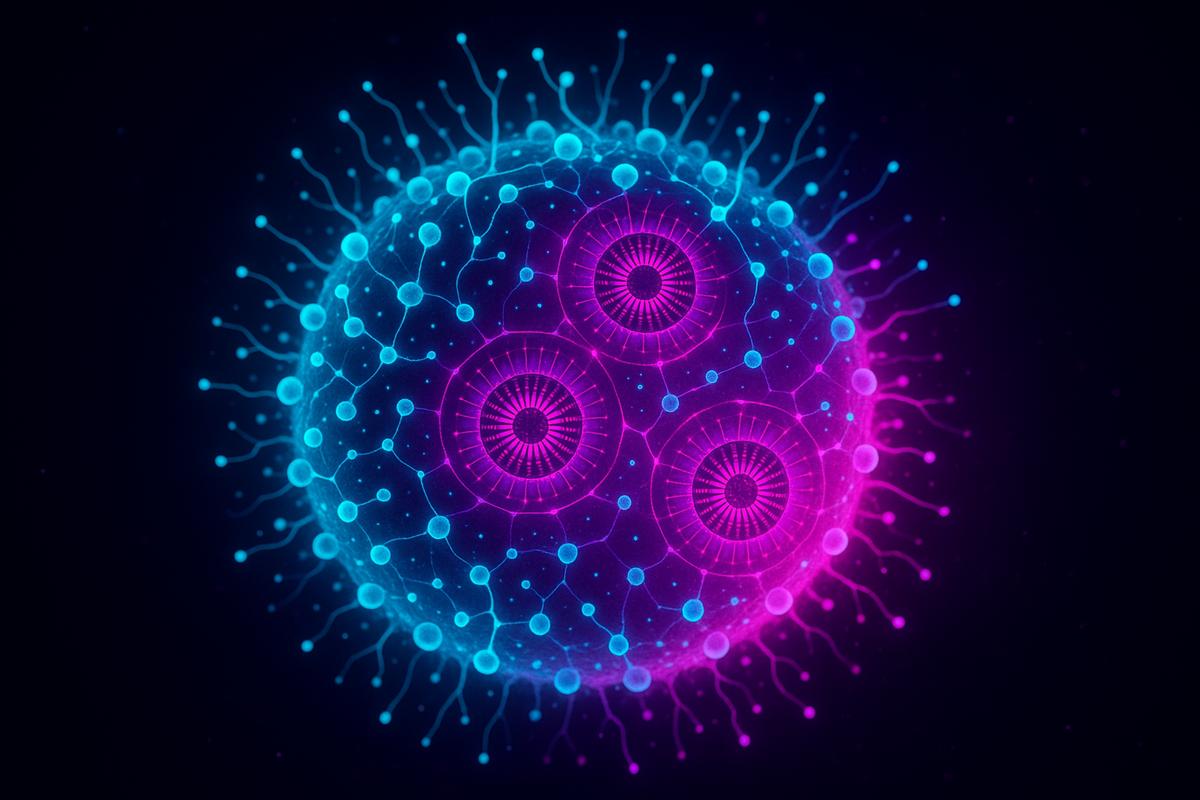
Series: Organoid Intelligence | Part: 2 of 10
The recipe sounds almost absurdly simple. Take human stem cells. Put them in the right chemical bath. Wait. Within weeks, those cells will organize themselves into something that looks like a miniature brain—complete with neurons, glia, even rudimentary structures resembling cortical layers. No blueprint. No instruction manual. Just cells finding their way to neural destiny through an ancient choreography written in their molecular machinery.
This is cerebral organoid development. And the fact that it works at all forces us to confront what’s arguably the deepest question in developmental biology: how does structure emerge from cells that contain no master plan for building it?
The answer isn’t just interesting biology. It’s a window into how coherence—organized, functional complexity—bootstraps itself into existence. And it suggests that what we call “intelligence” might be less a feature installed in brains and more a property that tissue expresses when conditions allow.
The Pluripotent Starting Point
Every cerebral organoid begins as a cluster of induced pluripotent stem cells (iPSCs)—adult cells chemically rewound to an embryonic-like state where they retain the capacity to become virtually any cell type. The 2012 Nobel Prize went to Shinya Yamanaka for figuring out this trick: introduce four specific transcription factors (now called “Yamanaka factors”) into ordinary skin cells, and you can reprogram them into pluripotency.
What makes these cells “pluripotent” isn’t magic. It’s a specific configuration of chromatin—the structural packaging of DNA—that leaves large swaths of the genome accessible for transcription. The cell hasn’t forgotten how to be liver or heart or neuron. It’s in a state where any of those trajectories remain possible, waiting for the right signals to collapse the possibilities into one developmental path.
This is coherence at the molecular level—a high-entropy state maintained by active suppression of commitment. Pluripotent cells are dynamically preventing themselves from settling into any single identity. They’re poised.
The key insight: this poise isn’t chaos. It’s structured indeterminacy. The cell maintains pluripotency through coordinated gene networks that mutually inhibit differentiation programs. Think of it as balanced tension across multiple possible futures, none yet realized.
The Self-Organization Protocol
To coax these cells toward neural fate, researchers don’t build a brain. They remove inhibitions.
Madeline Lancaster at the MRC Laboratory of Molecular Biology pioneered the current organoid protocol in 2013. The core method is almost Taoist in its minimalism: withdraw signals that tell cells not to become neurons, and neurons are what emerge. This is called default neuralization—the observation that without external signals pushing them elsewhere, pluripotent cells preferentially differentiate into neural ectoderm.
The protocol has three basic phases:
Phase 1: Aggregation (Days 0-6)
Dissociated iPSCs are placed in suspension culture where they spontaneously aggregate into three-dimensional structures called embryoid bodies. No scaffold. No external architecture. Just thousands of cells finding each other through adhesion molecules and forming a sphere.
Within days, cells at the surface begin expressing neural markers. They’re forming a primitive neural epithelium—the same structure that would become the neural tube in an embryo. The geometry matters: cells at the boundary between the aggregate and culture medium experience different chemical gradients than cells in the core, and this spatial heterogeneity kickstarts differentiation.
Phase 2: Neural Induction (Days 6-12)
Transfer the embryoid bodies to neural induction medium—a chemical bath that typically includes dual SMAD inhibition (blocking BMP and TGF-beta signaling). These pathways normally push cells toward mesoderm and endoderm fates. Remove them, and the default is neural ectoderm.
At this stage, you start seeing organized structures: neuroepithelial rosettes, which are circular arrangements of neural progenitors that resemble the ventricular zone of the developing brain. Cells are polarized with their nuclei arranged radially, dividing asymmetrically to produce both more progenitors and differentiating neurons.
The rosettes aren’t imposed by the experimenters. They self-organize through local interactions—cells secreting signals, responding to neighbors, establishing polarity axes. This is emergence in the technical sense: structure at one scale (tissue architecture) arising from interactions at another (cell-cell signaling).
Phase 3: Maturation (Days 12-Months)
Embed the neural aggregates in Matrigel—a gel extracted from mouse sarcoma cells that mimics extracellular matrix—and transfer to spinning bioreactors. The rotation keeps organoids suspended, preventing them from adhering to the culture dish and allowing nutrients to perfuse the tissue.
Now the really remarkable part begins. Over weeks to months, distinct brain regions begin to emerge. Cortical layers form. You see excitatory neurons, inhibitory interneurons, astrocytes, oligodendrocytes. Synapses connect neurons into networks. Electrical activity appears—first sporadic, then increasingly coordinated.
Researchers have documented dorsal forebrain structures, ventral telencephalon, even rudimentary hippocampus and choroid plexus. The organoids are generating regionalized identity without anyone specifying where these regions should go.
The Information Problem: Who’s Directing This?
Here’s the conceptual vertigo: there’s no conductor. No central command issuing instructions about which cell becomes what or where different brain regions should form. The stem cells don’t contain a blueprint for “cerebral organoid.” They contain regulatory networks—transcription factors, signaling pathways, epigenetic modifications—that respond to local conditions.
Michael Levin, whose work on basal cognition reframes cellular behavior as a form of distributed problem-solving, would call this morphogenetic intelligence. Cells are solving the problem “what should we become?” through collective computation. They’re measuring chemical gradients, mechanical forces, electrical potentials, and using those measurements to update their own gene expression, which changes what signals they send to neighbors, which updates the environment other cells are measuring.
It’s a feedback loop that extends across scales: - Molecular: transcription factor binding updates gene expression - Cellular: gene expression changes what signals cells send and receive - Tissue: collective signaling establishes gradients and boundaries - Structural: tissue architecture creates new mechanical and chemical contexts
This is active inference playing out in development. Each cell is minimizing prediction error about what it should become given its local environment. But that environment is itself constituted by other cells doing the same thing. So what emerges is a collective inference about developmental trajectory—not planned, but converged upon.
The mathematics here maps cleanly to variational free energy minimization. Cells maintain viable states (stay alive, differentiate appropriately) by reducing surprise (discrepancies between expected and actual signals). The developmental trajectory that unfolds is the one that minimizes collective free energy across the entire aggregate.
The Limits of Self-Organization
Cerebral organoids don’t develop into normal brains. They can’t. Absent vascularization—blood vessels providing nutrients and oxygen—cells in the organoid core die once the structure exceeds about 4 millimeters. You get a necrotic center surrounded by a shell of viable tissue.
Researchers have tried multiple workarounds: - Vascularization: Transplanting organoids into mouse brain or co-culturing with endothelial cells to induce blood vessel formation - Microfluidics: Growing organoids in chips with perfusion channels that mimic capillary networks - Slicing: Keeping organoids thin enough that nutrients diffuse throughout
Each approach works partially. Transplanted organoids can integrate host vasculature and grow larger. But they also raise ethical complexity: you’re now putting human neural tissue into another animal’s brain.
The deeper limitation is architectural. Normal brains develop in conversation with bodies. Sensory input patterns neural growth. Motor outputs shape circuit refinement. The organoid has no eyes, no ears, no limbs. It’s a brain without a world—developing in vitro according to intrinsic programs but lacking the extrinsic structure that typically guides regionalization and functional differentiation.
This connects to 4E cognition—the framework arguing that minds are embodied, embedded, enacted, and extended. If cognition is fundamentally about organism-environment coupling, then a brain-in-a-dish is developing in a context so impoverished that we shouldn’t expect normal cognitive architecture to emerge.
Yet it develops something. Neurons fire. Networks exhibit spontaneous activity patterns that transition between states. When researchers from Cortical Labs connected organoids to simulated environments (the DishBrain experiments we’ll explore later in this series), the tissue learned to play Pong.
So even in radical isolation, even without body or world, neural tissue exhibits plasticity, adaptation, learning. The hardware for intelligence seems disturbingly robust to context.
Reproducibility, Variability, and the Futility of Control
One of the persistent frustrations in organoid research is variability. Grow a hundred organoids from the same cell line using identical protocols, and you’ll get a hundred slightly different outcomes. Some develop robust cortical layering. Others remain disorganized. Size varies. Cell type composition varies. Gene expression profiles cluster into similar-but-not-identical patterns.
Part of this is technical noise—slight differences in media composition, temperature fluctuations, subtle variations in handling. But part is intrinsic to the system. Development is not deterministic in the clockwork sense. It’s probabilistic. Cells make decisions through stochastic gene expression—individual molecules randomly binding to promoters, kicking off cascades that amplify into divergent outcomes.
This has driven efforts toward guided organoid protocols—introducing morphogen gradients, patterning factors, specific timing of signal exposure to nudge development in reproducible directions. You can generate “dorsal forebrain organoids” or “ventral forebrain organoids” by modulating WNT, BMP, or SHH signaling at specific developmental windows.
The tradeoff: more control means less self-organization. You’re imposing structure rather than letting it emerge. The resulting organoids may be more reproducible but potentially less reflective of how development actually unfolds in vivo.
There’s a philosophical tension here that recurs throughout biology: Do we want to control the system or understand it? Control requires simplification, reduction of variables, imposition of external structure. Understanding requires watching what the system does when left to its own devices—messier, more variable, but potentially revealing principles that deterministic protocols mask.
From Mechanism to Meaning
Cerebral organoid development is not metaphor for how coherence emerges. It’s a literal instance. You start with high-entropy, high-potential cells in a relatively unconstrained state. Through local interactions and feedback across scales, the system settles into structured, differentiated states where cells have specialized identities and organized relationships.
In AToM terms, this is coherence increasing as tension resolves. The pluripotent state is high tension—many possible futures, none actualized. Differentiation reduces tension by collapsing possibilities. But the way it collapses isn’t random. It’s path-dependent, history-sensitive, geometrically constrained. The developmental trajectory follows attractors in a high-dimensional state space defined by gene regulatory networks, signaling dynamics, and mechanical forces.
The fact that this produces functional neural tissue—neurons that fire, circuits that compute—suggests something profound: intelligence isn’t installed; it’s expressed under conditions that allow coherent dynamics. The organoid doesn’t need to be taught how to be a brain. The cells already “know”—encoded in their regulatory networks and ancestral evolutionary history—how to self-organize into structures capable of information processing.
This reframes the question of organoid intelligence. We shouldn’t be asking “Can we make organoids intelligent?” We should be asking: “Under what conditions does the intelligence latent in neural tissue actualize into something we’d recognize as cognition?”
Because if neurons in a dish can learn Pong, what are they doing when given richer environments? What could they become with vascularization, sensory input, motor output? How much of “being a brain” is intrinsic to neural dynamics versus contingent on embodied context?
Those are questions for later in this series. For now, the takeaway is simpler but perhaps more unsettling: growing a brain turns out to be mostly about creating conditions where cells can do what they already want to do. The intelligence was always there, waiting for permission to emerge.
This is Part 2 of the Organoid Intelligence series, exploring the frontier of biological computing.
Previous: Brains in a Dish: The Promise and Peril of Organoid Intelligence Next: The Energy Equation: Why Wetware Beats Silicon
Further Reading
- Lancaster, M. A., et al. (2013). “Cerebral organoids model human brain development and microcephaly.” Nature, 501(7467), 373-379.
- Yamanaka, S. (2020). “Pluripotent Stem Cell-Based Cell Therapy—Promise and Challenges.” Cell Stem Cell, 27(4), 523-531.
- Velasco, S., et al. (2019). “Individual brain organoids reproducibly form cell diversity of the human cerebral cortex.” Nature, 570(7762), 523-527.
- Qian, X., et al. (2019). “Brain-Region-Specific Organoids Using Mini-bioreactors for Modeling ZIKV Exposure.” Cell, 165(5), 1238-1254.
- Levin, M. (2021). “The Computational Boundary of a ‘Self’: Developmental Bioelectricity Drives Multicellularity and Scale-Free Cognition.” Frontiers in Psychology, 10, 2688.
Comments ()