Organoid Intelligence
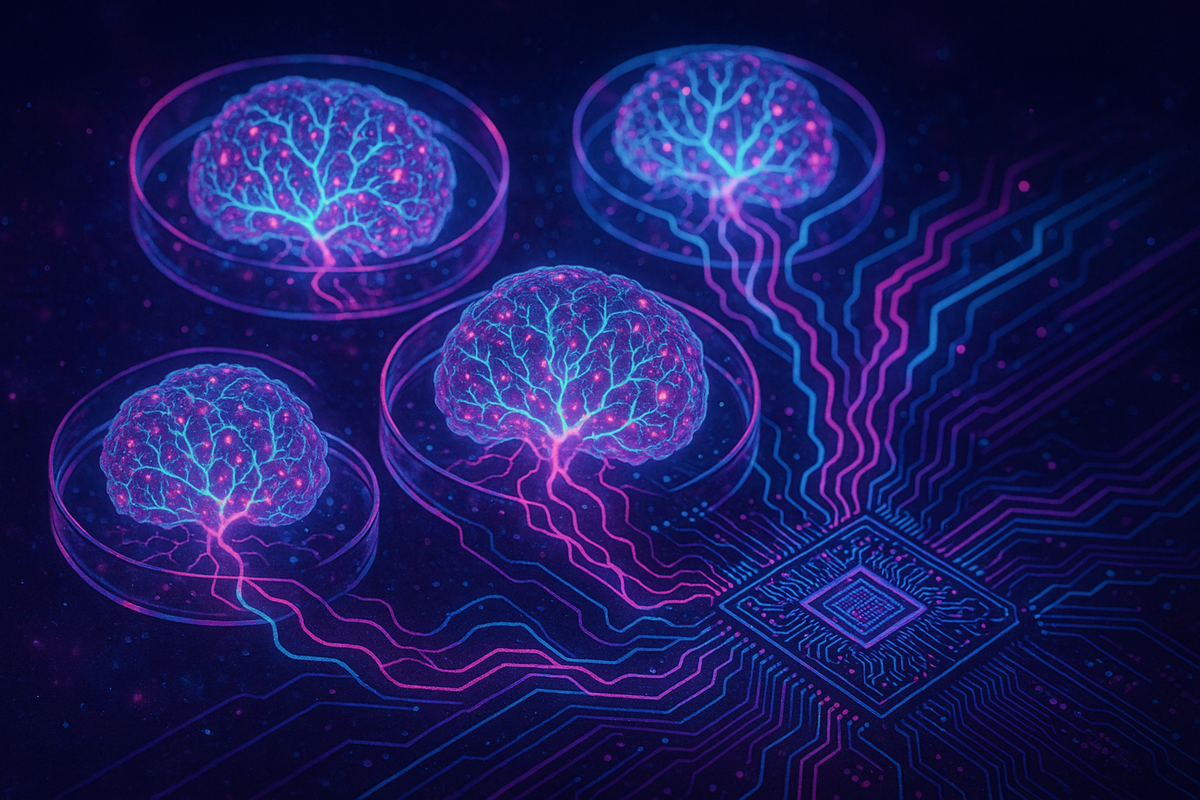
What if the most powerful computer you could build wasn’t made of silicon, but of neurons?
Brain organoids—miniature self-organizing neural tissue grown from stem cells—are already being trained to play Pong, control robots, and recognize patterns. They’re not conscious (probably), but they are computational. And they’re orders of magnitude more energy-efficient than any artificial neural network we’ve built.
This isn’t science fiction. It’s the emerging field of organoid intelligence: using biological neural tissue as a computational substrate. The hardware of the future might not be chips at all. It might be wetware.
Why This Matters for Coherence
Biological systems achieve coherent computation through mechanisms we still barely understand. Growing neural tissue and teaching it to compute gives us unprecedented access to how coherence maintenance actually works in biological substrates—how networks learn, self-organize, maintain stability, and generalize.
Organoid intelligence isn’t just about building better computers. It’s about understanding what coherence looks like when implemented in the same substrate that gave rise to minds in the first place.
What This Series Covers
This series explores organoid intelligence and its implications for understanding biological computation, consciousness, and the future of AI. We’ll examine:
- The biology of growing brain tissue in dishes
- Why wetware beats silicon on energy efficiency
- How to teach organoids and interface with neural tissue
- Current research from Cortical Labs and other pioneers
- Ethical frameworks for working with potentially conscious tissue
- Connections between organoids and active inference
- What organoid research reveals about biological coherence
By the end of this series, you’ll understand why the question “What should we build AI out of?” might have a biological answer—and why that answer raises profound questions about consciousness, ethics, and the nature of computation.
Articles in This Series
- Brains in a Dish: The Promise and Peril of Organoid Intelligence
- How to Grow a Brain: The Science of Cerebral Organoids
- The Energy Equation: Why Wetware Beats Silicon
- Teaching Organoids: How Brain Tissue Learns
- The Interface Problem: Connecting Wetware to Hardware
- DishBrain and Beyond: Current State of the Field
- The Ethics of Organoid Intelligence: When Does Tissue Become Someone?
- Organoids Meet Active Inference: Biological Free Energy Minimizers
- Synthesis: What Organoid Intelligence Teaches About Biological Coherence
Part of the FRONTIER SCIENCE collection. For more on biological computation, see Basal Cognition and Neuromorphic Computing.
Comments ()