Indigenous Ways of Knowing: Knowledge Held in Land, Story and Relationship
Aboriginal stories remembered drowned coastlines for thousands of years. How Indigenous ways of knowing store knowledge in land, story and relationship, and the honest arguments around it.
Tue Nov 10 · Human Meaning
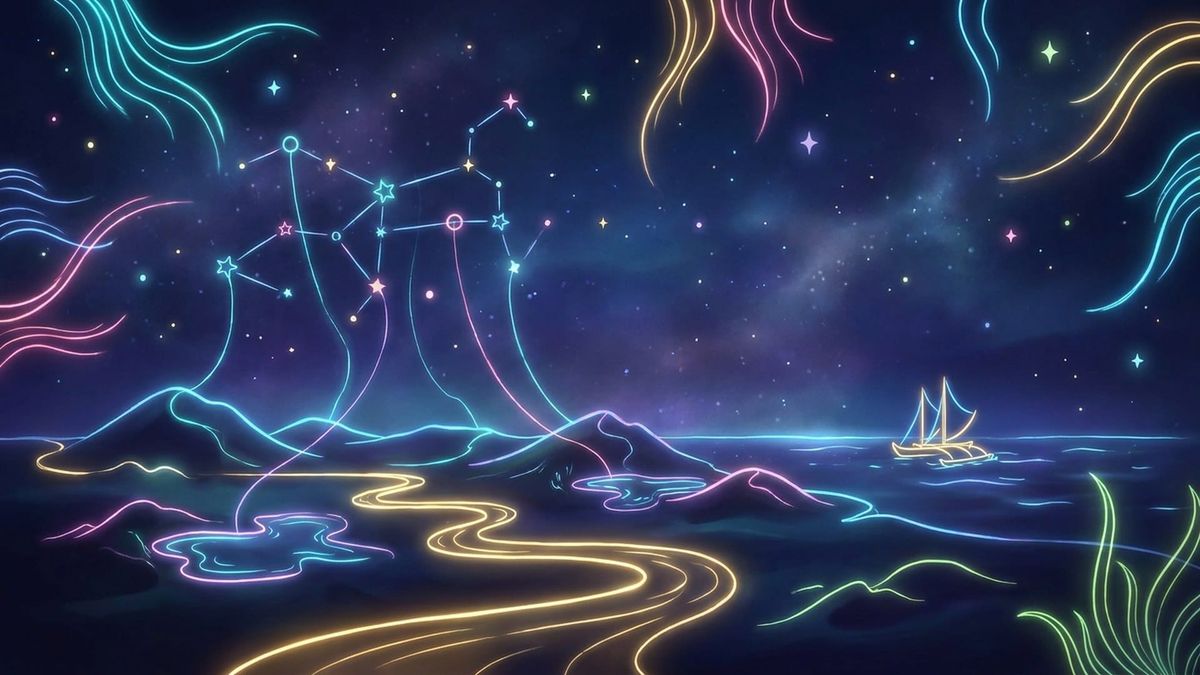
Along the coast of Australia, Aboriginal stories describe land that drowned, and a 2016 study estimated that the events they describe go back 7,250 to 13,070 years. [1]
Indigenous ways of knowing are the practices, understandings and philosophies that peoples with long histories on a particular land have built through living in relationship with it. They are carried in story, song, language and place rather than only in books. UNESCO's programme on the subject says the knowledge is "specific to the holders of the knowledge" and bound up with language, classification, mythology and ritual. [2]
Sit with the sea-level part for a second.
How can a story remember a flood?
In 2016 Patrick Nunn and Nicholas Reid collected Aboriginal stories from 21 coastal locations that describe the sea breaking in over former land. They worked out how deep the water would need to be for each story's details to be true, compared that with Australia's sea-level record, and concluded the stories appear to have endured for 7,250 to 13,070 years. [1] At Port Phillip Bay, for example, groups tell of the sea covering what was once a kangaroo hunting ground. [3]
The honest complication: many scholars hold that oral traditions survive intact for no more than about 800 years. Historian David Henige told Science News that such a claim "can neither be verified nor falsified," and archaeologist Peter Hiscock called the paper "fantastical and not believable." [3] This is a live argument, not a settled result. What is not in dispute is that the stories were collected from real coastlines, and that sea level really did rise by then. [3]
Where is the knowledge kept?
If a story is going to last that long, it needs a hard drive. Lynne Kelly, in her 2016 book The Memory Code, argues the drive is the land itself. Australian songlines, she proposes, work like the ancient Greek method of loci, the "memory palace": a sequence of places acts as a set of subheadings, and the knowledge for each one is stored in song, story and dance. [4] Modern memory competitors use the same trick, picturing a familiar place and hanging facts on it. [4]
The stars are part of the system, too. Aboriginal Law Man Ghillar Michael Anderson explains that the Euahlayi memorised star maps at night, with each star tied to a landscape feature such as a waterhole, then sang the matching song as they travelled across country by day. [5] The sky is a mnemonic. The land is a book. You read it by walking.
What does it look like in practice?
In 1976 the double-hulled canoe Hōkūleʻa sailed from Hawaiʻi to Tahiti without instruments or other aids. [6] The navigator, Mau Piailug of Satawal in Micronesia, used the rising points of stars, plus the sun, moon and ocean swells, as a natural compass, and kept a running mental picture of the canoe's position. [6] After 30 days at sea the canoe reached the atoll of Matahiva (also spelled Mataiva), where small terns signalled that land was near. [6] The crew had recruited a navigator from Satawal because, as Ben Finney wrote, they knew of no traditional navigator elsewhere in Polynesia who could do the job. [6] Knowledge like that does not survive in a manual. It survives in people.
Is this one thing?
No, and it would be a mistake to treat it as one. "Indigenous" covers many distinct peoples, each with its own languages and methods. UNESCO notes that its programme has no fixed definition of Indigenous and local knowledge and that such systems are not "static or frozen in time." [2] Some knowledge is also sacred or secret, and not for outsiders to collect. [2] Which is a good reason to learn about it from the people who hold it.
One frame offered by Mi'kmaw Elder Albert Marshall is Two-Eyed Seeing: "learning to see from one eye with the strengths of Indigenous ways of knowing and from the other eye with the strengths of Western ways of knowing and to using both of these eyes together." [7] It is a lens, not a law of physics.
Where do we come in?
This is not a claim about who anyone is. It is a rhyme, and you can take it or leave it. Plenty of us already find our way by chains of places: you can walk your old school's corridors in your head and find every locker, or remember a shelf by where each thing sits rather than what it is called. Some of us spot a wrong note in a room the way the dyslexic in the woods spots a wrong branch. And the figures that every culture keeps nearby, the tricksters, seers and holy fools, are partly a reminder that the person who stands a little outside the group often holds a piece of the map.
These systems keep information in the relationship between a thing and its place, its story and the people who tell it. That sounds a lot like how some of our own minds already work.
The flat-circle part
The sea reached its present level about 7,000 years ago. [3] Some stories apparently kept the shoreline anyway, passed from mouth to mouth for what Nunn and Reid suggest is several hundred generations, while the water did what water does. [3] Rust Cohle would say time is a flat circle. The people who sang those songs would probably say it is a country, and you walk it.
Sources
- Nunn, P. D., & Reid, N. J. "Aboriginal Memories of Inundation of the Australian Coast Dating from More than 7000 Years Ago." Australian Geographer, 47(1), 11-47, 2016. https://www.tandfonline.com/doi/full/10.1080/00049182.2015.1077539
- UNESCO. "Mission" (Local and Indigenous Knowledge Systems programme, LINKS), last updated August 26, 2024. https://www.unesco.org/en/links/mission
- "Handed-down tales tell of ancient sea level rise." Science News, 2015. https://www.sciencenews.org/article/handed-down-tales-tell-ancient-sea-level-rise
- Kelly, L. The Memory Code (Allen & Unwin, July 2016); author's pages on songlines and the method of loci. https://www.lynnekelly.com.au/?page_id=15 and https://www.lynnekelly.com.au/?page_id=1343
- "The Memory Code: how oral cultures memorise so much information." The Conversation. https://theconversation.com/the-memory-code-how-oral-cultures-memorise-so-much-information-65649
- Finney, B. "1976 Hawai'i to Tahiti and Back." Polynesian Voyaging Society archive (from "Voyaging into Polynesia's Past," 1992). https://archive.hokulea.com/holokai/1976/ben_finney.html
- Albert Marshall, quoted in Bartlett, Marshall & Marshall (2012), Journal of Environmental Studies and Sciences 2, 331-340, via "Two-Eyed Seeing." https://www.2eyedseeing.ca/about-5
Comments ()