Information Geometry
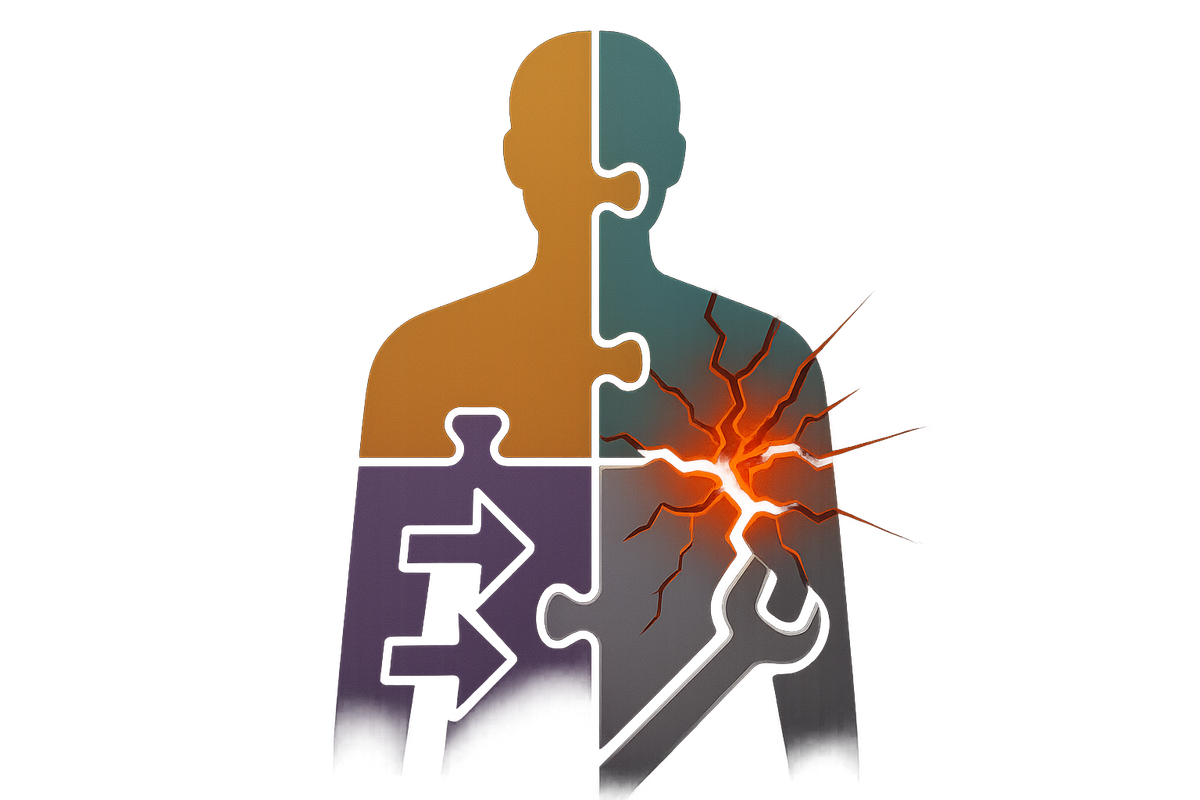
Your beliefs live on a curved surface you can’t see.
Information geometry treats probability distributions as points on a manifold—a mathematical surface with shape, curvature, and distance. When you change your mind, you’re not just swapping one belief for another. You’re moving across a landscape where some transitions are easy (following geodesics) and others are nearly impossible (crossing regions of high curvature).
This isn’t metaphor. It’s rigorous mathematics with direct implications for understanding why some people feel everything more sharply, why certain patterns trap us in loops, why trauma creates lasting distortions, and why insight sometimes fails to produce change.
Why This Matters for Coherence
Coherence has geometry. The same mathematical structures that describe how probability distributions relate to each other also describe how mental states, belief systems, and meaning structures organize themselves. Information geometry provides the formal vocabulary for talking about:
- Curvature: Why some people are more sensitive to small changes
- Geodesics: The paths of least resistance through belief space
- Divergence: How far apart two states actually are (not how far they seem)
- Topology: Why some patterns create inescapable loops
This is the mathematical backbone of AToM’s coherence framework. Understanding information geometry means understanding why coherence isn’t just a nice word—it’s a measurable property of how systems organize.
What This Series Covers
This series makes information geometry accessible without sacrificing rigor. We’ll examine:
- Your mind as a point on an invisible probability manifold
- The Fisher metric and what it actually measures
- Why curvature determines sensitivity
- KL divergence and the math behind “something feels off”
- Topological traps: holes, loops, and voids in belief space
- Hysteresis and why systems don’t simply return to baseline
- Geodesics as paths of least psychological resistance
- Dimensional collapse under trauma
- The coherence operator as a unified measure
- Why bottlenecks aren’t metaphors—they’re literal geometric constraints
Articles in This Series
- Your Mind Is a Point on a Surface You Can’t See
- The Shape of Surprise: What Information Geometry Actually Measures
- Why Some People Feel Everything More Sharply: Curvature Explained
- The Math Behind “Something Feels Off”
- Holes, Loops, and Voids: The Topology of Getting Stuck
- When the Map Warps and Won’t Unwarp: Hysteresis in Human Systems
- Geodesics: The Paths of Least Resistance Through Meaning-Space
- Dimensional Collapse: How Trauma Narrows Your Options
- The Coherence Operator: One Equation for Integration Across Scales
- Bottlenecks Aren’t Metaphors: The Literal Geometry of Feeling Trapped
Part of the SCIENCE collection, Foundations sub-hub. This series provides the mathematical foundation for AToM’s coherence geometry. See also The Free Energy Principle and Constructor Theory.
Comments ()