Learning in Topological Space: How Neural Manifolds Transform
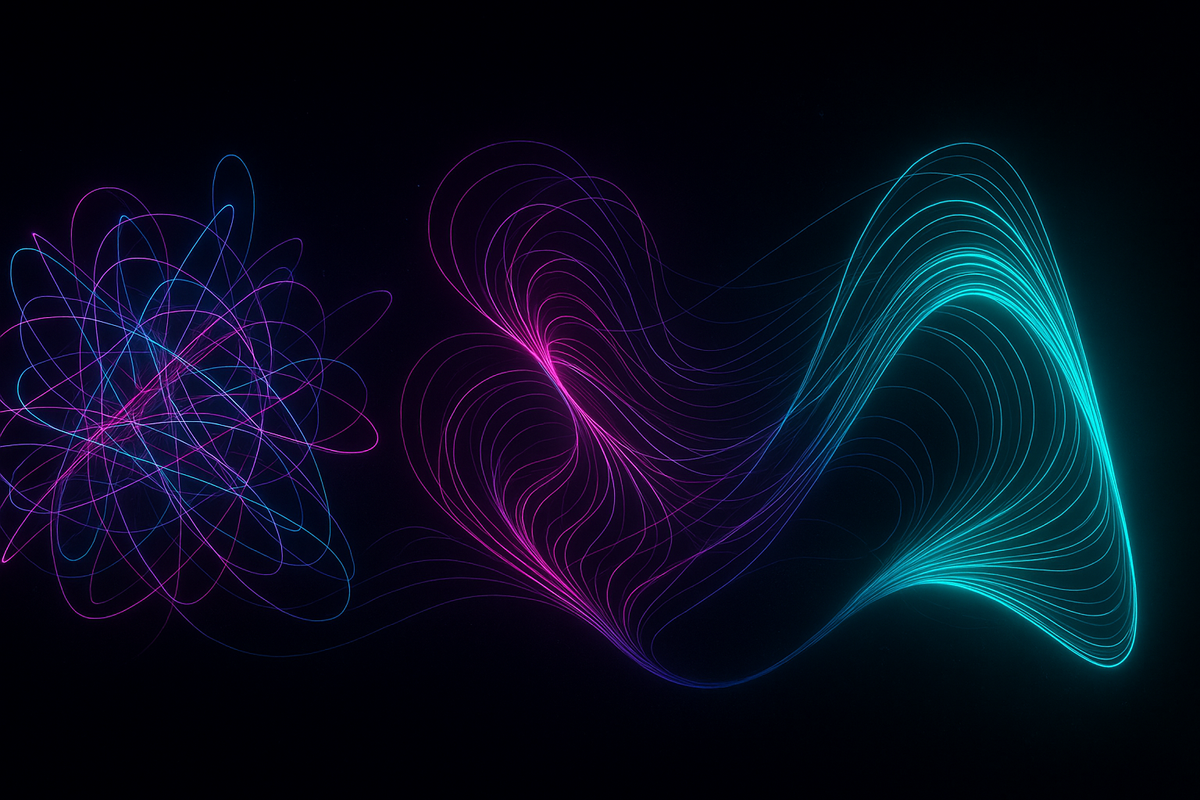
The brain's activity doesn't fill high-dimensional space randomly — it lies on low-dimensional manifolds. Learning bends and reshapes those manifolds. Understanding how is one of the most productive frontiers in systems neuroscience.
Learning in Topological Space: How Neural Manifolds Transform
Series: Topological Data Analysis in Neuroscience | Part: 6 of 9
You practiced. You got better. Something changed in your brain.
But what changed? At the geometric level, what does learning actually do to neural activity patterns?
The standard story: synapses strengthen or weaken. Neurons that fire together wire together (Hebbian plasticity). New connections form, unused ones prune. The physical circuitry restructures itself.
All true. But incomplete. Because the functional outcome—what you can now do that you couldn't before—doesn't reduce to synapse counts or connection strengths. The outcome is access to new regions of neural state space. Stable trajectories where there were none. Attractors that pull activity into patterns enabling skilled performance.
Learning reshapes the manifold.
And topology can see exactly how.
The Neural Manifold Hypothesis
Start with a conceptual shift. Instead of thinking about the brain as a collection of individual neurons, think about population activity—the joint firing pattern of many neurons simultaneously.
If you record from 100 neurons, each moment's activity pattern is a point in 100-dimensional space. Over time, as the brain's state evolves, these points trace a trajectory through that high-dimensional space.
But here's the key discovery from the past decade: neural activity doesn't fill the entire space uniformly. It concentrates on low-dimensional manifolds—curved subspaces embedded in the high-dimensional space where most of the variance lives.
Why? Because brains are constrained systems. Neurons aren't independent. They're coupled through connectivity, modulated by shared neuromodulators, entrained by rhythms. These constraints force activity onto lower-dimensional subspaces.
The manifold is the geometry of possibility for this network. What lives on the manifold is achievable. What lies off the manifold is inaccessible (or requires major effort to reach).
Learning is manifold transformation. Practice doesn't just change individual neuron firing rates. It reshapes the geometric structure of the space that population activity flows through.
Topology reveals precisely how.
Novice vs. Expert: Different Geometries
Watch someone learn a motor skill—playing an instrument, typing, juggling, athletic movement. Early performance is clumsy, variable, effortful. With practice, it becomes smooth, consistent, automatic.
What's changing topologically?
Novice neural manifolds are:
- Higher dimensional. Activity explores broadly, trying different patterns, hasn't settled on efficient solutions. The manifold has many degrees of freedom.
- Low persistence. Topological features form and collapse quickly. No stable geometric structures organize activity.
- Highly variable. Each performance produces different trajectories through state space. The manifold hasn't stabilized.
Expert neural manifolds are:
- Lower dimensional. Activity concentrates on a smaller, more precisely structured subspace. Constraints have learned what works. Unnecessary dimensions get pruned.
- High persistence. Stable topological features organize activity. Loops, attractors, geometric structures that reliably guide performance.
- Consistent. Repeated performance produces trajectories that occupy the same geometric structures. The manifold has crystallized around effective patterns.
Critically: the topological structures that appear during expert performance predict behavioral success.
When motor cortex forms high-dimensional cliques with persistent cavities during skilled movement, performance is accurate and consistent. When those topological features fail to form—due to fatigue, distraction, or insufficient practice—errors increase.
The geometry enables the skill.
Learning Curves as Topological Transitions
Plot learning over time: performance improves, typically following a power law or exponential curve. Early gains are rapid. Later improvements slow. Eventually you plateau.
What's happening to topology during this process?
Phase 1: Exploration (high dimensionality, low structure)
Early learning involves trying many strategies. Neural activity explores broadly. Topological analysis shows high-dimensional manifolds with few persistent features. The brain hasn't discovered the right geometric structures yet.
Phase 2: Consolidation (dimensional reduction, structure formation)
As certain strategies succeed and others fail, the manifold compresses. Unnecessary dimensions collapse. But persistent topological features start appearing—loops, cavities that organize effective activity patterns. The geometry is crystallizing.
Phase 3: Automatization (low dimensionality, high structure)
Expert performance occupies a low-dimensional manifold with rich persistent topology. The activity flows through stable geometric structures requiring minimal control signals. The skill has become encoded in the shape of neural dynamics.
Phase 4: Plateau (geometric saturation)
Further practice produces diminishing returns because the topology has already optimized given the network's constraints. You've discovered the most efficient geometric structures your anatomy supports. Additional practice reinforces these structures but doesn't fundamentally reshape them.
To break through plateaus requires either: (1) neuroplastic changes that alter the manifold's structure (new synapses, new connectivity patterns), or (2) discovering different geometric structures—alternative stable configurations you hadn't accessed before.
This is why varied practice beats repetitive drilling. Variation forces exploration of topology-space, increasing the chance of discovering better geometric structures.
Perceptual Learning: Reshaping Representational Manifolds
Motor learning reshapes how activity flows through motor cortex. Perceptual learning reshapes how sensory input gets represented.
Classic example: learning to identify faces. Newborns can't distinguish individual faces well. Adults are experts (except at distinguishing faces from other races—a failure of perceptual learning that produces the "other-race effect").
What changes topologically?
Early visual cortex projects faces into a high-dimensional space. Each face becomes a point (actually a trajectory, since faces move and lighting changes). The question is: how is this space organized?
Before learning: Faces cluster crudely. Basic features (two eyes, nose, mouth) define one region of the manifold, but individual faces don't occupy reliably distinct geometric locations. The topology is coarse.
After learning: The manifold reorganizes. Individual faces occupy distinct geometric regions. The space develops topological structure that separates familiar faces into different basins of attraction. Subtle features—the slight curve of a cheekbone, the specific spacing of eyes—become dimensions that meaningfully organize the manifold.
And critically: the topology of face-space predicts recognition ability. People with richer topological structure in face-selective regions (measured via TDA on fMRI data) are better at distinguishing individual faces. The geometric organization is the skill.
Damage this topology (fusiform face area lesions, prosopagnosia), and face recognition collapses. The geometric structure that enabled discrimination is gone.
Memory Consolidation as Topological Stabilization
Why does sleep improve learning? Why do new memories require hours to stabilize?
The dominant theory: memory consolidation involves replaying activity during sleep, transferring temporary hippocampal representations to more permanent cortical storage.
Topology adds precision. Consolidation isn't just reactivation. It's topological stabilization.
When you first encode a memory, hippocampal activity forms transient topological features—loops, cavities that represent the event's structure. But they're unstable. They'll collapse unless reinforced.
During sleep—particularly during sharp-wave ripples in slow-wave sleep—these patterns replay repeatedly. With each replay, synaptic changes accumulate. The topological features persist longer. Betti numbers stabilize. The geometry becomes permanent.
In cortex, complementary learning systems gradually build corresponding topological structures. The memory doesn't just transfer location. It transforms from transient hippocampal topology into stable cortical topology with different geometric properties—more abstract, more integrated with prior knowledge, more resistant to disruption.
Forgetting is topological decay. Memories that don't get consolidated lose their geometric structure. The features collapse. The patterns dissolve back into noise. The information is irretrievable because the topology that organized it no longer exists.
Interference is topological conflict. When new learning creates geometric structures incompatible with existing ones, both degrade. The manifold can't simultaneously support both topologies. Spacing practice gives time for consolidation—locking in geometry before loading new patterns that might disrupt it.
Expertise and Topological Efficiency
Anders Ericsson's research on expertise found that world-class performers in any domain have typically accumulated ~10,000 hours of deliberate practice. Why does it take so long?
Partly skill complexity. But topology suggests another factor: building sophisticated geometric structures takes time.
Expert chess players don't just remember more positions. They organize chess knowledge on a richer topological manifold. Positions that novices see as distinct cluster together for experts (they're all "variants of the King's Indian Defense"). Positions novices conflate occupy different geometric regions for experts (one is winning, the other losing, despite superficial similarity).
This geometric reorganization requires massive exposure. Each game, each puzzle, each analysis session slightly reshapes the manifold. Topological features emerge, stabilize, become reliable guides to evaluation and move selection.
Same for expert musicians, athletes, mathematicians, surgeons. In every domain, expertise involves building mental manifolds with topological structure that novices lack—geometric organizations that make relevant distinctions, cluster meaningfully related patterns, create attractors around effective strategies.
You can't shortcut this. Reading about chess doesn't reshape your manifold. You have to play, make mistakes, correct them, gradually let the geometry settle into forms that support expert judgment.
Deliberate practice is deliberate manifold-sculpting.
Neural Basis: Plasticity as Geometric Remodeling
What's the mechanism? How does practice actually change topology?
Multiple interacting processes:
Synaptic plasticity (LTP/LTD): Strengthening and weakening connections changes the flow structure—which trajectories through state space are stable, which are repelled, where attractors form.
Structural plasticity: New dendritic spines, new axonal branches, even new neurons (in hippocampus) literally add dimensions to the manifold and create new geometric possibilities.
Myelination: White matter changes during learning. Faster transmission along certain pathways reshapes timing relationships, which changes dynamical structure, which changes topology.
Neuromodulation: Changes in dopamine, acetylcholine, norepinephrine release patterns alter which synapses are eligible for modification—gating which geometric transformations are possible during which states.
All these mechanisms converge on the functional outcome: the manifold reshapes to support desired behaviors more efficiently.
And this connects directly to AToM's framework. Learning is coherence optimization. The system is restructuring itself to minimize prediction error more effectively, to maintain integrated organization across more varied conditions, to access meaningful states more reliably.
M = C/T increases because C increases: the geometric structure becomes more sophisticated, more stable, more capable of supporting integrated function.
Practical Implications
Understanding learning as topological transformation has concrete applications:
1. Training design: Structure practice to systematically explore topology-space. Early: broad variation. Middle: targeted consolidation. Late: refinement of persistent features.
2. Spacing effects: Give the manifold time to stabilize between sessions. Sleep consolidates topology. Cramming prevents geometric stabilization.
3. Transfer learning: Skills transfer when they involve similar topological structures. Training one skill reshapes the manifold in ways that benefit other skills occupying nearby geometric regions.
4. Learning disabilities: Some learning difficulties might reflect inability to form stable topological features—geometry that won't consolidate, manifolds that won't compress, persistent features that won't persist. Interventions might target geometric stabilization directly.
5. Accelerated learning: Can we design interventions that speed topological transformation? Neurostimulation, pharmacology, virtual reality training environments that provide richer geometric feedback?
The shape of learning is literally the learning of shape.
This is Part 6 of the Topological Data Analysis in Neuroscience series, exploring how geometric methods reveal the hidden structure of mind.
Previous: Brain Networks Through a Topological Lens
Next: TDA Meets Information Geometry: Two Approaches to Neural Structure
Further Reading
- Sadtler, P. T., et al. (2014). "Neural constraints on learning." Nature, 512(7515), 423-426.
- Gallego, J. A., et al. (2017). "Neural manifolds for the control of movement." Neuron, 94(5), 978-984.
- Russo, A. A., et al. (2018). "Motor cortex embeds muscle-like commands in an untangled population response." Neuron, 97(4), 953-966.
- Chung, S., & Abbott, L. F. (2021). "Neural population geometry: An approach for understanding biological and artificial neural networks." Current Opinion in Neurobiology, 70, 137-144.
- Saxe, A., et al. (2019). "If deep learning is the answer, what is the question?" Nature Reviews Neuroscience, 20(11), 611-620.
Comments ()