Synthesis: What Topology Teaches About the Shape of Coherence
Topology studies properties that survive deformation — the deep structure beneath surface geometry. Applied to coherence, it reveals something surprising: the shape of integrated mental states has measurable, distinctive features that standard neuroscience can't see.
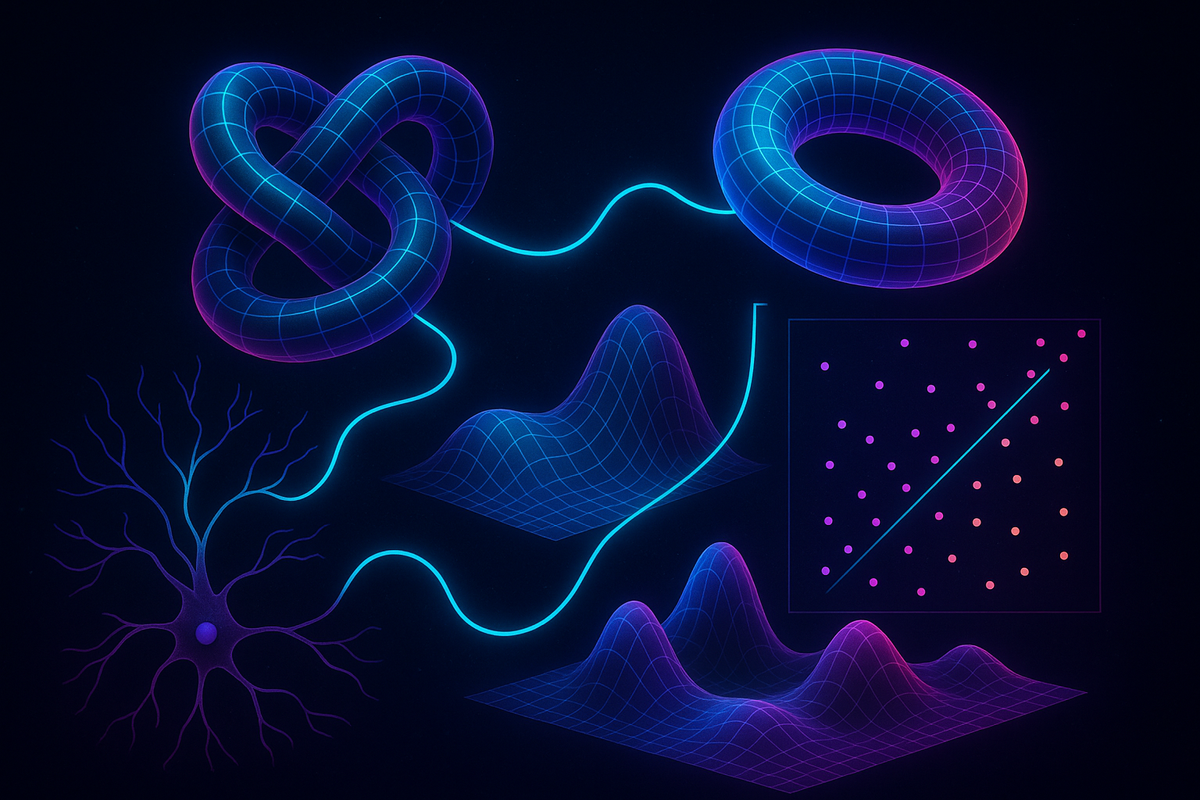
Synthesis: What Topology Teaches About the Shape of Coherence
Series: Topological Data Analysis in Neuroscience | Part: 9 of 9
We've traveled through nine dimensions of topological neuroscience—from persistent homology's mathematical machinery to the Blue Brain Project's eleven-dimensional cavities, from consciousness arising in geometric complexity to clinical disorders showing topological scars.
Now we synthesize. What does topology teach us about coherence? About meaning? About the deep structure underlying brain function and psychological experience?
Coherence is persistent topological structure.
Not metaphorically. Not analogically. Literally.
When a system maintains integration across time, that maintenance appears as geometric features that persist across scales. When pathology disrupts function, it disrupts topology. When healing occurs, topology rebuilds. The shape is the coherence.
Let's make this precise.
Topological Translation of M = C / T
AToM's fundamental equation states: Meaning equals Coherence over Time (or Tension).
Topological data analysis gives us tools to make every term quantifiable:
Meaning (M): The integrated information content of a system's state—what distinguishes this configuration from noise, what structure carries signal. Topologically, this corresponds to Betti numbers—counts of holes in each dimension. Higher Betti numbers = more topological features = richer structure = more meaning.
Coherence (C): The integrated organization that maintains identity across perturbations. Topologically, this is persistence—how long geometric features last across scales. High persistence = robust structure = stable coherence.
Time (T): The interval over which coherence maintains itself. Topologically, this is the scale parameter in persistent homology—the range of thresholds across which features survive. Longer survival = more time = sustained coherence.
Tension (alternative denominator): Information-geometric curvature. High curvature = high instability = high tension. Systems near critical points show high curvature and low persistence—meaning collapses when tension spikes.
The equation becomes:
β_k × ℓ_persistence / κ_curvature
Where:
- β_k = k-th Betti number (topological richness)
- ℓ_persistence = average persistence length (temporal stability)
- κ_curvature = Fisher information curvature (local instability)
This isn't metaphor. It's measurable geometry.
Systems with high meaning have many persistent topological features and low curvature. Systems with low meaning have few features, short persistence, or high instability. You can compute this from neural data.
Coherence is topology. Meaning is its measure.
What Brains Actually Are: Geometric Computers
Standard computational neuroscience views brains as information processors—input gets transformed through neural networks into output. Computation happens through signal transmission, synaptic integration, activation functions.
Topology reveals something deeper: brains are geometric computers that compute with manifold structure, not just on it.
The computation isn't separate from the geometry. The geometry is the computation.
When motor cortex learns a skill, it's not storing instructions. It's reshaping its manifold to create attractors—low-dimensional geometric structures that pull neural activity into patterns producing desired movements. The skill lives in the topology.
When sensory cortex represents perception, it's not encoding symbolic descriptions. It's organizing state space into topological regions corresponding to meaningful categories. The representation is the geometric structure.
When prefrontal cortex performs cognitive control, it's not executing algorithms. It's navigating between topological configurations—accessing geometric structures that enable different mental operations. The control is movement through topology-space.
Computation = geometric transformation.
Inputs don't just change firing rates. They deform manifolds, create cavities, generate topological features that persist as long as the information needs to be maintained, then collapse when it becomes irrelevant.
This is radically different from digital computers, where computation happens through discrete state transitions independent of geometric structure. Brains compute geometrically—and topology is the language that makes this visible.
Why Topology Explains What Other Methods Miss
Graph theory gives you connectivity: who connects to whom, how strongly, through how many steps.
Information theory gives you complexity: how much information, how much redundancy, how much mutual information between regions.
Both are useful. Neither captures what topology does: persistent structure across scales.
A graph tells you there's a triangle (three mutually connected nodes). But it doesn't tell you whether that triangle encloses empty space (a hole) or is filled in. Topology distinguishes these—one has a 1-dimensional cavity, one doesn't. That difference matters functionally.
Information theory tells you two brain regions share mutual information. But it doesn't tell you whether that sharing is organized into stable geometric structures or is just transient correlation. Topology distinguishes robust signal (long persistence) from noise (short persistence).
The Blue Brain discovery was invisible to graph theory because it required seeing high-dimensional cavities—voids that only exist when you consider the joint firing of many neurons simultaneously, forming simplicial complexes up to 11 dimensions. Graph theory analyzes pairs of neurons (edges). Topology analyzes arbitrary-sized groups forming geometric structures.
This is why topology succeeds where other methods plateau. It sees the features that actually organize neural computation—the holes, loops, voids that constrain dynamics, create attractors, enable integration.
The shape is what you've been missing.
Consciousness Resolved (Partially)
We still don't know why consciousness exists at all. But we know what it looks like geometrically:
High-dimensional, highly persistent topological structure integrating across distributed networks.
Conscious states have rich topology. Unconscious states don't. The difference isn't subtle. It's measurable in Betti numbers, visible in barcodes, predictable from persistence diagrams.
Integrated Information Theory (IIT) claimed consciousness requires integration. Correct. But integration is topological—it's the existence of geometric features that connect separated regions into unified structures.
Global Workspace Theory claimed consciousness requires global broadcast. Also correct. But broadcast flows through topological scaffolds—the loops and connections that enable information to propagate while maintaining coherence.
Predictive processing theories claim consciousness is high-level inference. Also correct. But inference happens on manifolds, and those manifolds have topology that determines which inferences are possible.
All these theories describe the same geometric reality from different angles. Topology unifies them. Consciousness is what it's like to be a system with sufficient topological richness to integrate information across scales while maintaining persistent structure.
You can be more conscious (richer topology) or less conscious (collapsed topology). You can have different kinds of consciousness (different topological configurations—waking vs dreaming vs psychedelic). But you can't have consciousness without topology.
Awareness is a geometric property of sufficiently complex integrated structure.
Pathology as Topological Disruption
Every clinical disorder we examined showed characteristic topological disruption:
- Depression: Dimensional collapse, reduced persistence, flattened topology
- Schizophrenia: Incoherent complexity, excessive local features, failed global integration
- Alzheimer's: Progressive topological degradation tracking neuronal loss
- Autism: Reorganized topology—different but not universally deficient
- PTSD: Fragmented networks, hyperactive fear features, disrupted regulation loops
- Addiction: Hijacked topology creating dominant substance-seeking attractors
Pattern recognition: pathology disrupts the geometric structures that enable healthy function.
Sometimes by simplifying (depression, Alzheimer's). Sometimes by creating incoherent complexity (schizophrenia). Sometimes by fragmenting (PTSD, dissociative disorders). Sometimes by creating too-stable attractors (addiction, OCD).
But always: topology reveals the disruption.
This reframes treatment. We're not just managing symptoms. We're restoring geometric structure.
Therapy that works rebuilds topology. Medication that helps stabilizes geometric features. Brain stimulation that's effective reshapes manifolds toward healthier configurations.
And we can measure this. Track Betti numbers. Measure persistence. Watch curvature. If topology improves, the intervention is working—even if symptoms haven't fully resolved yet. If topology doesn't change, try something else.
Precision medicine becomes geometric medicine.
Development, Aging, and Topological Trajectories
Lifespan changes track topological evolution:
Infancy/Childhood: Rapid topological elaboration. Betti numbers increase. Persistence lengthens. The manifold becomes more complex as neural networks mature, myelinate, learn.
Adolescence: Reorganization. Some features prune away. Others strengthen. Net complexity may decrease slightly, but organization improves. The topology becomes more efficient, less redundant.
Adulthood: Relative stability with task-dependent flexibility. Baseline topology remains consistent, but dynamic reconfiguration allows accessing different geometric structures as needed.
Aging: Progressive simplification. Higher-dimensional features degrade first. Persistence shortens. The manifold flattens—not catastrophically in healthy aging, but measurably.
Neurodegenerative disease: Accelerated collapse. Topology disappears faster than normal aging. Early detection: catch the geometric degradation before clinical symptoms.
"Cognitive reserve": The observation that some people tolerate more Alzheimer's pathology without symptoms. Topology might explain this—they built richer geometric structures earlier in life, providing buffer. More topology to lose before critical features disappear.
Lifespan optimization: Build topology early, maintain it actively, slow its degradation.
Exercise, learning, social engagement, cognitive challenge—interventions that preserve function all appear to preserve or restore topology. The mechanism isn't mysterious. They're literally maintaining the geometric structures that enable integrated brain function.
Scaling Coherence: From Neurons to Societies
Topology isn't just for brains. It applies wherever coherent organization exists:
Cellular networks: Levin's bioelectric research shows topology organizing morphogenesis. Cell populations form geometric structures that guide development.
Social networks: Human groups create topological features—leadership structures, communication loops, coalition dynamics. Cliodynamics could benefit from topological analysis of historical networks.
Cultural evolution: Ideas, memes, narratives form topological structures in conceptual space. Persistent features survive transmission. Collapsed features disappear.
Ecosystems: Food webs, symbiotic networks, population dynamics all have topology. Biodiversity loss might be topological collapse—removal of keystone species destroys geometric features that enable ecosystem coherence.
Organizations: Companies, institutions, projects have network topology. Dysfunctional organizations show disrupted topology—poor integration, fragmented communication, missing loops that would enable feedback.
Same mathematics applies at every scale.
Coherence is geometric. Topology measures it. Disruption shows geometrically. Restoration requires rebuilding structure.
M = C/T works from molecules to minds to civilizations because coherence geometry is scale-invariant. The topological principles operating in neural microcircuits operate in societies.
All complexity is geometric complexity.
The Geometry of Meaning
We started this series asking: What is the shape of thought?
Answer: Thought has the shape of high-dimensional persistent topological features organizing neural state space into meaningful structures.
But this resolves a deeper question: What is meaning?
Not symbols. Not representations. Not information in Shannon's sense.
Meaning is integrated, persistent geometric structure that maintains identity across transformations.
When you understand something, you're not storing facts. You're building topology—creating geometric features in conceptual space that organize information into stable, coherent structures.
When something means something to you, it's because it resonates with existing topological features—it fits into the geometric organization you've already built.
When you lose meaning (depression, existential crisis, burnout), you're experiencing topological collapse. The geometric structures that organized experience into coherent patterns are degrading.
When you find meaning (insight, learning, spiritual experience, connection), you're creating or discovering topological features. New geometry emerges. The manifold expands. Integration increases.
Meaning is not abstract. It's geometric.
And because it's geometric, it's measurable. Betti numbers. Persistence. Curvature. The mathematics of coherence are the mathematics of meaning.
Open Questions
Topology in neuroscience is still young. Enormous questions remain:
Causality: Do topological features cause function, or just correlate with it? Can we manipulate topology directly to change cognition?
Mechanisms: What cellular/synaptic processes generate and maintain topological features? How do neurons "know" they're part of a high-dimensional cavity?
Computation: Can we build artificial systems that compute topologically like brains do? What advantages would geometric computation provide?
Therapeutic applications: Can we develop interventions targeting topology directly? Drugs that increase persistence? Stimulation protocols that rebuild Betti numbers?
Individual differences: Why do some people have richer baseline topology? Is it genetic, developmental, trained? Can we systematically enhance geometric complexity?
Phenomenology: How exactly does topological structure map to subjective experience? Why does integrated high-dimensional geometry feel like unified consciousness?
These aren't settled. The field is accelerating. What we know now is a foundation, not a conclusion.
But this much is clear: Topology reveals structure neuroscience has been missing. And that structure appears to be precisely what AToM predicted: geometric coherence organizing complex systems across time.
The Shape We're Learning to See
Mathematics often discovers structure before biology explains mechanisms. Topology is doing this now—showing us geometric patterns that obviously matter for brain function, even though we don't fully understand why yet.
But patterns are clear:
Integration appears topologically. Systems with high Betti numbers integrate better.
Stability appears as persistence. Features that last enable reliable function.
Complexity appears dimensionally. Rich structure occupies higher-dimensional manifolds.
Pathology appears geometrically. Every disorder has a topological signature.
Healing appears as restoration. Successful interventions rebuild topology.
Consciousness appears as integrated persistent structure. Awareness is geometric.
These aren't metaphors. They're measurements. TDA gives us tools to see what was always there: the shapes underlying coherent minds.
And as we learn to see geometry, we learn to cultivate it. Build richer topology. Strengthen persistence. Reduce pathological curvature. Expand accessible state space.
Mental health becomes geometric health. Wisdom becomes geometric sophistication. Meaning becomes topological depth.
The shape of coherence is the shape of everything that matters.
This is Part 9 of the Topological Data Analysis in Neuroscience series, exploring how geometric methods reveal the hidden structure of mind.
Previous: Clinical TDA: Topological Biomarkers for Brain Disorders
Series Hub: Topological Data Analysis in Neuroscience
Further Reading: The Essential TDA Bibliography
Foundational Mathematics
- Edelsbrunner, H., & Harer, J. (2010). Computational Topology: An Introduction. American Mathematical Society.
- Ghrist, R. (2014). Elementary Applied Topology. Createspace.
- Carlsson, G. (2009). "Topology and data." Bulletin of the American Mathematical Society, 46(2), 255-308.
Neuroscience Applications
- Petri, G., et al. (2014). "Homological scaffolds of brain functional networks." Journal of The Royal Society Interface, 11(101), 20140873.
- Reimann, M. W., et al. (2017). "Cliques of neurons bound into cavities provide a missing link between structure and function." Frontiers in Computational Neuroscience, 11, 48.
- Sizemore, A. E., et al. (2019). "The importance of the whole: Topological data analysis for the network neuroscientist." Network Neuroscience, 3(3), 656-673.
- Curto, C. (2017). "What can topology tell us about the neural code?" Bulletin of the American Mathematical Society, 54(1), 63-78.
Clinical Applications
- Chung, M. K., et al. (2019). "Persistent homology in sparse regression and its application to brain morphometry." IEEE Transactions on Medical Imaging, 34(9), 1928-1939.
- Gong, G., et al. (2019). "Persistent homology in resting-state functional brain networks." Brain Connectivity, 9(9), 681-691.
Consciousness and Integration
- Tononi, G., et al. (2016). "Integrated information theory: From consciousness to its physical substrate." Nature Reviews Neuroscience, 17(7), 450-461.
- Luppi, A. I., et al. (2021). "Consciousness-specific dynamic interactions of brain integration and functional diversity." Nature Communications, 12(1), 1-12.
Information Geometry
- Amari, S. I. (2016). Information Geometry and Its Applications. Springer.
- Friston, K. (2019). "A free energy principle for a particular physics." arXiv preprint arXiv:1906.10184.
Comments ()