TDA Meets Information Geometry: Two Approaches to Neural Structure
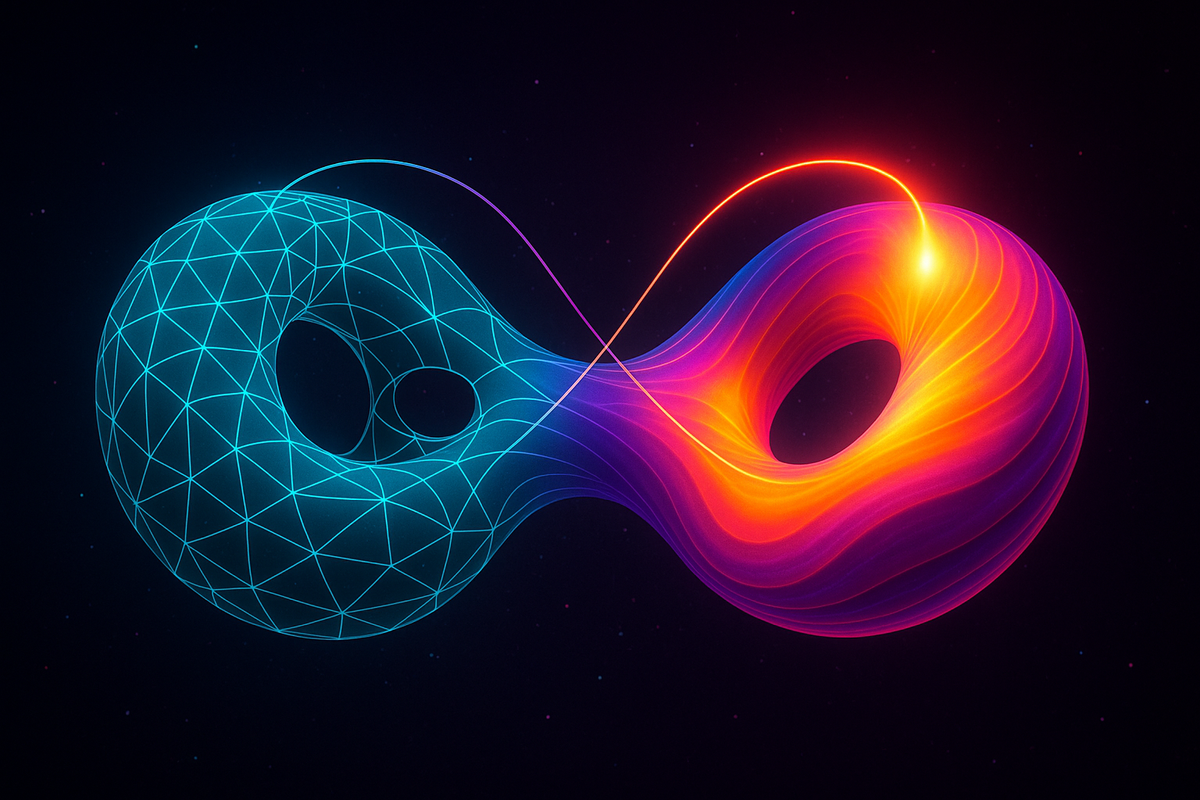
Topological data analysis asks about holes and connected components in neural data. Information geometry asks about the curvature of probability distributions. They're looking at the same brain from different mathematical angles — and together they see structure that neither catches alone.
TDA Meets Information Geometry: Two Approaches to Neural Structure
Series: Topological Data Analysis in Neuroscience | Part: 7 of 9
Two mathematical frameworks. Two ways of seeing brain geometry. Both reveal structure invisible to classical methods. But they see different things—or do they?
Topological data analysis extracts holes, loops, cavities. It counts connected components, measures persistence, tracks features that survive across scales. It cares about shape—what structure remains invariant under continuous deformation.
Information geometry measures curvature, geodesics, the shape of probability distributions. It treats neural state space as a Riemannian manifold where distance means distinguishability, where shortest paths are most efficient trajectories, where curvature indicates instability.
For years, these approaches developed separately. Neuroscientists using TDA rarely engaged with information geometry. Researchers applying free energy principles paid little attention to persistent homology.
But the convergence is happening. And it's revealing something profound: topology and geometry aren't separate descriptions of neural structure. They're complementary lenses on the same underlying coherence architecture.
What Information Geometry Sees
Information geometry starts from a different place than TDA. Instead of point clouds and simplicial complexes, it begins with probability distributions.
When a brain processes information, it's essentially performing inference—building probabilistic models, updating beliefs, minimizing surprise. Each possible brain state corresponds to a different probability distribution over sensory inputs, motor outputs, hidden causes.
These distributions can be organized into a manifold—an information-geometric manifold—where:
- Each point represents one probability distribution
- Distance between points measures statistical distinguishability (KL divergence, Fisher information metric)
- Geodesics are the most efficient paths between distributions
- Curvature indicates how quickly optimal paths deviate from each other
Karl Friston's free energy principle uses this framework. The brain minimizes variational free energy, which is equivalent to climbing down the information-geometric manifold toward distributions that better predict sensory input. Learning is gradient descent on this manifold. Perception is inference along geodesics. Action is moving the world to match predictions.
This gives you tools TDA doesn't directly provide: differential geometry. You can measure curvature (how unstable is this brain state?), compute geodesics (what's the optimal learning trajectory?), analyze flows (how does neural dynamics evolve over the manifold?).
But here's what information geometry traditionally misses: topological features that are metric-independent. A hole is a hole regardless of how you measure distance. Curvature can tell you the manifold is warped, but not whether it contains voids or loops that fundamentally constrain dynamics.
Enter the synthesis.
The Fisher Information Metric and Persistent Features
The Fisher information metric is the standard distance measure in information geometry. It quantifies how distinguishable two nearby probability distributions are.
High Fisher information means small parameter changes produce large distributional changes—high sensitivity. Low Fisher information means parameters can vary substantially without affecting the distribution much—low sensitivity or redundancy.
This metric defines the geometry of neural state space. But here's the connection to topology: persistent homological features correlate with regions of high Fisher information.
Why? Because topological features represent robust structural properties. A loop that persists across many scales indicates the distribution landscape has organized such that certain closed cycles exist. Traversing that loop means returning to similar probabilistic structure despite intermediate variation.
High Fisher information marks points where the geometry is most informative—where small changes matter most. These are precisely the regions where topological features tend to localize.
Recent work combining both frameworks shows: Betti numbers predict Fisher information structure. Brain states with many persistent loops have characteristic Fisher information profiles—high curvature near the features, lower curvature along the loops themselves.
The topology organizes where geometry becomes steep.
Geodesics and Topological Constraints
A geodesic is the shortest path between two points on a manifold. In neural terms, it's the most efficient trajectory from one brain state to another—the learning path that minimizes wasted effort, the perceptual inference that requires fewest computational steps.
But geodesics can't ignore topology. Holes constrain which paths exist.
Simple example: if neural state space contains a 1-dimensional hole (a loop), you can't smoothly contract a trajectory wrapping around that hole into the trivial path. The hole prevents it. Topologically, certain paths are fundamentally distinct.
This has functional consequences:
1. Multiple learning paths: If state space contains voids, there may be multiple geodesics between the same two endpoints—paths that go around the hole in different directions. Both are locally optimal, but they involve different sequences of synaptic modifications.
2. Path dependence: The history of learning matters because topology means different routes are genuinely distinct, even if they end at the same destination. Order of presentation affects final structure.
3. Local minima: Holes create basins of attraction in the free energy landscape. Gradient descent can get stuck because the topology prevents finding shorter paths that would require "jumping" over voids.
4. Robustness: Topological features that remain stable across perturbations correspond to geodesics that remain optimal despite noise. Persistent features create persistent optimal paths.
Information geometry alone might find a geodesic. But topology explains why that geodesic can't be further optimized—it's constrained by the manifold's shape.
Curvature and Dimensional Collapse
In information geometry, curvature indicates instability. High curvature means geodesics diverge rapidly—small perturbations produce large differences in outcome. This corresponds to critical points, phase transitions, high sensitivity.
In AToM's language, high curvature means high tension. The system is near a boundary, close to losing coherence, at risk of fragmentation.
TDA complements this by revealing what happens at the transition: dimensional collapse.
When a system approaches criticality (high curvature), topological features begin to collapse. Loops close up. Voids fill in. Betti numbers drop. The manifold loses dimensionality.
This is visible in neural data during phase transitions:
Wake to sleep: As consciousness fades (high curvature transition), topology collapses. High-dimensional features disappear first. Low-dimensional structure (connected components) persists longest.
Learning critical periods: Developmental windows where specific circuits are highly plastic. Information-geometric analysis shows high curvature. Topological analysis shows rapid dimensional reduction as the space compresses onto task-relevant structures.
Seizure onset: Pathological synchronization represents dimensional collapse—all neurons doing the same thing, manifold crushing to near-zero dimensionality. Curvature spikes at the transition point.
Trauma response: Dimensional collapse from psychological trauma shows both high curvature (instability, unpredictability) and topological reduction (fewer accessible states, simplified geometry).
The geometry tells you when the system is unstable. The topology tells you how it collapses.
Integrating Both: The Fisher-Betti Diagram
Novel approach emerging in computational neuroscience: Fisher-Betti diagrams that combine both frameworks.
Vertical axis: Fisher information (from information geometry).
Horizontal axis: Scale parameter for TDA filtration.
Plot: How Fisher information varies at each scale, colored by Betti numbers.
This reveals patterns neither approach shows alone:
Persistent features at low Fisher information: Robust topological structure in "flat" regions of the manifold. These are stable, easily accessible states—like attractors where neural dynamics reliably settles.
Transient features at high Fisher information: Short-lived topological structure in high-curvature regions. These mark transition zones—critical points where small changes reshape topology.
Hierarchical nesting: Low-dimensional persistent features (components, loops) stabilize first, at low Fisher information. Higher-dimensional features appear later, at higher curvature regions. The geometry builds from simple to complex.
Pathology signatures: Different disorders show different Fisher-Betti profiles. Depression: low Fisher information, low Betti numbers (flat and simple). Mania: high Fisher information, high transient Betti numbers (unstable and chaotic). Healthy function: moderate Fisher information with high persistent Betti numbers (dynamic but stable).
This diagnostic potential is just beginning to be explored. But the principle is clear: combining topology and geometry provides richer characterization than either alone.
Active Inference Meets Persistent Homology
Friston's active inference framework treats perception and action as unified free energy minimization. The brain generates predictions (descends the manifold toward better models), and acts to make predictions come true (changes sensory input to match expectations).
TDA adds topological precision:
Generative models have topology. The prior distributions used in active inference define a manifold. That manifold has homological features—loops, voids that constrain inference. Bayesian updating must respect topology. You can't infer across holes.
Markov blankets have topological boundaries. The statistical separations that define "inside" and "outside" for active inference agents can be characterized topologically. Self-other distinction isn't just correlation structure—it's a topological separation.
Precision-weighting reshapes topology. When active inference agents modulate precision (how much to trust different information sources), they're effectively changing the information metric. This reshapes geodesics and can create or destroy topological features.
Hierarchical inference creates nested topology. Multi-level generative models produce hierarchical manifolds. High-level priors constrain low-level inference. Topologically, this appears as nested simplicial complexes—higher-order features organizing lower-order dynamics.
The synthesis: active inference provides the dynamics, topology provides the constraints. Free energy minimization flows across manifolds shaped by persistent homology. The topology determines which inferences are possible. The geometry determines which are optimal.
Practical Convergence: Hybrid Methods
Researchers are now building hybrid approaches that use both frameworks:
1. Topology-guided geodesic computation: Use persistent homology to identify topological features, then compute information-geometric geodesics that respect those features. Produces more robust learning algorithms.
2. Curvature-weighted persistence: Weight topological features by local Fisher information. Features in high-curvature regions get different treatment than features in flat regions. Better distinguishes meaningful from artifactual structure.
3. Multi-scale Fisher metrics: Compute Fisher information at each scale of TDA filtration. Reveals how informational content varies across topological scales.
4. Topological priors for inference: Use persistent homology to constrain Bayesian inference. Forces generative models to respect topological structure extracted from data.
These aren't just theoretical exercises. They're producing better brain-machine interfaces, more accurate neural decoding, improved understanding of psychiatric disorders, and clearer connections between neural dynamics and cognitive function.
What This Means for AToM
The topology-geometry synthesis directly supports AToM's core claims:
Coherence is geometric structure that persists. Topology measures persistence. Geometry measures what structure exists. Together they fully characterize coherence.
M = C/T becomes precisely measurable. Meaning (M) corresponds to persistent topological features. Coherence (C) is the integrated information-geometric structure. Time (T) is the scale across which features persist. The equation isn't metaphor—it's quantifiable.
Curvature indicates tension. High Fisher information curvature marks instability. Topological collapse follows. The framework predicts where coherence will fail.
Healing is geometric repair. Interventions that restore healthy topology and reduce pathological curvature should restore function. Measurable targets: increase persistent Betti numbers, reduce curvature in critical regions, expand dimensionality of accessible state space.
Consciousness is topology and geometry. IIT's integrated information (geometry) plus persistent topological structure (TDA) together characterize awareness more completely than either alone.
The synthesis isn't complete. But the convergence is accelerating. Two mathematical traditions are discovering they've been studying the same thing from different angles: the geometric structure that enables coherent minds.
This is Part 7 of the Topological Data Analysis in Neuroscience series, exploring how geometric methods reveal the hidden structure of mind.
Previous: Learning in Topological Space: How Neural Manifolds Transform
Next: Clinical TDA: Topological Biomarkers for Brain Disorders
Further Reading
- Amari, S. I. (2016). Information Geometry and Its Applications. Springer.
- Ay, N., et al. (2017). Information Geometry. Springer.
- Friston, K. (2010). "The free-energy principle: A unified brain theory?" Nature Reviews Neuroscience, 11(2), 127-138.
- Sengupta, B., et al. (2016). "Gradient-based MCMC samplers for dynamic causal modelling." NeuroImage, 125, 1107-1118.
- Patel, A., et al. (2021). "Generalized notions of sparsity and restricted isometry property for persistent homology." Foundations of Computational Mathematics, 1-43.
Comments ()