The Interface Problem: Connecting Wetware to Hardware
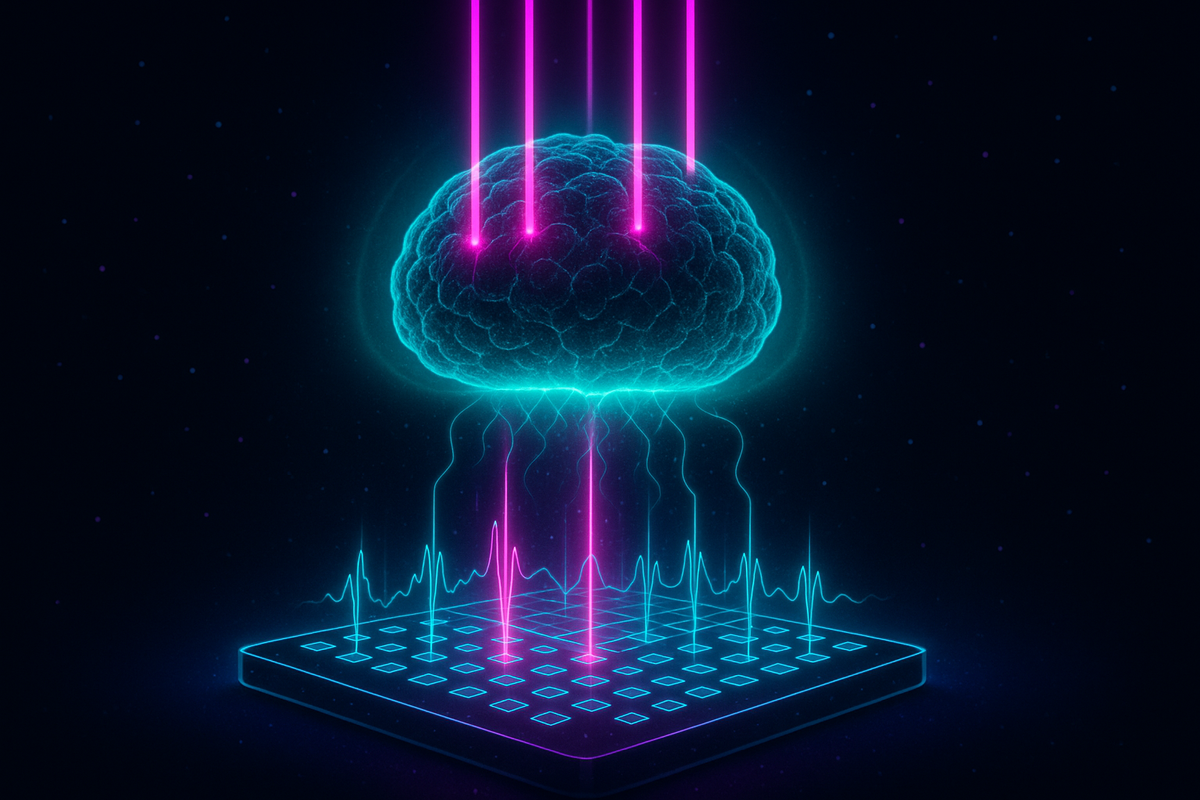
Series: Organoid Intelligence | Part: 5 of 9
You can grow a brain in a dish. You can watch it develop neurons that fire, networks that self-organize, patterns of activity that look unmistakably like computation. But here’s the problem: you can’t talk to it.
This is the interface problem, and it’s the bottleneck standing between current organoid research and the promise of biological computing. We’ve gotten remarkably good at coaxing neural tissue to grow and organize itself. We have not gotten good at reading what it’s doing—or writing information into it—with anywhere near the resolution and bandwidth required to make use of its computational capacity.
The gap between what neurons can do and what we can measure them doing is vast. And it’s not just a technical limitation. It’s a conceptual mismatch between two radically different kinds of systems: one evolved over hundreds of millions of years to process information through ion gradients and neuromodulator cocktails, the other designed in the past century to move electrons through silicon. The interface problem is what happens when you try to bridge systems that weren’t designed to talk to each other.
What an Interface Actually Has to Do
Let’s be specific about the requirements. A functional brain-computer interface for organoid systems needs to do three things simultaneously:
Read neural activity at sufficient spatial and temporal resolution to capture meaningful information. Individual neurons fire on millisecond timescales. Neural codes often depend on precise spike timing across populations of cells. You need to record from enough neurons, fast enough, to catch the patterns that matter.
Write information into neural tissue in a way the tissue can interpret as input. This isn’t about crude electrical stimulation—that’s like shouting at someone in a language they don’t speak. You need to deliver signals that the neural network recognizes as meaningful, that interface with its existing dynamics rather than disrupting them.
Do both without killing the tissue. Neural tissue is fragile. Stick electrodes into it and you cause damage, inflammatory responses, scar tissue that degrades signal quality over time. The interface needs to be biocompatible, minimally invasive, and stable enough for chronic recording and stimulation.
Current approaches manage two of these requirements, sometimes. Getting all three at once—high resolution, bidirectionality, biocompatibility—remains the central engineering challenge.
The Resolution Problem: Too Few Electrodes, Too Many Neurons
The most established technology for reading neural activity is the multi-electrode array (MEA). These are essentially grids of electrodes—metal contacts embedded in a substrate—that sit beneath a cultured organoid. As neurons fire, they generate electrical fields that the electrodes detect as voltage changes.
MEAs work. They’re the workhorse technology that enabled projects like DishBrain, where researchers trained neural tissue to play Pong. But they have severe limitations.
A typical high-density MEA has somewhere between 60 and 256 electrodes. A cubic millimeter of human cortical tissue contains approximately 100,000 neurons. You’re sampling a tiny fraction of the network’s activity. It’s like trying to understand a conversation by overhearing random words from a crowd.
The spatial resolution problem compounds over time. As organoids grow, developing more complex three-dimensional structure, MEAs only detect activity from cells close to the array surface. Neurons deeper in the tissue remain invisible. You’re recording from a two-dimensional slice of a three-dimensional computational structure.
Temporal resolution is less of a problem—MEAs sample at kilohertz rates, fast enough to catch individual spikes—but the spatial undersampling means you’re catching individual spikes from an unknown and constantly shifting subset of the network. The code you’re trying to read is distributed across the population. Missing most of the population means missing most of the code.
The Penetration Problem: Going Deeper Without Destroying
If surface electrodes aren’t enough, the obvious move is to penetrate the tissue with electrode arrays that reach deeper structures. This is the approach taken by Utah arrays and Michigan probes in brain-machine interface research with animal models.
It works, after a fashion. You get access to neurons deep in tissue. But penetrating electrodes cause trauma. The insertion damages cells. The immune response creates a glial scar around the electrode, insulating it from the very neurons it’s meant to record. Signal quality degrades over weeks to months as the tissue tries to wall off the foreign object.
In living brains with blood flow and immune regulation, this is a manageable problem. In organoids—which lack vasculature and have limited inflammatory responses but also limited healing capacity—penetrating electrodes can be catastrophic. You damage the tissue on insertion, and the tissue has no good way to recover.
Researchers have experimented with flexible neural probes made from softer materials—polymers instead of rigid silicon—that reduce mechanical mismatch and tissue damage. These help, but don’t solve the fundamental issue: putting things into neural tissue creates wounds, and wounds disrupt the very signals you’re trying to measure.
What you want is a way to access information from inside the tissue without breaching its integrity. Which brings us to the optical approaches.
The Optical Turn: Light as Information Channel
The most promising route around the penetration problem involves optical methods: using light to read and write neural activity instead of electrodes.
On the reading side, calcium imaging has become standard. Neurons express fluorescent proteins that change brightness when calcium ions flood the cell during an action potential. Shine light on the tissue, and you can watch individual neurons light up as they fire. A microscope equipped with a fast camera captures this activity across thousands of cells simultaneously.
Spatial resolution is excellent—you can resolve individual somata and even dendritic arbors if your optics are good enough. Temporal resolution is limited by the kinetics of the calcium indicator proteins, which typically operate on timescales of tens to hundreds of milliseconds. That’s slower than the millisecond precision of electrical recordings, but often fast enough to capture meaningful neural dynamics.
The deeper innovation comes from optogenetics, which enables optical writing. Cells are genetically modified to express light-sensitive ion channels—proteins that open in response to specific wavelengths of light, allowing ions to flow across the membrane and triggering neural activity. Shine blue light on a neuron expressing channelrhodopsin, and it fires. Different opsins respond to different colors, enabling multi-channel control.
This is powerful. You can selectively stimulate specific cell types—excitatory versus inhibitory neurons, for example—by expressing different opsins under different genetic promoters. You can stimulate with millisecond precision, targeting individual cells within a population.
But optical approaches have their own interface problems. Light scatters in tissue. Deeper structures are harder to reach and harder to resolve. Calcium imaging typically works well in thin tissue slices or the surface layers of organoids, but struggles in thick, dense structures. Optogenetic stimulation faces the same limitations—you can stimulate surface neurons easily, but delivering patterned light to specific cells deep in tissue requires sophisticated holographic microscopy or implanted light guides.
And both methods require genetic modification. You need to express the calcium indicators and opsins, which means either starting with genetically engineered stem cells or using viral vectors to transfect the tissue. This works in research contexts. It’s less clear how it scales to applications where genetic modification is undesirable or prohibited.
The Bioelectric Approach: Meeting Tissue on Its Own Terms
There’s a conceptually different approach, one that draws on Michael Levin’s work on bioelectricity and morphogenetic fields. Instead of imposing silicon-like digital interfaces onto neural tissue, you work with the native bioelectric signaling that tissue already uses to coordinate development and pattern formation.
Neurons communicate through action potentials—rapid spikes of electrical activity—but they also maintain resting membrane potentials and respond to slower, graded changes in voltage. These slower dynamics can encode information and influence neural network properties: excitability, synchronization, plasticity.
Bioelectric interfaces modulate these slower potentials through controlled application of electric fields or localized ion concentration gradients. Instead of trying to make individual neurons fire in precise patterns, you shape the field in which networks operate. You adjust their gain, their tendency to synchronize, their receptivity to input.
This is a lower-bandwidth approach than single-neuron optogenetics. You’re not writing precise spike patterns. But it may be more robust and more scalable. Electric fields penetrate tissue readily. You don’t need genetic modification. And you’re working with signaling modalities that biological systems already use for large-scale coordination.
The conceptual shift matters. Instead of treating the neural tissue as a substrate you control from outside—programming it like you’d program a computer—you’re treating it as a dynamical system you couple with. You don’t command; you influence. You don’t write code; you modulate coherence.
This approach remains experimental. We don’t yet have good frameworks for designing bioelectric interfaces that achieve specific computational outcomes. But the idea that you might communicate with neural tissue through native bioelectric gradients rather than imposed electrode signals points toward a fundamentally different interface paradigm.
The Bandwidth Bottleneck: Information Flow and the Markov Blanket
Even with perfect spatial resolution and full optical access, there’s a deeper constraint: bandwidth. How much information can actually flow across the interface between hardware and wetware?
The Free Energy Principle offers a useful framing here. The interface is a Markov blanket—a boundary separating two systems that minimizes their mutual surprise. What crosses the boundary is constrained by the blanket’s properties. In this case, the blanket is defined by the sensors (electrodes, cameras, whatever reads activity) and actuators (stimulators, light sources, whatever writes activity) that couple silicon to neurons.
The information channel has a finite capacity, determined by: - Number of sensors/actuators (how many channels) - Temporal resolution (how fast you can sample and update) - Precision (how accurately you can measure and control) - Noise (how much uncertainty degrades the signal)
Current MEA systems might deliver on the order of 10-100 kilobits per second of information from the organoid. High-speed calcium imaging could increase this by an order of magnitude. But consider: a square millimeter of cortex contains roughly 100,000 neurons firing at variable rates up to hundreds of Hz, with information encoded in spike timing, population dynamics, and network synchronization. The total information processing capacity of the tissue vastly exceeds what any interface can capture.
You’re always reading a compressed, low-dimensional projection of the system’s state. Which means the hardware never has full access to what the wetware is doing. The interface is fundamentally lossy.
This isn’t just a technical limit. It’s baked into the physics of coupling systems across a boundary. You can improve the interface—more channels, better sensors, faster sampling—but you’ll never eliminate the compression. The question becomes: what’s the minimal viable bandwidth to make useful computation possible?
The Write Problem: How Do You Teach Neurons?
Reading is one thing. Writing—delivering information into neural tissue in a way it can use—is harder.
When you stimulate a neuron, you’re not writing a bit. You’re perturbing a dynamical system. The network responds according to its current state, its connectivity, its history. The same stimulation can produce completely different effects depending on context.
In the DishBrain experiments, researchers used simple feedback: stimulate the network in spatial patterns corresponding to where the ball was in the game environment, then deliver structured or random stimulation depending on whether the network’s activity was successful or not. The network learned to predict stimulation patterns—effectively learning to play Pong—through a form of prediction error minimization.
But this was an extremely stripped-down task, with a highly constrained input space and a binary reward structure. Scaling to more complex tasks requires richer input encoding and more sophisticated training protocols.
One approach: rate-based encoding, where information is represented in the overall firing rate of a population. Deliver more frequent stimulation to represent higher values, less frequent for lower values. This is biologically plausible—many neural codes use rate representations—but low bandwidth.
Another approach: temporal coding, where information is in the precise timing of spikes. This is higher bandwidth but requires millisecond-level control of stimulation and precise knowledge of the network’s refractory periods and integration windows. Optogenetics can achieve this in principle, but coordinating stimulation across populations while the network is also spontaneously active is extremely complex.
The deeper issue is that you’re not just injecting information. You’re training the network to interpret your stimulation as meaningful. This requires closing the loop: you stimulate, the network responds, you read the response, you adjust future stimulation based on what you read. Over time, the network learns to extract information from your patterns. But this learning is bidirectional. The network is shaping your interface protocol as much as you’re shaping its responses.
You’re not programming neurons. You’re negotiating a shared code with a system that has its own autonomous dynamics.
Towards Hybrid Systems: Silicon Meets Wetware
The interface problem isn’t just about organoids. It’s the challenge facing any attempt to build hybrid systems where biological and artificial computation are genuinely integrated.
In one direction, you have silicon asking: how do I incorporate the efficiency, adaptability, and robustness of biological computation? In the other direction, you have wetware asking: how do I leverage the speed, precision, and programmability of digital systems?
The interface is where these questions collide. And the emerging picture suggests that hybrid systems won’t look like neural tissue controlled by computers. They’ll look like coupled dynamical systems, each operating according to its own logic, connected through interfaces that enable information exchange but also preserve autonomy.
This is already how brain-machine interfaces work in practice. The brain isn’t programmed; it learns to generate motor commands that produce desired cursor movements. The prosthetic limb isn’t told what to do; it translates neural signals into actions according to its own decoder. There’s mutual adaptation, co-learning, entrainment.
For organoid systems, the same principles apply. The successful interface won’t be the one that gives silicon full read/write access to neural state. It will be the one that enables stable, high-bandwidth coupling while respecting the irreducible autonomy of the biological substrate.
Which means solving the interface problem isn’t just engineering. It’s figuring out what it means for two different kinds of minds to think together.
The Coherence Constraint
Here’s the deeper issue: neural tissue maintains its computational capacity through coherence. Networks self-organize, synchronize, establish attractor dynamics that enable stable representations and flexible transitions. This coherence is fragile. Disrupt it too much, and you don’t have a working computer anymore—you have damaged tissue.
The interface can’t just extract information. It has to do so in a way that preserves the tissue’s internal coherence. Which means respecting the system’s intrinsic dynamics, working with its natural timescales and spatial organization, minimizing perturbations that would fragment network activity or drive the system into pathological states.
This is why crude stimulation doesn’t work well. You can make neurons fire, but you can’t make them compute. Computation requires structured activity across populations, maintained over time, shaped by learning. The interface has to couple to this structure without breaking it.
In AToM terms, the interface problem is about establishing a low-curvature connection between two coherence regimes. Silicon and wetware each have their own geometry, their own basins of stability. The interface is a saddle point between them—a path that enables information flow while keeping both systems within their viable operational ranges.
Get the curvature wrong—make the interface too invasive, too noisy, too high-bandwidth for the tissue to integrate—and coherence collapses. The neural network fragments, synchronization breaks down, computation fails. You’ve destroyed the very thing you were trying to harness.
This is why biocompatibility isn’t just about not poisoning cells. It’s about maintaining the conditions under which neural coherence can persist. The successful interface is one that becomes part of the system’s Markov blanket—a boundary the network learns to treat as an extension of its own sensorimotor loop, rather than a source of unpredictable perturbation.
Where We Are: Progress and Bottlenecks
As of now, the state of the art looks like this:
Multi-electrode arrays can record from dozens to hundreds of sites simultaneously, enabling closed-loop interaction with organoid networks. Spatial resolution is limited, but sufficient for proof-of-concept learning experiments.
Calcium imaging provides much higher spatial resolution—thousands of neurons simultaneously—but slower temporal resolution and limited ability to stimulate in closed loop. You can watch networks do their thing, but not easily intervene.
Optogenetics enables precise, fast, cell-type-specific stimulation, but requires genetic modification and struggles with deep-tissue access. It’s the gold standard for research, but less clear how it scales to applications.
Bioelectric modulation is promising but immature. We don’t yet know how to design field patterns that reliably produce desired network-level effects. But the approach is biocompatible, scalable, and conceptually aligned with how biological systems actually coordinate activity.
Hybrid MEA-optical systems combine electrodes for fast temporal resolution with imaging for spatial resolution, at the cost of complexity and expense. These are cutting-edge research tools, not scalable platforms.
The bottleneck isn’t any single technology. It’s the absence of a unified framework for designing interfaces that respect the constraints of both biological and artificial systems. We’re still in the phase of borrowing tools from neuroscience and hoping they work for organoid computing. We don’t yet have a theory of what makes an interface good.
The Path Forward: Co-Design and Mutual Adaptation
Solving the interface problem requires co-design: building the tissue and the interface together, rather than treating the interface as something bolted onto organoids grown in isolation.
That means:
Designing organoids with interfaceability in mind. If optical access is critical, grow flatter, more transparent structures. If electrode penetration is necessary, pre-pattern the tissue with channels or scaffold materials that guide electrode insertion with minimal damage. If bioelectric coupling matters, engineer ion channel expression profiles that enhance responsiveness to field modulation.
Training networks to use the interface. Rather than assuming the neural tissue will spontaneously generate signals the silicon can interpret, explicitly train the network—through closed-loop feedback—to produce activity patterns that map reliably to outputs. The network learns to speak a language the interface understands.
Adaptive interfaces. Instead of fixed hardware, build interfaces that adjust their encoding and decoding strategies based on the tissue’s current state. Machine learning models that learn to predict network responses to stimulation, or infer hidden states from partial observations. The silicon learns to speak a language the neurons understand.
This is fundamentally about entrainment: getting two different dynamical systems to synchronize enough that information can flow, but not so much that one dominates the other. The interface is the coupling term in the dynamical equations. Get it right, and you achieve stable, high-bandwidth communication. Get it wrong, and one system overwhelms the other, coherence collapses, and computation fails.
This is Part 5 of the Organoid Intelligence series, exploring the promise and challenges of biological computing.
Previous: Teaching Organoids: How Brain Tissue Learns Next: DishBrain and Beyond: Current State of the Field
Further Reading
- Kagan, B.J. et al. (2022). “In vitro neurons learn and exhibit sentience when embodied in a simulated game-world.” Neuron.
- Obien, M.E.J. et al. (2015). “Revealing neuronal function through microelectrode array recordings.” Frontiers in Neuroscience.
- Deisseroth, K. (2015). “Optogenetics: 10 years of microbial opsins in neuroscience.” Nature Neuroscience.
- Levin, M. (2021). “Bioelectric signaling: Reprogrammable circuits underlying embryogenesis, regeneration, and cancer.” Cell.
- Friston, K.J. (2019). “A free energy principle for a particular physics.” arXiv preprint.
Comments ()