The Limits of Naive RAG: Why Your AI Agent Can't Reason
Retrieval-augmented generation was supposed to fix AI hallucinations by grounding answers in real documents. It helps — but hits a wall fast. Multi-hop reasoning and semantic gaps expose the limits. Understanding where naive RAG fails is the first step to building something better.
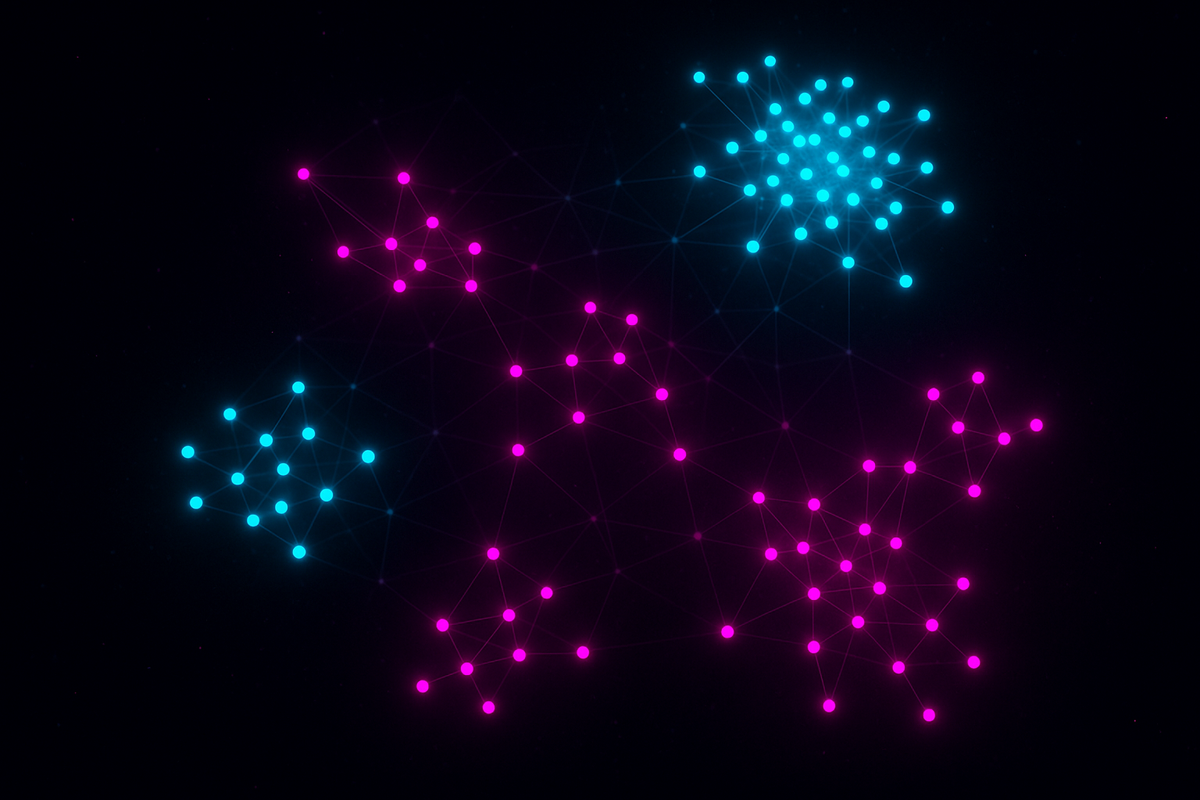
The Limits of Naive RAG: Why Your AI Agent Can't Reason
Series: Graph RAG | Part: 2 of 10
You built an AI agent. You connected it to your documentation, fed it embeddings, implemented vector search. The retrieval is fast. The responses cite sources. Everything should work.
But ask it to compare two concepts across different documents and it fails. Ask it to trace a dependency chain and it hallucinates. Ask it anything requiring multiple pieces of information that aren't sitting next to each other and you get confident nonsense.
This isn't a model problem. This is a retrieval problem.
The architecture everyone calls "RAG"—Retrieval Augmented Generation—has fundamental limitations that no amount of prompt engineering can fix. Understanding what breaks and why requires seeing what naive vector retrieval actually does and where its geometry collapses.
What Naive RAG Actually Retrieves
Here's the standard RAG pipeline:
- Chunk your documents into passages (usually 200-500 tokens)
- Embed each chunk into a high-dimensional vector space
- When a query comes in, embed it using the same model
- Retrieve the K nearest chunks by cosine similarity
- Stuff those chunks into the context window
- Generate a response
This works beautifully for certain classes of questions. Ask "What is the capital of France?" and if there's a chunk containing that information, cosine similarity will find it. The query embedding and the passage embedding sit close together in vector space because they share semantic content.
But semantic similarity is not semantic structure.
Vector embeddings collapse structured relationships into distance metrics. Two passages can be semantically similar—close in embedding space—without being logically connected. They might discuss the same topic from unrelated perspectives. They might use similar vocabulary while making contradictory claims.
Worse: passages that are logically connected—cause and effect, premise and conclusion, question and answer across different documents—can sit far apart in embedding space if they use different language to describe their relationship.
The fundamental limitation: Vector search finds passages that sound relevant. It doesn't find passages that are relevant to each other in ways that answer your actual question.
The Three Failure Modes
1. The Missing Context Problem
A user asks: "Why did the migration fail?"
The vector search finds a passage: "Migrations can fail due to schema mismatches, timeout errors, or insufficient permissions."
Perfect match. Highly relevant. The agent responds confidently.
But the actual migration failure had a fourth cause—a database connection pool exhaustion issue documented in a completely different section using completely different vocabulary. That passage discusses "connection pooling" and "resource limits" without ever using the word "migration."
The two pieces of information needed to answer the question correctly sit far apart in embedding space because they discuss the problem at different levels of abstraction. Vector search has no way to know they belong together.
Missing context makes agents incomplete. They find A when you need both A and B, and they have no mechanism to know B exists.
2. The Multi-Hop Reasoning Failure
A user asks: "Which services depend on the authentication system?"
To answer this question correctly, you need to:
- Find services that call the authentication API
- For each of those services, find what depends on them
- Recursively follow the dependency chain
This is multi-hop reasoning—following edges through a graph of relationships.
Vector search retrieves passages about authentication. It finds documentation about services that mention authentication. But it cannot traverse the relationship graph. It cannot follow "Service A depends on Auth" → "Service B depends on Service A" → "Therefore Service B transitively depends on Auth."
The information exists in your documentation. The logical chain is valid. But the retrieval mechanism can't construct it because vector search doesn't model relationships. It models similarity.
You get confident answers based on first-order connections while missing the second-order and third-order dependencies that actually matter.
3. The Semantic Gap Problem
A junior engineer asks: "How do I implement rate limiting?"
A senior engineer would know that the answer involves:
- The token bucket algorithm (not mentioned in the question)
- Redis for distributed state (not mentioned in the question)
- Middleware architecture (not mentioned in the question)
- Backpressure handling (not mentioned in the question)
These concepts don't share vocabulary with "rate limiting" in ways that guarantee high cosine similarity. An expert human bridges the semantic gap through domain knowledge—understanding that rate limiting implies these implementation details even when they're not explicitly mentioned.
Vector embeddings capture some of this implicit structure through training, but only weakly. If your documentation about the token bucket algorithm never uses the phrase "rate limiting," vector search might miss it entirely.
Semantic gaps make agents shallow. They answer questions at the level they're asked rather than bringing in the deeper structure an expert would know to include.
Why This Matters Now
These limitations were tolerable when AI agents were experimental toys. They become critical when agents are:
- Answering customer support questions where incomplete answers create more confusion
- Generating code where missing a dependency causes subtle bugs
- Making recommendations where the relationship between entities determines correctness
- Synthesizing research where connections across papers matter more than content within papers
The moment you move from "retrieve a fact" to "understand a system," naive RAG collapses.
And the failure mode is insidious: the agent doesn't fail silently. It fails confidently. It returns a response. It cites sources. It sounds right. But it's incomplete, shallow, or structurally wrong because the retrieval mechanism couldn't access the relationships necessary to construct a correct answer.
The Geometry of the Problem
In AToM terms, this is a dimensionality collapse.
Your knowledge has structure across multiple dimensions:
- Hierarchical structure (concepts and subconcepts)
- Temporal structure (before and after, cause and effect)
- Dependency structure (requires, enables, blocks)
- Categorical structure (is-a, has-a, part-of)
Vector embeddings compress all of this into a single geometric relationship: distance. Near or far. Similar or dissimilar.
That compression is lossy. Information about the type of relationship gets destroyed. You can't distinguish "A is caused by B" from "A and B are discussed in similar contexts." Both might yield similar cosine similarity scores.
This is not a bug in vector embeddings. Embeddings do exactly what they're designed to do: create a continuous geometric representation of semantic similarity. The problem is that similarity is insufficient for reasoning.
Reasoning requires traversing structured relationships. Cause-and-effect chains. Dependency graphs. Hierarchical taxonomies. Temporal sequences.
Vector search gives you a similarity engine. But you need a reasoning engine.
What You Can't Fix With Prompting
When naive RAG fails, the instinct is to improve the prompt:
- "Think step by step"
- "Consider related concepts"
- "Look for connections across documents"
These help at the margins. A better prompt can squeeze more reasoning out of a language model operating on whatever context retrieval provided.
But prompting can't fix retrieval failures. If the necessary information isn't in the context window, no amount of chain-of-thought reasoning will construct it. The model can only work with what it has access to.
You can prompt a model to think about dependencies, but if the retrieval step didn't include the documents describing those dependencies, the model will hallucinate them—constructing plausible-sounding relationships that don't exist in your actual system.
The failure happens before generation. It happens at retrieval.
The Path Forward
Recognizing these limitations points toward the solution: we need retrieval that preserves and traverses structured relationships.
We need knowledge graphs.
A knowledge graph represents information as entities and relationships:
- "Service A" → depends_on → "Authentication System"
- "Authentication System" → uses → "JWT tokens"
- "JWT tokens" → require → "Secret rotation policy"
With this structure, multi-hop reasoning becomes graph traversal. "What depends on the authentication system?" becomes a query: find all entities connected by depends_on edges.
Missing context becomes discoverable. If you're explaining a migration failure, the graph can surface related concepts connected by causes, enables, or documented_in relationships—even if they use different vocabulary.
Semantic gaps get bridged through explicit structure. The graph encodes that "rate limiting" → typically_implemented_with → "token bucket algorithm," making that connection retrievable even when the query doesn't mention it.
This is what Graph RAG provides: retrieval that preserves the semantic structure necessary for reasoning, not just the semantic similarity sufficient for matching.
Further Reading
- Gao, Y. et al. (2023). "Retrieval-Augmented Generation for Large Language Models: A Survey." arXiv:2312.10997
- Lewis, P. et al. (2020). "Retrieval-Augmented Generation for Knowledge-Intensive NLP Tasks." NeurIPS 2020
- Bordes, A. et al. (2013). "Translating Embeddings for Modeling Multi-relational Data." NeurIPS 2013
This is Part 2 of the Graph RAG series, exploring how knowledge graphs solve the limitations of naive vector retrieval.
Previous: Beyond Vector Search: Why Graph RAG Is the Future of AI Retrieval
Next: Knowledge Graphs 101: Nodes, Edges, and Semantic Structure
Comments ()