The Shape of Thought: How Topologists Are Decoding the Brain
Topology was invented to study coffee cups and donuts. It turns out the brain has more in common with abstract shapes than with circuit diagrams. A new generation of neuroscientists is using topological data analysis to find structure in neural activity that standard methods miss entirely.
The Shape of Thought: How Topologists Are Decoding the Brain
Series: Topological Data Analysis in Neuroscience | Part: 1 of 9
Your brain isn't a computer. It's a shape.
Not metaphorically. Literally. The patterns of electrical activity rippling through your neural tissue at this exact moment—as you read these words, as meaning crystallizes, as understanding dawns—have a geometric structure. And that structure? It has features that persist across time, features that can be measured, features that reveal what other methods miss entirely.
This is the promise of topological data analysis (TDA) in neuroscience. While traditional approaches count connections or measure activation levels, topology asks a different question: What is the shape of this data? And when you apply that question to the brain, something extraordinary emerges. Consciousness has a topology. Learning changes geometric structure. Mental illness leaves topological signatures.
The mathematicians are finding the forms beneath the firing.
Why Shape Matters More Than You Think
Here's what neuroscience has been doing for decades: recording which neurons fire, measuring how strongly they fire, mapping which neurons connect to which. This produces data. Lots of data. Overwhelmingly large amounts of data.
And then we hit a wall. Because the brain isn't organized like a wiring diagram. It's not a simple graph where nodes connect to other nodes in straightforward ways. It's a high-dimensional dynamical system where patterns of activity flow through state spaces we can barely visualize, where the same neurons participate in different computational processes depending on context, where meaning emerges from geometry we don't yet have good tools to see.
Until topology.
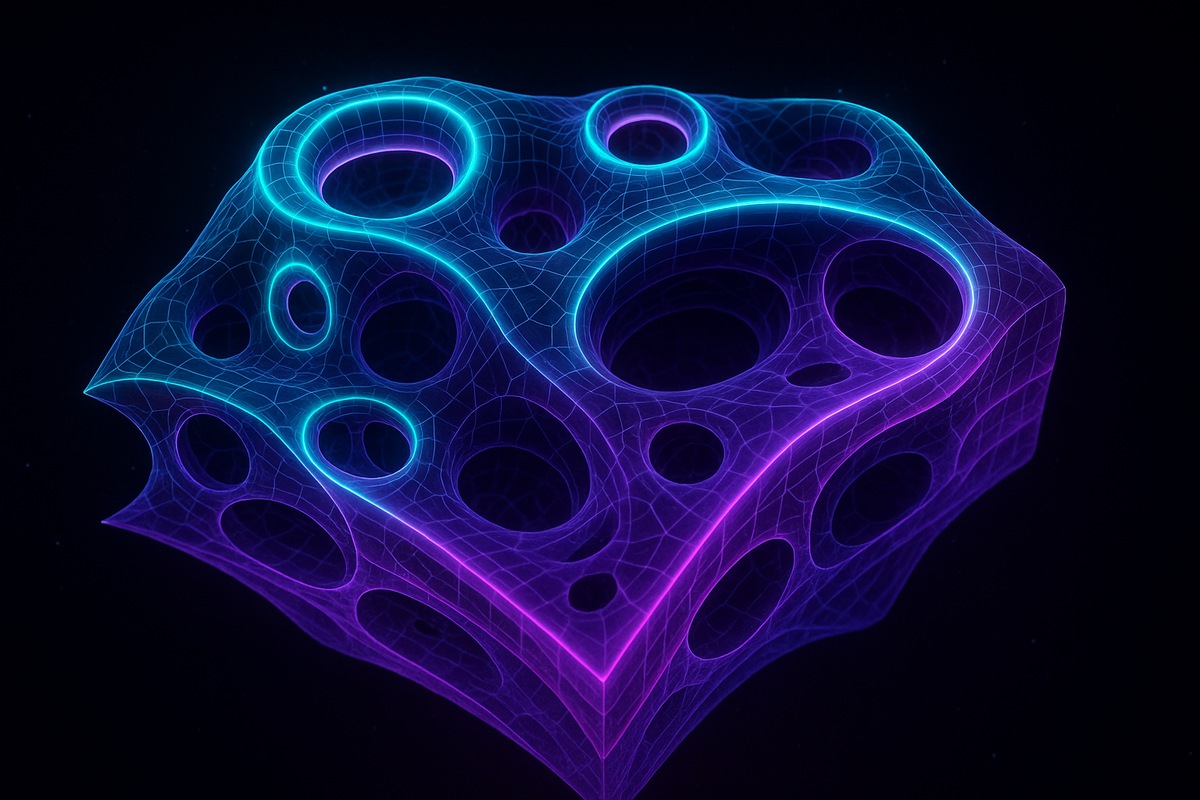
Topology is the branch of mathematics that studies properties of shapes that don't change under continuous deformation. A coffee cup and a donut have the same topology—both have exactly one hole. Stretch, squeeze, bend all you want; that hole persists. Topologists call these invariant features. They're what remains when you strip away the accidents of measurement and representation and look at the essential structure underneath.
When you apply this to neural data, you're asking: What features of brain activity persist across different states, different conditions, different scales? What holes, what loops, what voids live in the high-dimensional space where neural firing patterns evolve?
These aren't idle mathematical curiosities. They're the signatures of function.
What TDA Actually Sees
Let's get concrete. You record the electrical activity from a few hundred neurons while a person performs some task—maybe solving a problem, maybe experiencing an emotion, maybe just resting with eyes closed. Each neuron's firing rate at each moment is one dimension in your data space. If you're recording from 200 neurons, you have a 200-dimensional space. The activity pattern at each instant is one point in that space. Over time, as the brain's state evolves, these points trace out a trajectory—a path through this impossibly high-dimensional landscape.
Traditional methods might ask: Which neurons are most active? Which pairs of neurons fire together? How does the average activity change over time?
TDA asks: What is the shape of this cloud of points? Are there loops? Voids? Clusters that persist across time? Are there topological features that appear during one cognitive state and disappear in another?
This is where persistent homology comes in—the core technique of TDA. It systematically builds geometric structures from your data at different scales, tracking which topological features appear and how long they last. A fleeting feature that only exists at one scale might be noise. But a feature that persists across many scales? That's signal. That's structure. That's telling you something about how the system is actually organized.
When researchers apply this to brain data, they find something remarkable: different cognitive states have different topological signatures. Conscious awareness creates high-dimensional cavities that don't exist during anesthesia. Learning a new skill reshapes the manifold of neural activity. Depression leaves topological scars in functional connectivity patterns.
The brain's geometry is not incidental to its function. It is the function.
The Blue Brain Discovery
The watershed moment came from an unlikely place: a massive computational simulation of neural tissue called the Blue Brain Project. Henry Markram's team at EPFL spent years building detailed models of rat cortical columns—reconstructing not just which neurons connect to which, but the precise 3D locations, the ion channel distributions, the synaptic dynamics, everything they could measure.
Then they turned it on and watched what happened.
And what happened was this: when the simulated neurons started firing, their collective activity formed geometric structures in high-dimensional space. Not random structures. Directed simplicial complexes—geometric objects built from points, edges, triangles, tetrahedra, and higher-dimensional analogs. The activity didn't just flow through the network. It assembled cavities—high-dimensional voids surrounded by coordinated neural firing.
When mathematician Kathryn Hess and computational neuroscientist Ran Levi analyzed these structures with TDA, they found something nobody expected. The simulated cortex was building structures up to eleven dimensions. Not eleven neurons. Eleven topological dimensions. Structures that could only exist in abstract mathematical spaces, now appearing in the coordinated firing of biological tissue.
And these weren't artifacts. When they stimulated the network with different inputs, different topological structures formed. More complex stimuli produced higher-dimensional cavities. The Betti numbers—the topological invariants that count the number of holes in each dimension—changed systematically with the type of input.
The brain was computing in geometry nobody had seen before.
This wasn't simulation artifact. Follow-up work on actual biological tissue confirmed it. The connectome—the network of anatomical connections between neurons—has a topological structure that predicts function. Regions that perform similar computations have similar topological signatures. Development proceeds through a sequence of topological transformations. Damage to the network produces predictable topological deficits.
The shape is the computation.
Beyond Connectomes: The Topology of Mind
But here's where it gets really interesting. TDA doesn't just apply to the anatomical wiring diagram. It applies to functional connectivity—the patterns of which brain regions activate together during different mental states.
Record fMRI data while someone rests, eyes closed, mind wandering. The pattern of correlations between different brain regions has a topology. Build it into a simplicial complex, extract the persistent homology, measure the Betti numbers. Now ask that person to perform a task—solve math problems, remember a story, plan future actions. The topology changes.
Different mental states live in different regions of topological space.
Giulio Tononi's Integrated Information Theory predicts that consciousness should correspond to high integration—lots of mutual information between different parts of the brain. But integration can be measured topologically. Conscious states should have rich, high-dimensional topological structure. Unconscious states should be simpler, lower-dimensional.
And that's exactly what researchers find. Under anesthesia, the topological complexity of brain activity collapses. Dreaming sleep shows intermediate complexity—some high-dimensional structures remain, but fewer than waking. Deep sleep shows even less. Disorders of consciousness—vegetative states, minimally conscious states—each have characteristic topological signatures that correlate with behavioral measures of awareness.
You can see consciousness in the shape of neural activity.
Learning Changes Geometry
Watch someone learn. Maybe it's a motor skill—juggling, playing an instrument, touch-typing. Maybe it's conceptual—grasping a mathematical proof, understanding a foreign language's grammar, internalizing a theory. Whatever it is, something changes in their brain. New synapses form. Existing connections strengthen or weaken. Neural firing patterns reorganize.
TDA can watch this happen in geometric terms.
Before learning, the neural activity occupies one region of state space. It has a particular topological structure—certain loops, certain voids, certain persistent features. As learning proceeds, this structure transforms. New cavities appear. Old ones collapse. The manifold of possible activity patterns reshapes itself.
The critical insight: these geometric changes aren't just correlates of learning. They're what learning is. To learn is to reorganize the topology of neural state space such that certain patterns become easier to access, certain trajectories become more stable, certain computations become available that weren't before.
This connects directly to AToM's framework. Learning is coherence transformation at the neural scale. The system is restructuring its geometry to minimize prediction error more effectively, to maintain integrated organization in new environmental contexts, to expand the dimensionality of state space it can coherently occupy.
When you study learning with TDA, you're watching M = C/T evolve in real time. The meaning-making capacity of the system increases as its coherence geometry becomes more sophisticated.
Clinical Applications: Topological Biomarkers
If different mental states have different topological signatures, then mental illnesses should too. And if those signatures are measurable, they become biomarkers—objective geometric features that correlate with diagnostic categories, predict treatment response, track recovery.
This is already happening.
Depression shows up as reduced topological complexity in resting-state networks. The high-dimensional cavities that normally exist in healthy brains are flattened, collapsed. The geometry of possibility shrinks—which is, of course, exactly what depression feels like from the inside. Your state space contracts. Fewer futures seem accessible. The manifold of viable life-trajectories narrows.
TDA makes this visible.
Schizophrenia shows the opposite pattern in some ways—hyperconnectivity, excess topological features that don't normally exist. But they're not organized. They don't integrate. The geometry is complex but incoherent—lots of local structure that doesn't fit together into stable global patterns. Again, this matches phenomenology. Schizophrenia often involves overwhelming richness of experience that the system can't integrate into coherent narrative.
Alzheimer's disease progressively destroys topological structure. As neurons die and connections degrade, the geometric features that characterize healthy brain function disappear one by one. Tracking these changes with TDA might provide early detection years before clinical symptoms—catching the disease when the manifold first starts collapsing, not after it's already flat.
Autism (and here we tread carefully, because autism is not simply pathology) shows distinct topological signatures—particularly in the structure of local versus global connectivity. Autistic brains often show rich local topology but different global integration patterns. This isn't deficit. It's different coherence architecture. Different ways of structuring state space. Different but not broken.
The clinical promise of TDA is this: by measuring the actual geometry of brain function, we might finally have objective markers for conditions that currently depend on subjective report and behavioral observation. We might be able to see mental illness in the shape of mind.
What This Means for AToM
Everything we're learning from TDA in neuroscience supports AToM's core claims about coherence geometry:
1. Mental states are geometric configurations. Not just metaphorically. The high-dimensional manifolds traced out by neural activity have measurable topological properties that correspond to psychological function.
2. Pathology is geometric disruption. Depression collapses dimensionality. Trauma fragments topology. Psychosis creates incoherent complexity. These aren't analogies. They're descriptions of what's actually happening in neural state space.
3. Healing is geometric repair. Therapy that works, medication that helps, practices that restore function—they're all reshaping the manifold. Making certain regions of state space accessible again. Rebuilding integration. Restoring the capacity for coherent trajectories.
4. Consciousness is topology. The difference between awake and anesthetized, between aware and vegetative, between integrated and fragmented—it's all visible in the geometric structure of neural dynamics.
5. Meaning emerges from shape. When we say meaning equals coherence over time, TDA shows us what that means concretely. The integrated, persistent topological structure of neural activity is meaning at the neurobiological scale.
This is not metaphor. This is not poetic language. This is what the mathematics reveals when you actually look at how brains work.
The Series Ahead
Over the next eight articles, we'll dive deeper into each aspect of this topological revolution:
Part 2 explains persistent homology—the mathematical engine that makes TDA work—in actually accessible terms.
Part 3 explores the Blue Brain Project in detail—what they found and why it matters.
Part 4 examines the topology of consciousness—what shape awareness actually has.
Part 5 applies TDA to brain networks—functional connectivity through a geometric lens.
Part 6 tracks learning as manifold transformation—how knowledge changes shape.
Part 7 bridges TDA and information geometry—two complementary ways of seeing neural structure.
Part 8 surveys clinical applications—topological biomarkers for diagnosis and treatment.
Part 9 synthesizes everything—what topology teaches us about the deep geometry of coherence.
The brain has been speaking in shapes all along. We're finally learning to listen.
This is Part 1 of the Topological Data Analysis in Neuroscience series, exploring how geometric methods reveal the hidden structure of mind.
Next: Persistent Homology 101: Finding Features That Matter
Further Reading
- Reimann, M. W., et al. (2017). "Cliques of neurons bound into cavities provide a missing link between structure and function." Frontiers in Computational Neuroscience, 11, 48.
- Lord, L. D., et al. (2016). "Insights into brain architectures from the homological scaffolds of functional connectivity networks." Frontiers in Systems Neuroscience, 10, 85.
- Petri, G., et al. (2014). "Homological scaffolds of brain functional networks." Journal of The Royal Society Interface, 11(101), 20140873.
- Sizemore, A. E., et al. (2018). "Cliques and cavities in the human connectome." Journal of Computational Neuroscience, 44(1), 115-145.
- Chung, M. K., et al. (2019). "Persistent homology in sparse regression and its application to brain morphometry." IEEE Transactions on Medical Imaging, 34(9), 1928-1939.
Comments ()