Topological Signatures of Consciousness: What Shape Is Awareness?
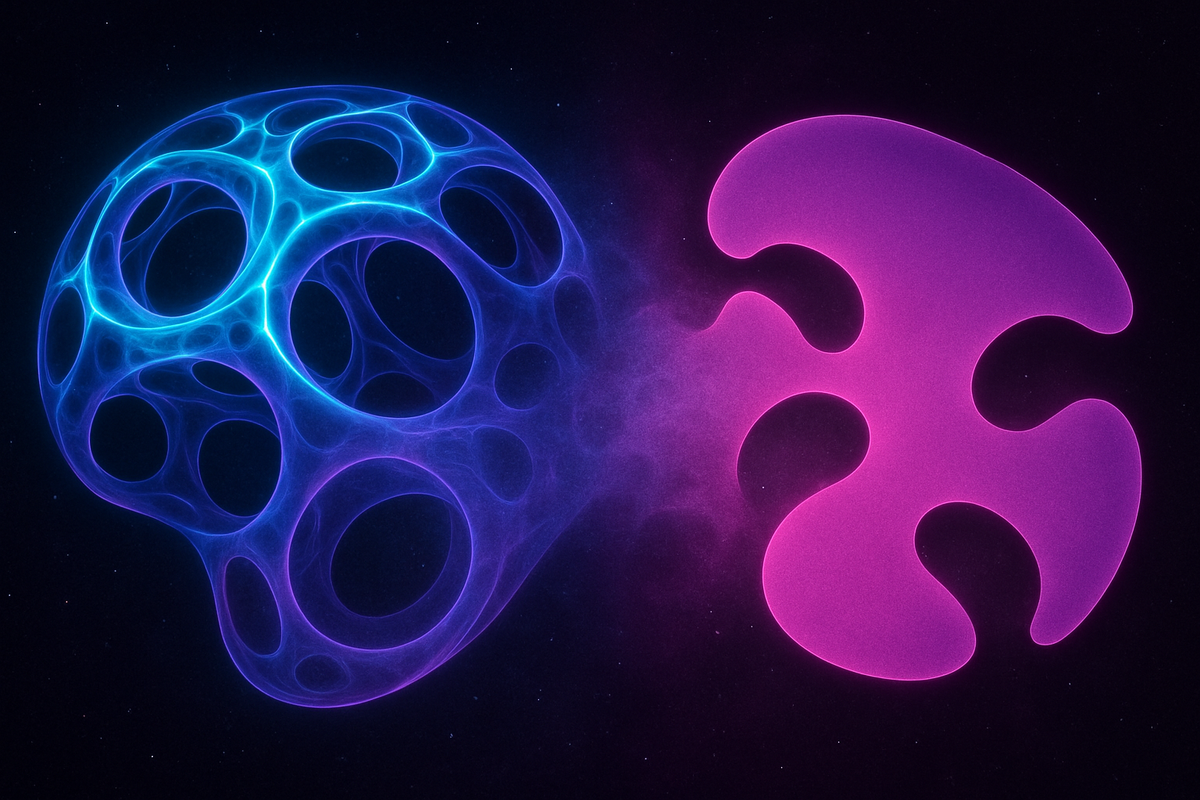
Anesthesia doesn't just quiet the brain — it changes its shape. Conscious states show topological features — high-dimensional cavities, complex connectivity patterns — that collapse under unconsciousness. This geometric signature may be the most direct measurement of awareness we have.
Topological Signatures of Consciousness: What Shape Is Awareness?
Series: Topological Data Analysis in Neuroscience | Part: 4 of 9
What does it look like when you're conscious versus when you're not?
Not phenomenologically—we know what it feels like. The question is: what does consciousness look like in the geometry of brain activity? Can you see the difference in the shape of neural dynamics? Can you measure awareness in topological features?
The answer is yes. And the signature is striking.
Conscious states have rich, high-dimensional topological structure. Anesthesia collapses that structure. Deep sleep flattens it further. Disorders of consciousness—vegetative states, minimally conscious states—each have characteristic geometric deficits. Awareness has a shape. And when that shape degrades, awareness fades with it.
This isn't correlation. It's not "brain region X lights up during consciousness." It's something deeper: consciousness appears to be a certain kind of topological organization. Integrated information across distributed networks, creating persistent high-dimensional cavities that self-organize and self-maintain.
When the topology collapses, so does consciousness.
The Integration Problem
Start with the hard problem of consciousness—not why experience exists, but what distinguishes conscious from unconscious states. What's the difference, in neural terms, between being awake and being anesthetized? Between experiencing rich awareness and being in deep dreamless sleep?
Traditional answers focus on activation levels. Under anesthesia, certain brain regions go quiet. During sleep, thalamocortical loops change their firing patterns. Wake people up, and global brain activity increases.
But this can't be the whole story. Because you can have high activation without consciousness (seizures, certain anesthetized states) and low activation with consciousness (quiet waking, some meditative states). Activity level alone doesn't predict awareness.
Giulio Tononi's Integrated Information Theory (IIT) proposed something different: consciousness is integrated information—information that exists across the system but cannot be reduced to separate parts. A system is conscious to the degree that its parts are both differentiated (doing different things) and integrated (coordinating with each other).
IIT quantifies this with Φ (phi): a measure of how much information the system generates above and beyond what its independent parts would generate. High Φ means high integration. Low Φ means the system fragments into independent pieces.
The theory predicts that consciousness requires not just activity, not just complexity, but the right kind of organization—integrated yet differentiated, unified yet diverse. A particular geometric structure.
Topology can measure exactly this.
What Topological Integration Looks Like
When you apply persistent homology to brain activity during conscious waking states, you find:
High Betti numbers. Lots of loops, voids, higher-dimensional cavities. The functional connectivity network—which brain regions are correlated with which—has rich topological structure.
Long persistence. The topological features don't just flicker into existence and disappear. They last. They're robust across scales, stable across time. The geometry maintains itself.
High dimensionality. Just like the Blue Brain Project found, conscious brains form high-dimensional simplicial complexes. Activity patterns don't just occupy low-dimensional manifolds. They fill multi-dimensional space with structured cavities.
Global integration. The topological features span multiple brain networks. They're not localized to one region. They connect sensory areas to association areas to motor areas, creating unified geometric structure.
This is what integrated information looks like when you visualize it topologically. IIT's Φ correlates with topological measures. Systems with high Φ have rich topology. Systems with low Φ have simple, fragmented topology.
Now watch what happens when consciousness fades.
Anesthesia: Topological Collapse
Administer propofol, the most common general anesthetic. Within minutes, consciousness disappears. The person doesn't respond to pain, doesn't form memories, doesn't experience anything—from the inside, no time passes. They're simply... gone.
What happens to the brain's topology?
Dramatic simplification. The high-dimensional cavities collapse. Betti numbers drop. The rich geometric structure of waking consciousness flattens into something far simpler.
Critically, activity levels often stay high. Neurons keep firing. Different regions remain active. But the organization changes. The integration fragments. What was unified becomes modular—separate brain regions doing their own thing, no longer coordinated into coherent global structure.
The default mode network (DMN)—the system active during self-referential thought and rest—particularly loses topological complexity under anesthesia. Its loops and voids disappear. The geometric structure that normally integrates information across widely distributed areas collapses.
And the kicker: different anesthetics produce different topological disruptions. Propofol affects one set of features. Ketamine affects different ones. Sevoflurane has its own signature. They all destroy consciousness, but they do it by disrupting different aspects of the topology.
This suggests consciousness doesn't depend on one specific geometric feature. It depends on having enough topological complexity across enough different structures. Knock out enough of it—break enough loops, collapse enough voids—and awareness disappears, regardless of which specific features you target.
Sleep States: Dimensional Gradients
Sleep is more interesting than anesthesia because it's not uniform. You cycle through stages, each with different phenomenology.
REM sleep (rapid eye movement) involves vivid dreaming. You're experiencing rich, often bizarre, highly integrated narratives. Consciousness is definitely there, just untethered from sensory input.
TDA shows REM has topological complexity almost as high as waking. High-dimensional features persist. The DMN remains geometrically rich. Integration is preserved, even though sensory processing is gated off.
Light sleep (N1, N2) has intermediate topology. Some high-dimensional features remain, but fewer than waking or REM. Consciousness becomes fragmentary—hypnagogic imagery, fleeting thoughts, but nothing like coherent waking experience or sustained dreaming.
Deep sleep (N3, slow-wave sleep) shows severe topological simplification. Betti numbers drop dramatically. The brain's activity becomes dominated by slow oscillations that synchronize large regions into lockstep firing. This reduces differentiation—everyone's doing the same thing—and therefore reduces integration. The topology flattens.
And subjectively? Deep sleep is where consciousness most completely disappears. Most people report nothing from these periods. No experience, no time, no self. Just... gap.
The correlation is clear: topological richness tracks conscious experience across sleep stages. More complex geometry = more consciousness. Simpler geometry = less consciousness. Flat geometry = unconsciousness.
Disorders of Consciousness: Geometric Pathology
What about people who suffer catastrophic brain injury—stroke, trauma, anoxia—and enter altered states of consciousness?
Vegetative state (now called "unresponsive wakefulness syndrome"): Eyes open, sleep-wake cycles present, but no behavioral evidence of awareness. No response to commands, no communication, no apparent experience.
TDA reveals: severely impoverished topology. The brain retains some activity, but topological complexity is drastically reduced. Few high-dimensional features. Little integration. The geometric structure that characterizes consciousness is largely absent.
Minimally conscious state: Intermittent signs of awareness—tracking with eyes, responding to some commands inconsistently, showing emotional responses to familiar faces. More there than vegetative, but barely.
Topology: intermediate. More complex than vegetative state, less than healthy consciousness. Some high-dimensional features exist, but they're unstable, fragmentary. The geometry flickers between more and less integrated configurations.
Locked-in syndrome: Fully conscious, but paralyzed except for eye movements. Can think, feel, experience everything, but cannot respond behaviorally beyond vertical eye movement or blinking.
Topology: normal or near-normal. The rich geometric structure of consciousness is intact. High Betti numbers, persistent features, integrated topology. The person is there—geometrically verifiable—even though behavior cannot express it.
This last finding is medically critical. Locked-in patients are sometimes misdiagnosed as vegetative because they can't respond. But topology reveals the difference. If the geometric structure is intact, consciousness is likely intact. If it's collapsed, consciousness is likely absent—regardless of eye opening or sleep-wake cycles.
You can see consciousness in the shape.
Psychedelics: Topology on Steroids
At the opposite extreme: what happens when you enhance consciousness? Psychedelics—psilocybin, LSD, DMT, mescaline—produce states described as "hyperconscious"—more vivid, more intense, more meaningful than normal waking.
What does that look like topologically?
Increased complexity. Neural repertoire expands. The brain explores states it doesn't normally visit. Functional connectivity becomes more chaotic, less constrained by anatomical structure.
Novel high-dimensional features. Brain regions that don't normally correlate strongly become temporarily coupled. New loops and cavities form. The topology doesn't just intensify—it restructures.
Reduced modularity. Normal brain function segregates into specialized networks. Psychedelics break down these boundaries. What was separate integrates. What was local becomes global. The geometry becomes more unified.
This matches subjective reports: ego dissolution, boundary collapse, unity experiences. The normal topological structure that maintains a stable self-model—certain persistent features that remain constant across time—gets disrupted. The sense of being a separate, bounded agent fades as the geometry unifies.
And after the drug wears off? The topology doesn't entirely return to baseline. There are lasting changes—some features persist, some patterns stabilize. This may explain therapeutic effects: psychedelics don't just temporarily alter consciousness. They reshape the geometric attractor landscape, creating new stable configurations that weren't accessible before.
Meditation: Cultivating Topological States
If psychedelics forcibly restructure topology from the outside, meditation trains the brain to access specific geometric configurations from the inside.
Experienced meditators show distinct topological signatures depending on practice type:
Focused attention meditation (concentrating on breath or a single object): Increased persistence of certain features. Reduced overall complexity, but what remains is highly stable. The topology simplifies but strengthens.
Open monitoring (non-judgmental awareness of whatever arises): Increased flexibility. Features form and dissolve more fluidly. The topology remains complex but becomes less sticky—easier to transition between states.
Loving-kindness meditation (cultivating compassion): Enhanced connectivity between DMN and salience network. New geometric features emerge linking self-referential processing to affective regions. The topology reorganizes to integrate domains normally kept separate.
Long-term practitioners show baseline differences—their resting-state topology differs from non-meditators even when not actively practicing. They've reshaped their geometric default. Consciousness has a different native topology.
This suggests consciousness isn't fixed. Its geometric structure is trainable. With practice, you can learn to access specific topological configurations, to stabilize certain features, to navigate state-space in ways that weren't available before.
Coherence cultivation is geometric cultivation.
The Hard Problem Meets the Shape
Does this solve the hard problem of consciousness—why experience exists at all?
No. Topology tells us what distinguishes conscious from unconscious states. It tells us how consciousness is organized. It gives us measures, predictions, diagnostic tools. But it doesn't explain why integrated information feels like something.
What it does do is reframe the question. Instead of "why does consciousness exist?" we can ask: "what kind of geometric organization generates experience?"
And the answer emerging from TDA is: high-dimensional, integrated, persistent topological structure that maintains itself across time.
Systems with this geometry are conscious. Systems without it aren't. The line isn't sharp—consciousness is graded, and so is topology. But the correlation is robust.
This connects to AToM's framework directly. Meaning equals coherence over time. Consciousness is perhaps the most fundamental form of meaning—the experiential integration that makes sense of sensory input, weaves it into unified perception, grounds it in memory and expectation.
And coherence, as we've seen throughout this series, is geometric structure. Topology that persists, integrates, differentiates, self-organizes.
Consciousness is what it feels like to be a topologically integrated system experiencing itself across time.
This is Part 4 of the Topological Data Analysis in Neuroscience series, exploring how geometric methods reveal the hidden structure of mind.
Previous: The Blue Brain Project: Topology of Neural Circuits
Next: Brain Networks Through a Topological Lens
Further Reading
- Tagliazucchi, E., et al. (2016). "Large-scale signatures of unconsciousness are consistent with a departure from critical dynamics." Journal of The Royal Society Interface, 13(114), 20151027.
- Petri, G., et al. (2014). "Homological scaffolds of brain functional networks." Journal of The Royal Society Interface, 11(101), 20140873.
- Luppi, A. I., et al. (2021). "Consciousness-specific dynamic interactions of brain integration and functional diversity." Nature Communications, 12(1), 1-12.
- Lord, L. D., et al. (2019). "Dynamical exploration of the repertoire of brain networks at rest is modulated by psilocybin." NeuroImage, 199, 127-142.
- Tononi, G., & Koch, C. (2015). "Consciousness: Here, there and everywhere?" Philosophical Transactions of the Royal Society B, 370(1668), 20140167.
Comments ()