What Is a Differential Equation? When Change Depends on the Current State
Newton's second law, the heat equation, the Schrödinger equation — all of them are differential equations. Instead of describing a quantity directly, they describe how it changes. That shift in perspective is one of the most productive moves in all of mathematics.
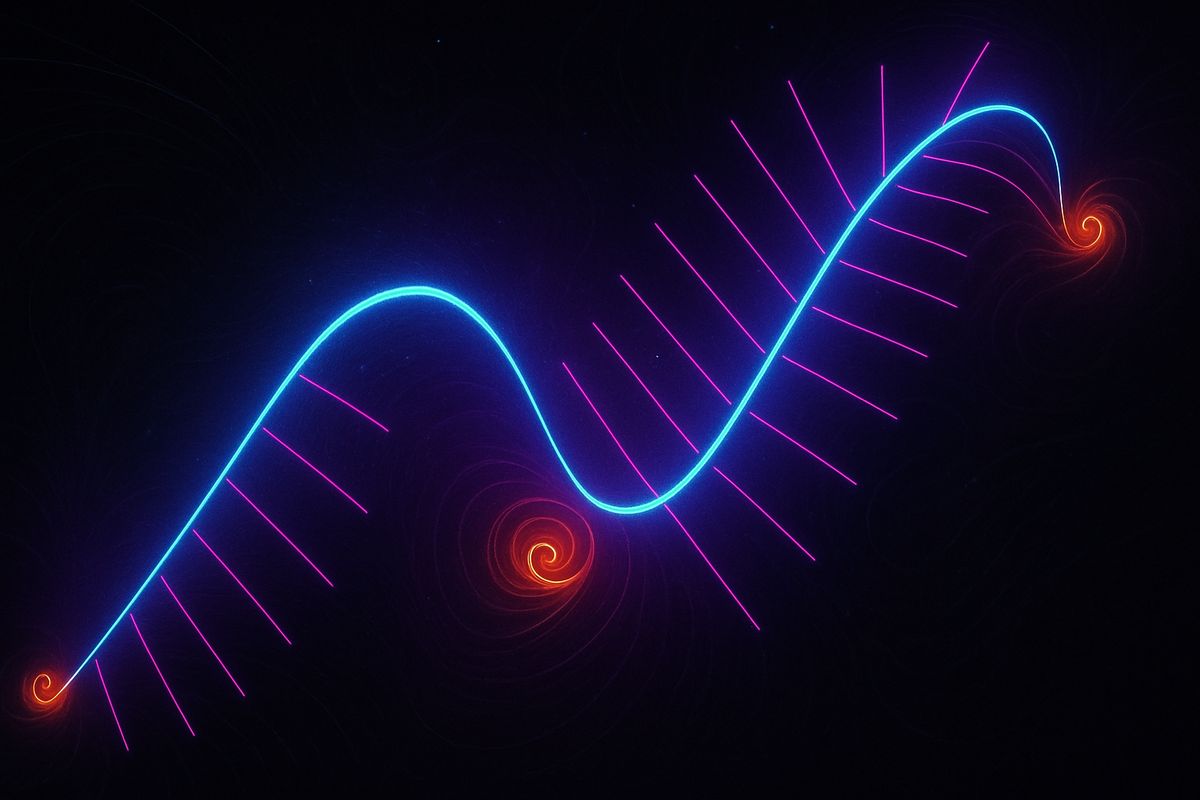
A differential equation is an equation that contains derivatives. That's it. That's the definition.
But holy shit, what that simple definition unlocks.
Regular equations ask: "What value satisfies this relationship?" Differential equations ask: "What function has this relationship between its values and its rates of change?"
The shift is from solving for numbers to solving for entire processes. From static to dynamic. From being to becoming.
The Core Insight
Standard algebra equation: x² = 9
Solution: x = 3 or x = -3. Two numbers.
Differential equation: dy/dx = 2x
Solution: y = x² + C. Infinite functions—one for every value of the constant C.
See the difference? The algebraic equation gives you points. The differential equation gives you a family of curves—entire trajectories describing how something changes.
What Derivatives Actually Mean
Before we go further, let's nail down what a derivative is.
dy/dx means "the rate at which y changes with respect to x." If x is time and y is position, dy/dx is velocity. If y is velocity, dy/dx is acceleration.
A derivative captures change. A differential equation captures relationships between changes.
Example: Newton's second law is a differential equation.
F = ma looks simple, but acceleration is the second derivative of position:
F = m(d²x/dt²)
This isn't saying "force equals mass times acceleration." It's saying "force equals mass times how fast velocity is changing."
That's a differential equation. It describes dynamics, not statics.
Why They Matter
Everything that changes obeys differential equations.
Population growth: dP/dt = rP says "the rate of population change is proportional to the current population." That's exponential growth, captured in one differential equation.
Cooling coffee: Newton's law of cooling is dT/dt = -k(T - T_ambient). Temperature changes at a rate proportional to the difference from room temperature.
Oscillating springs: m(d²x/dt²) + kx = 0. Mass times acceleration equals negative spring force. That's harmonic motion.
Electric circuits: L(di/dt) + Ri = V. Inductance times rate of current change plus resistance times current equals voltage.
These aren't separate phenomena requiring separate theories. They're all differential equations describing rates of change.
The Structure of a Differential Equation
Every differential equation has three components:
- The unknown function: Usually y(x) or y(t)—the thing you're solving for
- Derivatives of that function: dy/dx, d²y/dx², etc.—rates of change
- A relationship: How the function and its derivatives relate to each other
Example: dy/dx = y
- Unknown function: y(x)
- Derivative: dy/dx (first derivative)
- Relationship: The derivative equals the function itself
That particular equation describes exponential growth. Its solution is y = Ce^x—a function whose rate of change equals its current value.
Order and Degree
The order of a differential equation is the highest derivative it contains.
dy/dx = 2xis first-order (highest derivative is first)d²y/dx² + 3dy/dx + 2y = 0is second-order (highest derivative is second)d³y/dx³ - y = xis third-order
Higher order = more complex dynamics. First-order describes simple growth/decay. Second-order describes oscillation and acceleration. Third-order and higher describe increasingly complex behavior.
The degree is the power of the highest derivative (after clearing fractions and radicals). Most differential equations you'll encounter are first-degree—the derivatives appear linearly.
Linear vs Nonlinear
A differential equation is linear if the unknown function and its derivatives appear linearly (no products, powers, or compositions).
Linear: d²y/dx² + 3dy/dx + 2y = sin(x)
Nonlinear: dy/dx = y² (y is squared)
Nonlinear: y(dy/dx) = x (y multiplies its derivative)
Linearity matters because linear equations have systematic solution methods. Nonlinear equations are harder—sometimes much harder. Many can't be solved analytically at all.
What "Solving" Means
Solving a differential equation means finding the function(s) that satisfy it.
Given dy/dx = 2x, you need to find y(x) such that when you differentiate it, you get 2x.
The solution: y = x² + C
Check: dy/dx = 2x. ✓
The constant C represents the general solution—a family of curves. Each value of C gives a particular solution.
Why the constant? Because differentiation destroys constant information. When you integrate to solve, you recover that lost information as an arbitrary constant.
The number of arbitrary constants equals the order of the equation. Second-order equations have two constants, third-order have three, etc.
Initial Conditions
To pin down a particular solution, you need initial conditions—specific values the function must satisfy.
Example: dy/dx = 2x with y(0) = 5
General solution: y = x² + C
Apply initial condition: 5 = 0² + C, so C = 5
Particular solution: y = x² + 5
Initial conditions transform the general solution (infinite possibilities) into a particular solution (one specific function).
Physically, this makes sense. The differential equation describes the dynamics—how the system evolves. Initial conditions describe the starting state—where the system begins.
Together, they determine the complete trajectory.
The Power of Differential Equations
Here's why differential equations are profound:
Most phenomena are easier to describe in terms of how they change than in terms of what they are.
You might not know the exact trajectory of a falling object, but you know acceleration equals gravitational force. You might not know the exact population at time t, but you know growth rate depends on current population.
Differential equations let you start with local rules (how things change moment to moment) and derive global behavior (the full trajectory over time).
That's the fundamental insight: local rules generate global patterns.
The falling object doesn't "know" it will trace a parabola. It just follows d²x/dt² = -g at each instant. The parabola emerges.
The population doesn't "know" it will grow exponentially. It just follows dP/dt = rP at each instant. Exponential growth emerges.
Types of Differential Equations
Differential equations split into two major categories:
Ordinary Differential Equations (ODEs): Derivatives with respect to one variable. Example: dy/dx = y (y depends only on x)
Partial Differential Equations (PDEs): Derivatives with respect to multiple variables. Example: ∂u/∂t = ∂²u/∂x² (u depends on both time and space)
ODEs describe systems evolving in time (or along one dimension). PDEs describe fields evolving in space and time (or multiple dimensions).
We'll explore this distinction in depth in the next article.
Real-World Applications
Physics: Almost every law of physics is a differential equation. Newton's laws, Maxwell's equations, Schrödinger equation, Einstein's field equations.
Biology: Population dynamics, epidemic models, biochemical reactions, neural signaling.
Engineering: Circuit analysis, control systems, structural mechanics, fluid dynamics.
Economics: Growth models, market dynamics, optimal control.
Chemistry: Reaction kinetics, diffusion, thermodynamics.
If it changes, it's described by differential equations.
The Challenge
Differential equations are powerful but hard.
Some have exact analytical solutions—neat formulas you can write down. Many don't. They require numerical approximation or qualitative analysis.
Even when solutions exist, they might involve unfamiliar functions (Bessel functions, Legendre polynomials, elliptic integrals) that aren't taught in basic calculus.
The history of mathematics is partly the history of developing techniques to solve differential equations. Separation of variables. Integrating factors. Characteristic equations. Laplace transforms. Series solutions. Numerical methods.
Each technique unlocks a class of problems. Mastering differential equations means building a toolkit of solution strategies.
Why Start Here
Understanding differential equations fundamentally changes how you see the world.
You stop seeing static objects and start seeing dynamic processes. You stop asking "what is it?" and start asking "how does it change?"
A pendulum isn't a weight on a string. It's a solution to d²θ/dt² + (g/L)sin(θ) = 0.
A population isn't a number. It's a solution to dP/dt = rP(1 - P/K).
A vibrating guitar string isn't a shape. It's a solution to ∂²u/∂t² = c²(∂²u/∂x²).
Differential equations are the mathematics of motion, change, and time. They describe how the universe actually works—not as frozen frames but as flows and transformations.
That's what we're unpacking in this series. Not just how to solve differential equations, but what they mean and why they matter.
Next up: the crucial distinction between ordinary and partial differential equations.
Part 1 of the Differential Equations series.
Previous: Differential Equations Explained Next: Ordinary vs Partial: ODEs and PDEs
Comments ()