Apophenia: The Pattern-Seeker's Blessing and Curse
A NASA spacecraft photographed a face on Mars, and part of it was transmission static. Apophenia, the tendency to find meaning in noise, is also where Kepler's real discovery started.
In 1976, a NASA spacecraft photographed a face on Mars, and part of that face was transmission static.[1] Apophenia is the habit of seeing meaningful links between things that have no real link.[2] The German psychiatrist Klaus Conrad coined the word in 1958 and described it as "unmotivated seeing of connections," paired with a feeling that everything suddenly means something.[2] The reference entry names a face in an inanimate object as a common example, noting that car grills may appear to grin.[2] As Kepler shows below, the habit can also be where a real discovery starts.[5]
What was the face on Mars, really?
NASA's Viking 1 orbiter took the picture on July 25, 1976, while scouting a landing site for Viking 2.[1] NASA explains that the speckles are "bit errors" from problems in transmission, and that those errors are part of one "eye" and the "nostrils."[1] Shadows on the rock give the illusion of a nose and mouth, and planetary geologists put the formation down to purely natural processes.[1]
The rock was a rock. The faceness was ours.
Why do our brains see patterns that aren't there?
One answer is that guessing wrong can be cheap. A 2009 evolutionary model by Kevin Foster and Hanna Kokko found that natural selection can favor strategies that lead to frequent errors in assessment, so long as getting it right now and then pays off big.[4] The authors concluded that superstition-like behavior is an inevitable feature of adaptive behavior in all organisms, ourselves included.[4] Better to mistake a rustle for a predator than to miss the predator.
Another answer is that pattern-hunting turns up when the world feels out of our hands. In six experiments published in Science in 2008, Jennifer Whitson and Adam Galinsky found that participants who lacked control were more likely to see images in noise, form illusory correlations in stock market information, perceive conspiracies and develop superstitions.[3] The researchers traced the effect to a need for structure, and found that affirming the self reduced it.[3]
Is apophenia a blessing or a curse?
Both, and sometimes in the same notebook. Conrad's term came from his study of early delusional thought.[2] The reference entry calls apophenia a "commonplace effect of brain function" and ties it to conspiracy theories, where coincidences may be stitched into an apparent plot.[2] That is the curse side of the word.
The blessing has a famous face too. In 1596, Johannes Kepler described a model in which the five Platonic solids sat between the spheres of the six planets known to him.[5] The physicist Frank Wilczek says the model was wrong, yet a rung above Plato's speculation, since it made concrete numerical predictions about the relative sizes of orbits that could be compared with the observed values.[5] The agreement, he writes, "while not precise, was close enough to convince Kepler he might be on the right track."[5] Then Tycho Brahe's accurate observations arrived, Kepler found that the orbit of Mars is an ellipse rather than a circle.[5] Wilczek writes, "This and other discoveries fatally undermined" the system.[5] By hunting for further regularities among the orbits, Wilczek says, Kepler found his "famous three laws of planetary motion."[5]
A wrong pattern, tested against better data, ended with Kepler's laws.[5] That is the fine line the title is talking about: the checking.
What does it feel like from the inside?
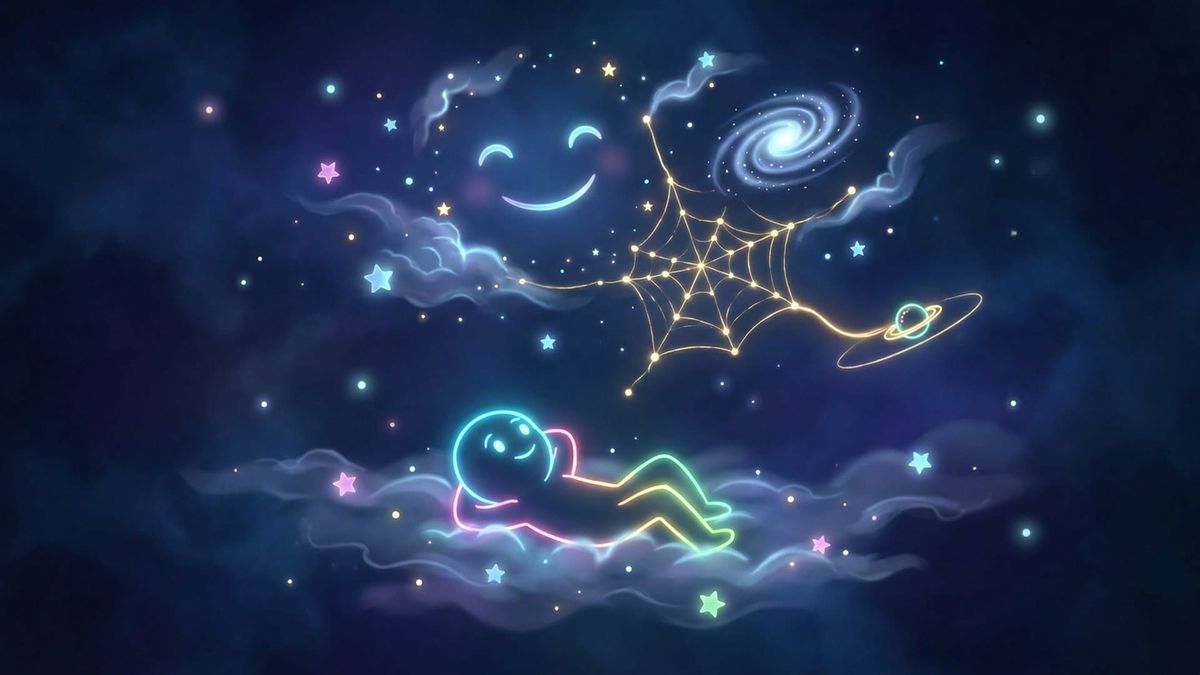
A song title shows up on a billboard, then in a podcast, then on a stranger's shirt, and the day starts to feel addressed to you. A row of numbers on a receipt sits oddly close to your birthday. A crack in the ceiling is a map of a coastline you almost recognize.
For plenty of us that hum of connection is part of the fun. It can spot an odd entry in a spreadsheet, a link between ideas from different fields, a joke hiding in a word. The trick is a second step, the one Kepler took, where you let the data push back. If you like this territory, synchronicity and meaningful coincidence is the same question seen through Jung, and tricksters, seers and holy fools is what cultures did with people who read the world this way. Our human meaning section keeps going from there, and your brain is guessing what happens next covers the guessing machine underneath.
The flat-circle part
Kepler's first model was built on nested spheres.[5] What the data gave him for Mars was an ellipse.[5]
In True Detective, Rust Cohle says, "Someone once told me time is a flat circle."[6] Cohle is talking about a mind caught in a loop. Kepler started with nested spheres and ended with ellipses.[5]
─────────
Sources
- NASA/JPL. "Geologic 'Face on Mars' Formation," PIA01141, Photojournal, April 2, 1998. PIA01141
- "Apophenia," Wikipedia, accessed November 25, 2026 (citing Conrad, K., Die beginnende Schizophrenie, Georg Thieme Verlag, 1958). Apophenia
- Whitson, J. A., and Galinsky, A. D. (2008). "Lacking control increases illusory pattern perception." Science 322(5898), 115-117. doi:10.1126/science.1159845
- Foster, K. R., and Kokko, H. (2009). "The evolution of superstitious and superstition-like behaviour." Proceedings of the Royal Society B 276(1654), 31-37. doi:10.1098/rspb.2008.0981
- Wilczek, Frank. "Beautiful Losers: Kepler's Harmonic Spheres," NOVA, PBS, December 29, 2011. Beautiful Losers
- True Detective, Season 1, Episode 5, "The Secret Fate of All Life" (HBO, 2014). Dialogue transcript: Rust Cohle quotes


Comments ()