We Are Made of Star Stuff: A Field Guide to Where Your Atoms Have Been
Sagan said the calcium in your teeth was made in collapsing stars. A 2020 model says the real story, for calcium, iron, carbon and nitrogen, is stranger.
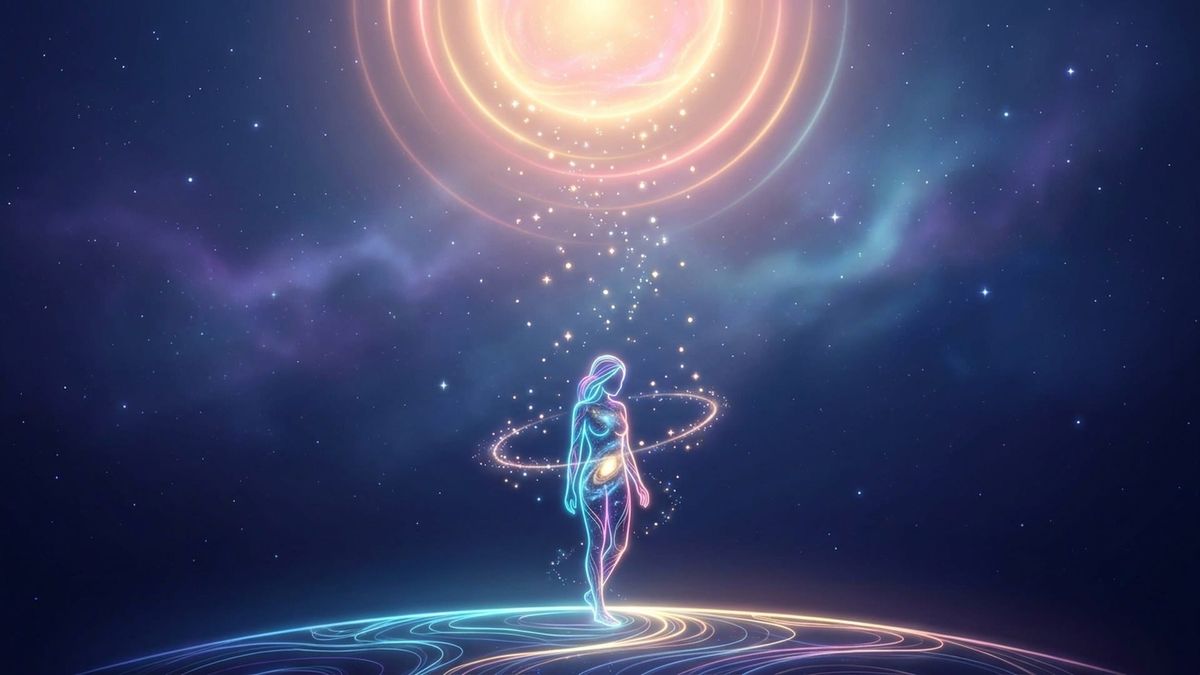
Carl Sagan wrote that the calcium in our teeth was made inside collapsing stars, and he meant it literally.[1] His line, "We are made of starstuff," is a claim about where the atoms in your body were made.[1] Hydrogen and most of the helium were produced in the Big Bang, and the elements from carbon upward were made in stars and the explosions of stars.[2] The details are stranger than the slogan.
What did Sagan actually say?
In his 1980 book Cosmos, Sagan wrote that "the nitrogen in our DNA, the calcium in our teeth, the iron in our blood, the carbon in our apple pies were made in the interiors of collapsing stars."[1] He added, "We are made of starstuff."[1] He also made an exception: every element of the Earth except hydrogen and some helium, he said, was cooked by stellar alchemy billions of years ago.[1]
It reads like poetry. It is also a checkable list of ingredients, and astronomers have checked it.
Where did the hydrogen in you come from?
Not from a star. A 2020 model of how the galaxy's chemistry built up credits Big Bang nucleosynthesis with hydrogen and most of the helium.[2] The hydrogen in your body's water did not come from a star, in that model's accounting.[2]
Where did your calcium come from?
More than 99% of the calcium in a human body sits in bones and teeth, mostly as a mineral called calcium hydroxyapatite, according to the NIH Office of Dietary Supplements.[3] The same 2020 model says calcium is mainly produced by core-collapse supernovae, the dying massive stars Sagan meant, but that 39% of it comes from Type Ia supernovae.[2] Those are the explosions of white dwarfs in binary systems.[2]
So the slogan is true, with a footnote: in that model, about two-fifths of your calcium came from exploding white dwarfs.[2]
What about the iron, carbon and nitrogen?
The model complicates Sagan's list further, since he credited all four of his examples to collapsing stars.[1,2] It puts about 60% of iron in Type Ia supernovae, with the rest mainly from hypernovae, the model's other big source of iron.[2] It credits asymptotic giant branch stars, swollen aging stars that shed their outer layers, with 49% of carbon and 74% of nitrogen at the 9.2-billion-year mark of its timeline.[2]
| Element | Main sources in the 2020 model[2] |
|---|---|
| Calcium | Mainly core-collapse supernovae; 39% from Type Ia[2] |
| Iron | About 60% from Type Ia, the rest mainly from hypernovae[2] |
| Carbon | 49% from AGB stars at 9.2 billion years[2] |
| Nitrogen | 74% from AGB stars at 9.2 billion years[2] |
Is the story settled?
No. These percentages are model outputs, not measurements, and the authors flag open problems.[2] Their calcium-to-iron ratios come out about 0.1 dex below the observed values, and the authors say calcium and silicon yields are affected by explosive burning and that it is unclear whether a change to one nuclear reaction rate would fix the mismatch.[2] The origin of the heaviest elements is still being argued. Sagan guessed supernovae for gold and uranium.[1] The 2020 paper finds that neutron star mergers can make r-process elements up to thorium and uranium, but that the delay is too long to account for what is seen in metal-poor stars.[2] Treat the table as a snapshot of a working hypothesis.
Why does this one land so hard for some of us?
Maybe you were the kid with the periodic table on the wall, reading it like a map of somewhere you were homesick for. Maybe you are the adult with a pile of open tabs late at night and a standing distrust of "it's just in there." This is the rare fact that rewards that kind of attention. Keep asking where something came from and you end up in a dying star.
It also makes the usual question, "why are you so into this?", easier to answer. The thing you are into is the thing you are made of. We followed those same ingredients in why life chemistry is special.
If your attention runs on pattern-hunting, the pattern-seeker's blessing and curse is the same urge from another angle, and our science section keeps pulling on threads like this one.
The flat-circle part
None of this is finished. Sagan noted that atoms made in stars are commonly returned to interstellar gas, after which later stars and planets take them in.[1] Your bones are not finished either: the NIH notes that bone constantly remodels, with calcium resorbed and deposited into new bone.[3] The calcium is passing through you on a longer loop. Another loop, the one that runs your sleep, we dug into in time blindness and body clocks.
Sagan's version of the ending was "starstuff pondering the stars."[1] In True Detective, Rust Cohle says, "Someone once told me time is a flat circle."[4] Put the two together and you get a cloud of gas that became a star, then a tooth, then a person looking up at the star, and the loop closes there for now.[1,3]
─────────
Sources
- Sagan, Carl. Cosmos. New York: Random House, 1980, ch. 9, "The Lives of the Stars." Full text: archive.org
- Kobayashi, C., Karakas, A. I., and Lugaro, M. (2020). "The Origin of Elements from Carbon to Uranium." The Astrophysical Journal 900(2), 179. doi:10.3847/1538-4357/abae65; preprint arXiv:2008.04660
- National Institutes of Health, Office of Dietary Supplements. "Calcium: Fact Sheet for Health Professionals," updated June 22, 2026. ods.od.nih.gov
- True Detective, Season 1, Episode 5, "The Secret Fate of All Life" (HBO, 2014). Dialogue transcript: Rust Cohle quotes

Comments ()